Hi, what do you want to do?





Soft Schools
Soft Schools: Physics Quizzes: Newton's Three Laws
Assess your understanding of Newton's three laws of motion and the ability to distinguish between the three with this interactive multiple choice quiz. Receive immediate feedback to your answers.
Wikimedia
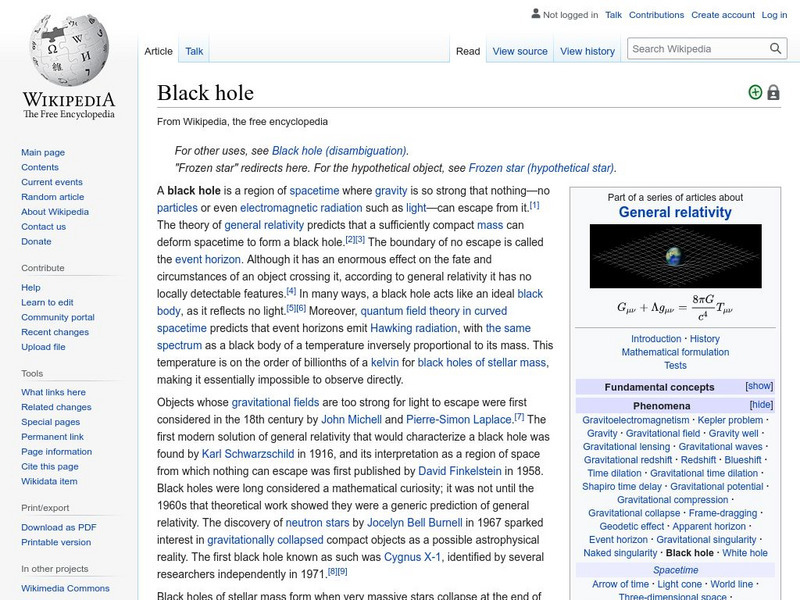
Wikipedia: The Black Hole
This site examines the black hole as an object in astrophysics. Delve into this comprehensive resource that covers this concept from its history, to qualitative physics, the reality of black holes, mathematical physics and more.
Texas Instruments
Texas Instruments: Collecting Ball Bounce Data
Many aspects relating to the motion of a bouncing ball can be modelled mathematically. The first stage in modelling the motion is to collect some data. The Calculator Base Laboratory or CBR is a motion detector that can be connected to a...
Other
Institute of Physics: Practical Physics: Investigate Mass on Spring Oscillators
This experiment allows the period, displacement, velocity, and acceleration of a mass suspended on a spring to be investigated by data logging the output from a motion sensor. It is an example of simple harmonic motion.
Texas Instruments
Texas Instruments: Good Vibrations Activity Modeling Motion
The student will investigate Hooke's law and the position, velocity and acceleration of an object oscillating vertically on a spring.

Physics Classroom
The Physics Classroom: Circular Motion Principles for Satellites
From The Physics Classroom. Uses easy- to-understand language to discuss how circular motion principles apply to the motion of satellites. Describes the tangential velocity and centripetal acceleration of a satellite. Includes many...
Texas Instruments
Texas Instruments: Kinematics Investigation
In this activity, students solve trigonometric equations and investigate kinematics. They calculate and graph the displacement, velocity, and acceleration of trigonometric functions.
Physics Aviary
Physics Aviary: Newton's Law Lab
This lab was designed to have students investigate the factors that affect the acceleration of an object on a frictionless horizontal surface. The simulation will give the students a position vs. time graph and a velocity vs. time graph....
Science Education Resource Center at Carleton College
Serc: Maximizing Kinetic Energy: An Investigation Using Marbles
Using marbles to construct a marble run, students will learn about projectile motion, kinetic energy, potential energy, final velocity, and forces.

Alabama Learning Exchange
Alex: Motion in One Dimension
This hands-on exercise allows learners to view and calculate the various factors involved in one-dimensional motion. Students will use remote control vehicles to illustrate the linear motion. Learners will use the information gathered...
Curated OER
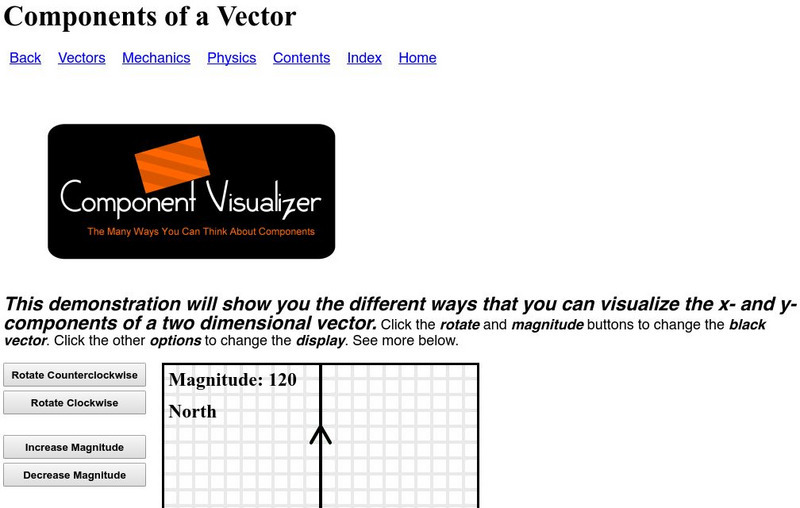
Zona Land: Components of a Vector
An interactive Java applet where users can rotate a vector about its tail and view the components of that vector. Magnitude of the components is updated on screen as the vector is dragged.
Ministry of Education and Universities of the Region of Murcia (Spain)
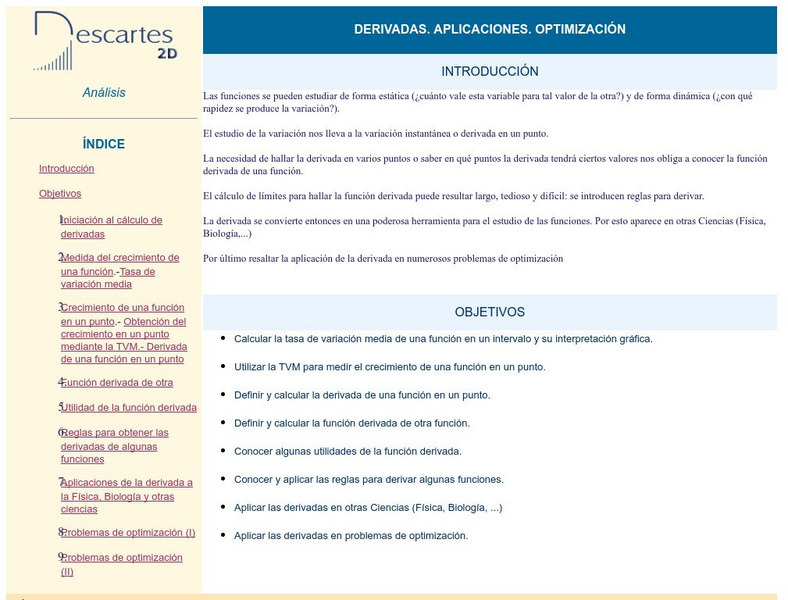
Ministerio De Educacion Y Ciencia: Derivadas. Aplicaciones. Optimizacion.
In Spanish. This interactive unit is intended to show you how to calculate the derivative of a function and the application of the derivative in other sciences.
Educaplus (Jesús Peñas Cano)
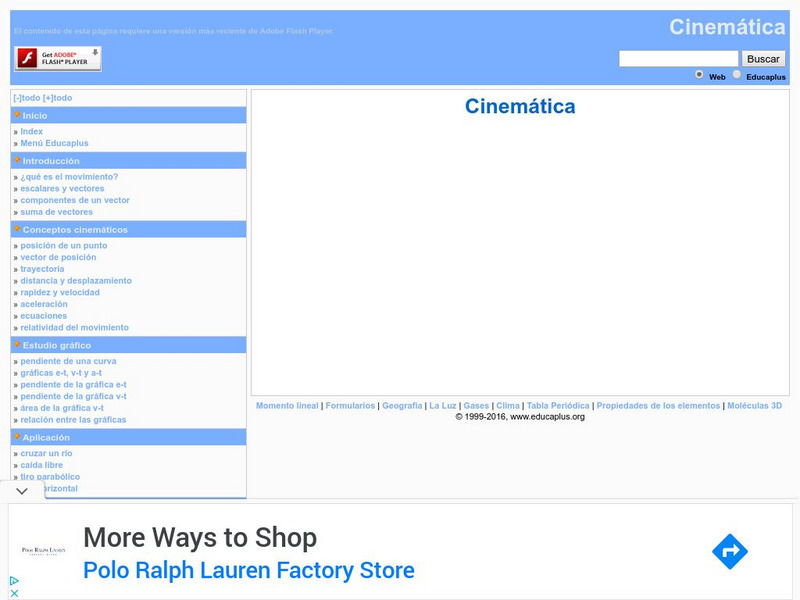
Educaplus: Estudio De Los Movimientos
This site shows a cinematic study of rectilinear movements which requires the use of equations and graphs. Every day life applications are also shown.
Texas Education Agency
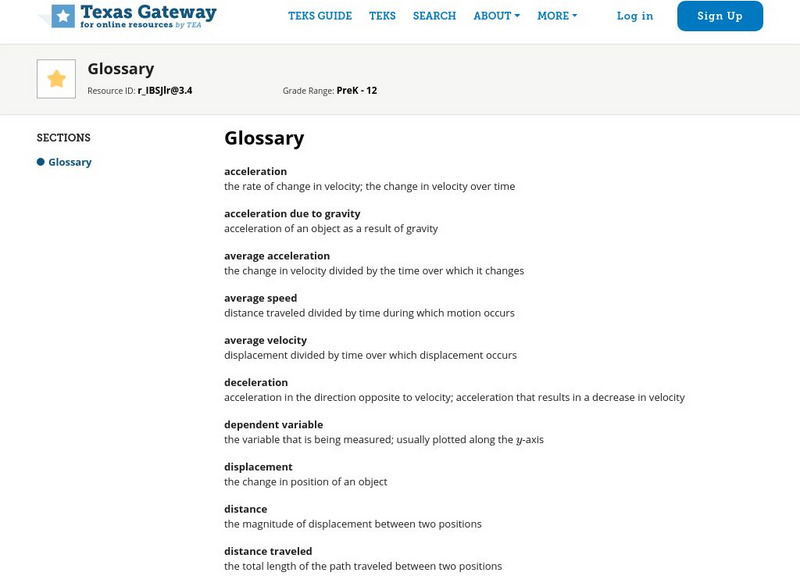
Texas Gateway: Ap Physics: Glossary for Kinematics
This is a glossary of terms and definitions used in AP Physics: Chapter 2: Kinematics.
Ministry of Education and Universities of the Region of Murcia (Spain)
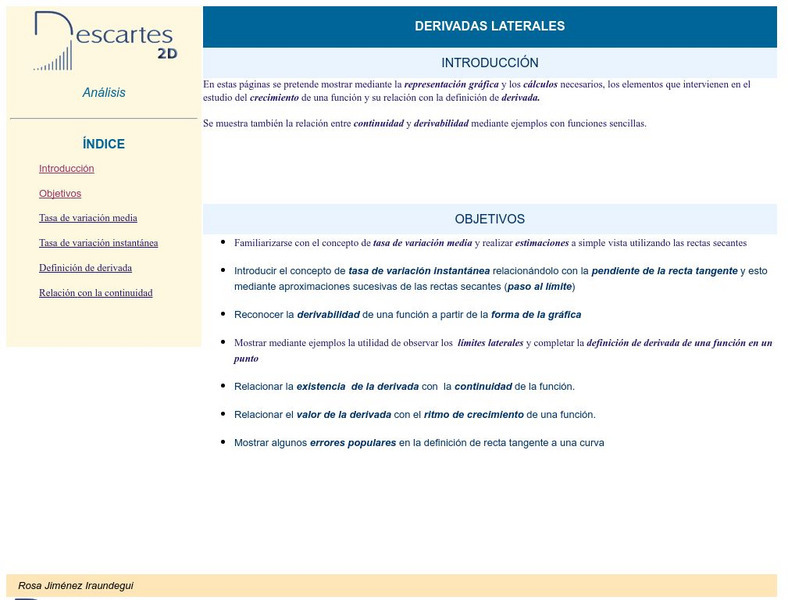
Ministerio De Educacion Y Ciencia: Derivadas Laterales
This interactive unit is intended to show by graphing and calculations, the elements involved in the study of the growth of a functions and its relation to the definition of derivative.
Other
Uc Riverside: Usenet Relativity Faq
A physics usenet listing of frequently asked questions relating to relativity, answered by a number of scientists. Administrivia and Reference, Speed of Light, Special Relativity, General Relativity and Cosmology, Black Holes. Loads of...
Other
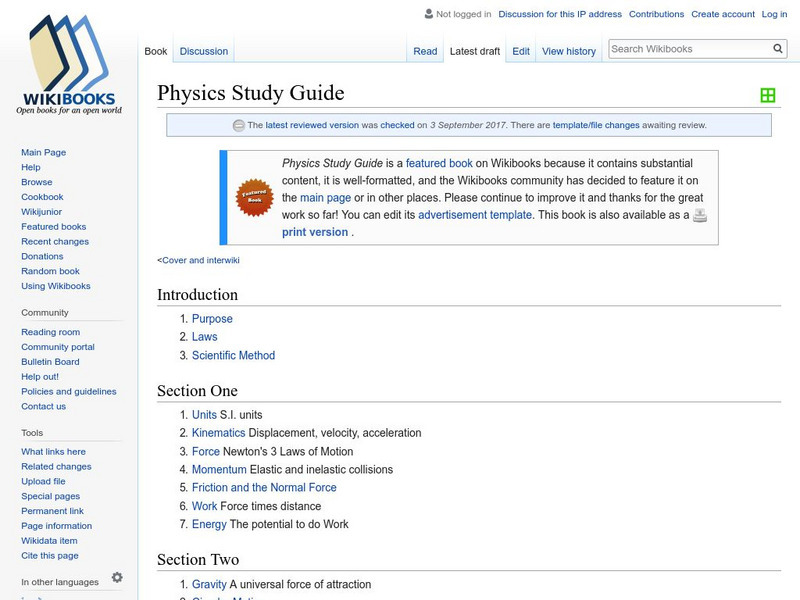
Wikibooks: Physics Study Guide
A handy resource that gives an overview of equations and definitions pertinent to an introductory, college-level physics course, with two of its three sections focusing on motion-related topics and principles.
Physics Aviary
Physics Aviary: Vertical Motion of Firework Level 3
Find the explosion height and the time to explosion for a firework that is fired vertically upward and explodes at the point where it already coming back down again. Information about the planet will be given to them so that they can...
Science Education Resource Center at Carleton College
Serc: Newton's Second: Having a Ball With Motion
Students will create a gravity ball launcher to demonstrate their understanding of mass, force, momentum, and motion. The students will use critical thinking, measurement, and observation and analysis of data to make changes and improve...
CK-12 Foundation
Ck 12: Physics Simulation: Oscillations Simulation
Use this interactive to learn the physics behind oscillation.
Physics Classroom
The Physics Classroom: Circular, Satellite, Rotational: Uniform Circular Motion
Uniform circular motion can be described as the motion of an object in a circle at a constant speed. This animation depicts this by means of a vector arrow.
Other
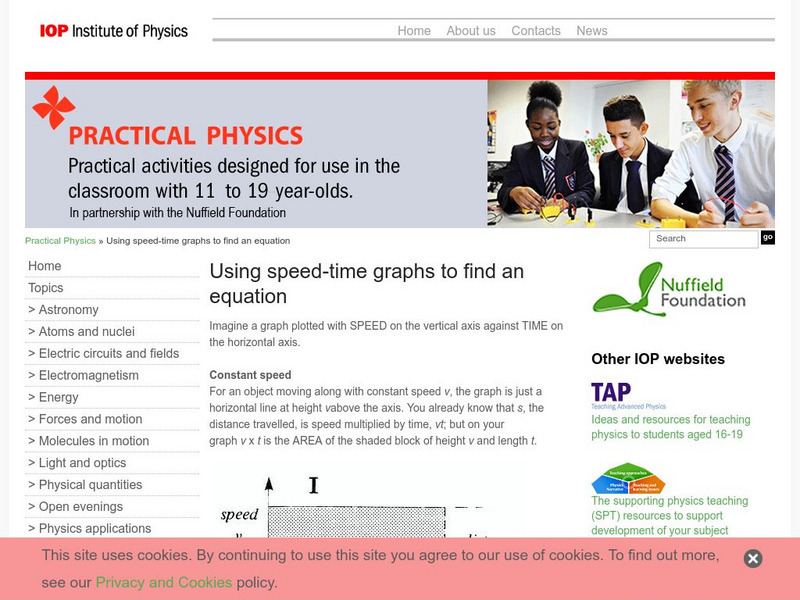
Institute of Physics: Practical Physics: Speed Time Graphs to Find an Equation
An illustrated example of a speed-time graph plotted with speed on the vertical axis against time on the horizontal axis.
CK-12 Foundation
Ck 12: Physics Simulation: Goalie
[Free Registration/Login Required] This hockey simulation addresses the question of how to force an object to move in a circle.
Texas Education Agency
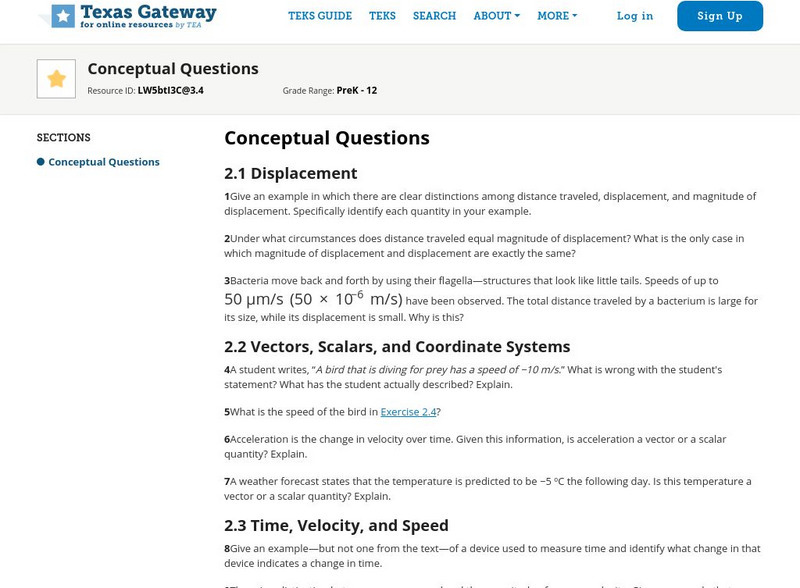
Texas Gateway: Ap Physics: Kinematics Conceptual Questions
This page provides practice questions on each of the conceptual content sections in AP Physics: Chapter 2: Kinematics.