Hi, what do you want to do?






Other
Center for Education Partnerships: The Marble Roll
In this Science-athon, students try to make their marble roll the farthest across a flat surface, using their knowledge of forces, motion, and energy to guide them through their apparatus design. Teachers must enroll online.
Department of Defense
Do Dea: Working With Parabolic Projectile Paths
Using the free-fall constants and gravity acceleration equations, we can determine many things about the position, velocity, and speed of a projectile. Here are a few examples and explanations. This is a great review for the AP Calculus...
MadSci Network
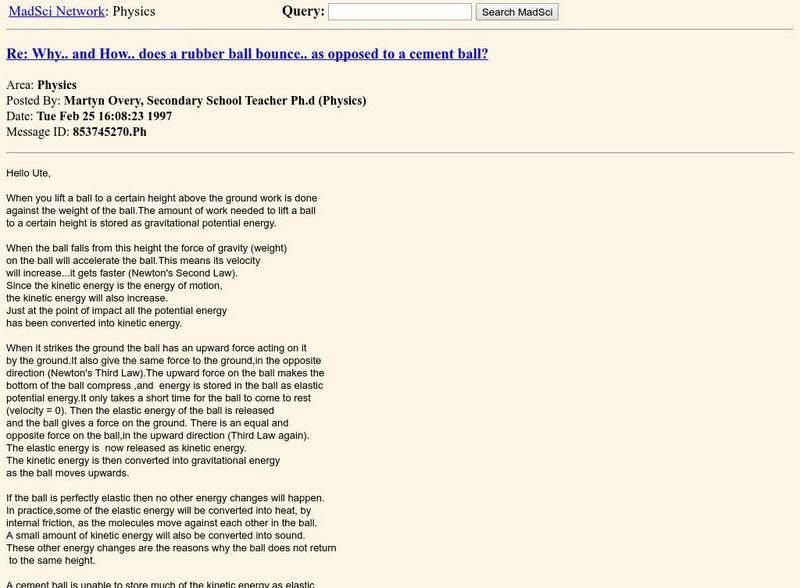
The Mad Scientist Network: Bouncing Rubber Ball
A question and answer format is used to relate elastic potential energy to the bounce of a rubber ball. Explanation of this simple phenomenon is thorough, complete, and free of trite statements.
TeachEngineering
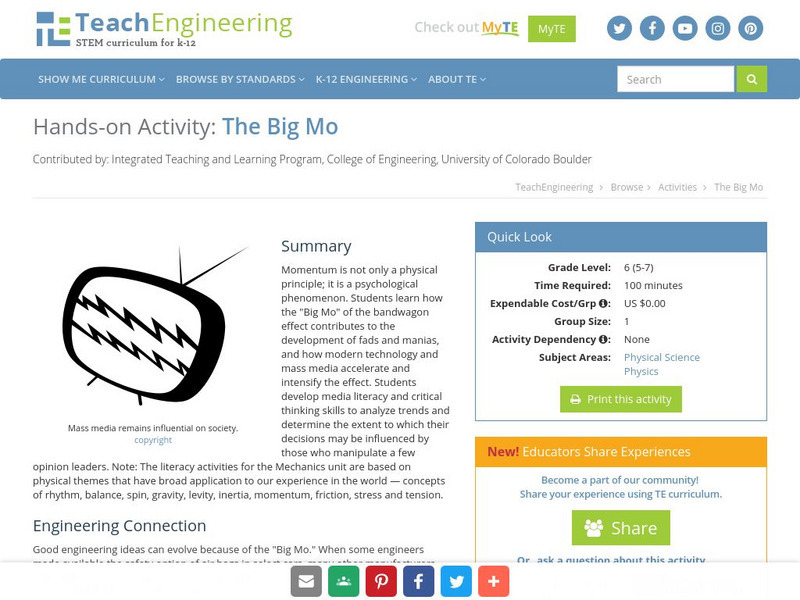
Teach Engineering: The Big Mo
Momentum is not only a physical principle; it is a psychological phenomenon. Students learn how the "Big Mo" of the bandwagon effect contributes to the development of fads and manias, and how modern technology and mass media accelerate...
PBS
Pbs Learning Media: Einstein: How Smart Was He?
This essay from the NOVA Web site explores the impact Einstein made on physics and most everything we know about the cosmos.
Physics Aviary
Physics Aviary: Pendulum Lab
This lab is designed to have students investigate the factors that affect the rate at which a pendulum oscillates. Students can change the length of the pendulum, the angle of release, and the heavenly body on which the pendulum is...
Wikimedia
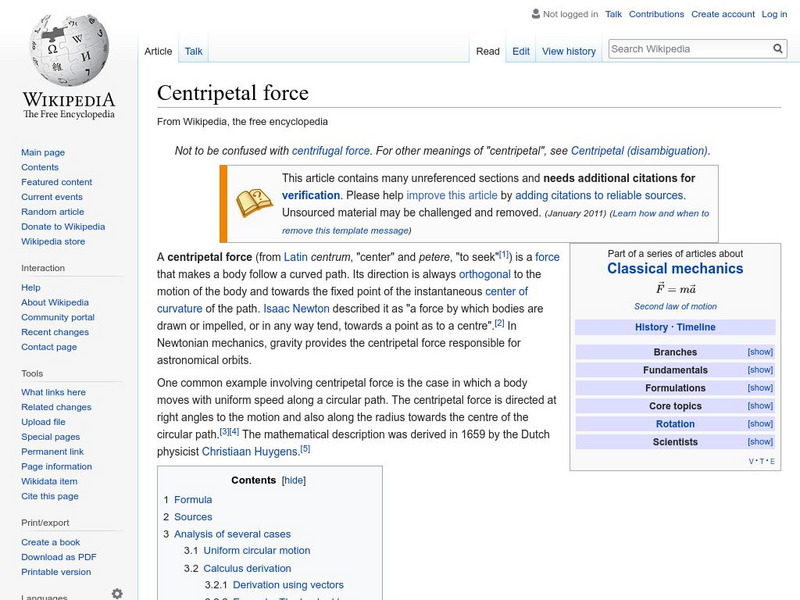
Wikipedia: Centripetal Force
Wikipedia's site on centripetal force provides a section explaining the difference between centripetal force and centrifugal force. Includes formulas and hyperlinked terms.