Hi, what do you want to do?





TeachEngineering
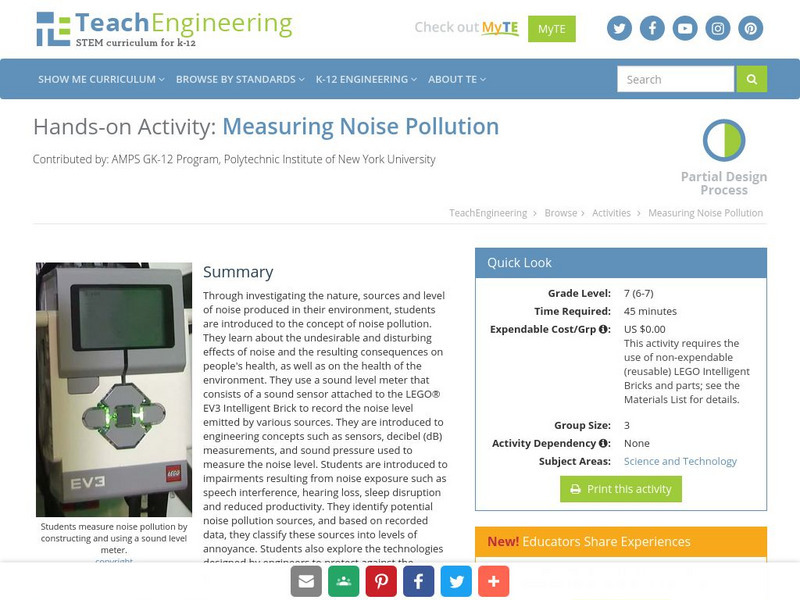
Teach Engineering: Measuring Noise Pollution
Through investigating the nature, sources and level of noise produced in their environment, students are introduced to the concept of noise pollution. They learn about the undesirable and disturbing effects of noise and the resulting...
TeachEngineering
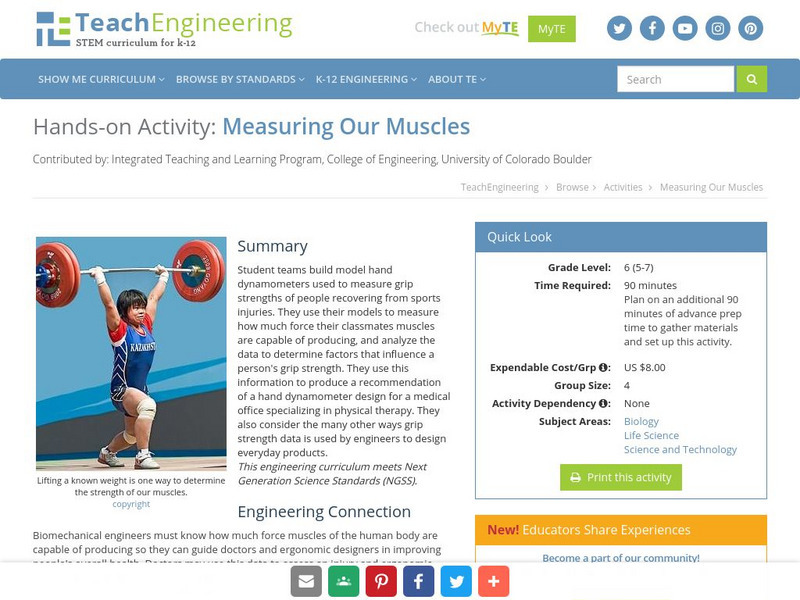
Teach Engineering: Measuring Our Muscles
Student teams build model hand dynamometers used to measure grip strengths of people recovering from sports injuries. They use their models to measure how much force their classmates muscles are capable of producing, and analyze the data...
University of Cambridge
University of Cambridge: Maths and Sports: Olympic Measures
Can you match these records and measurements to the correct event at the Olympic Games? This activity invites students to engage with units of measurement and orders of magnitude, and is aimed at secondary students at Key Stage 3.
National Council of Teachers of Mathematics
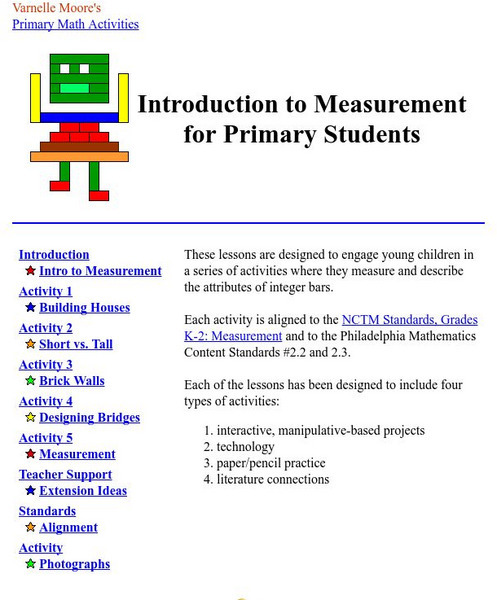
The Math Forum: Intro to Measurement for Primary Students
This site from the Math Forum is a great introduction to measurement for primary students. Each measurement activity has four components: interactive, manipulative-based project; technology; paper/pencil practice; literature connection.
University Corporation for Atmospheric Research
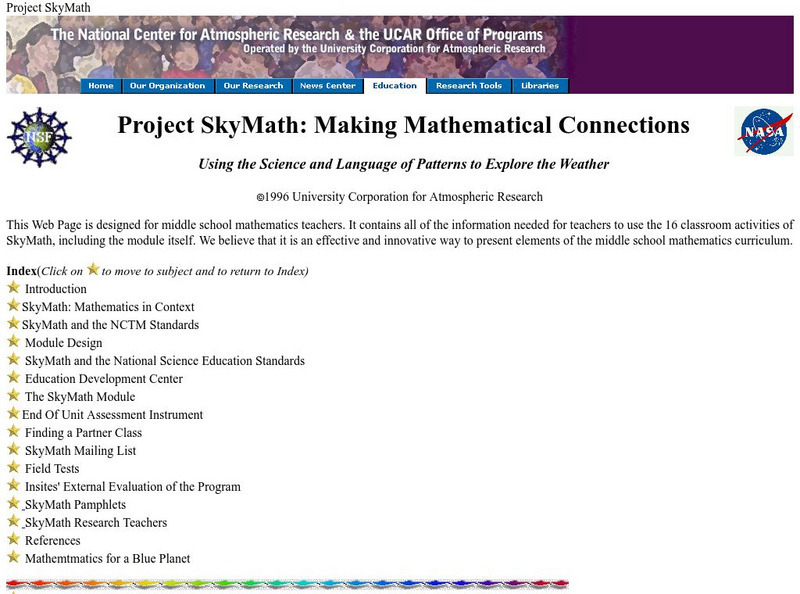
Ucar: Project Sky Math
Teachers will be interested to explore the SkyMath module, and the 16 classroom activities at this site. In this program, students will collect and record real-time weather data to analyze. Data analysis, graphing, number relationship,...

Khan Academy
Khan Academy: Activity: Notations and Measures
This chart is a guide to scientific notation, calendar notation, and other common measures.
Texas Instruments
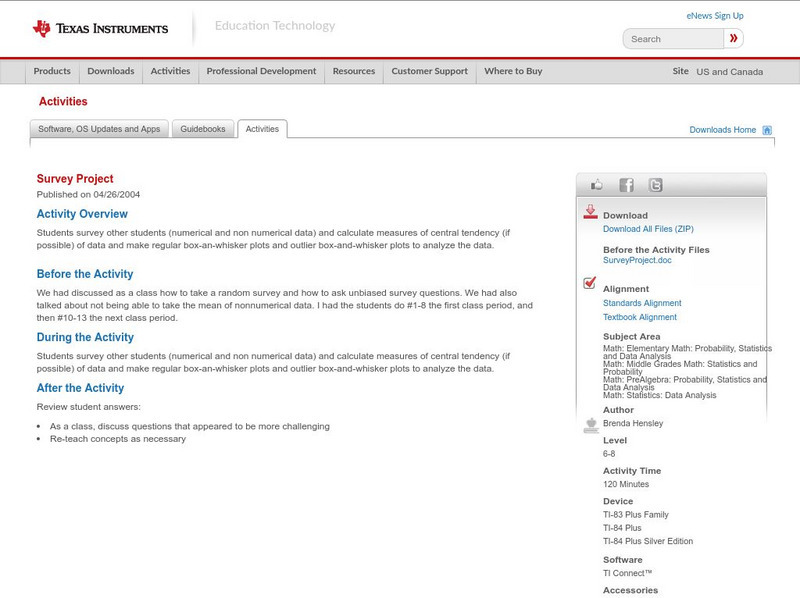
Texas Instruments: Survey Project
Students survey other students (numerical and non numerical data) and calculate measures of central tendency (if possible) of data and make regular box-an-whisker plots and outlier box-and-whisker plots to analyze the data.
TeachEngineering
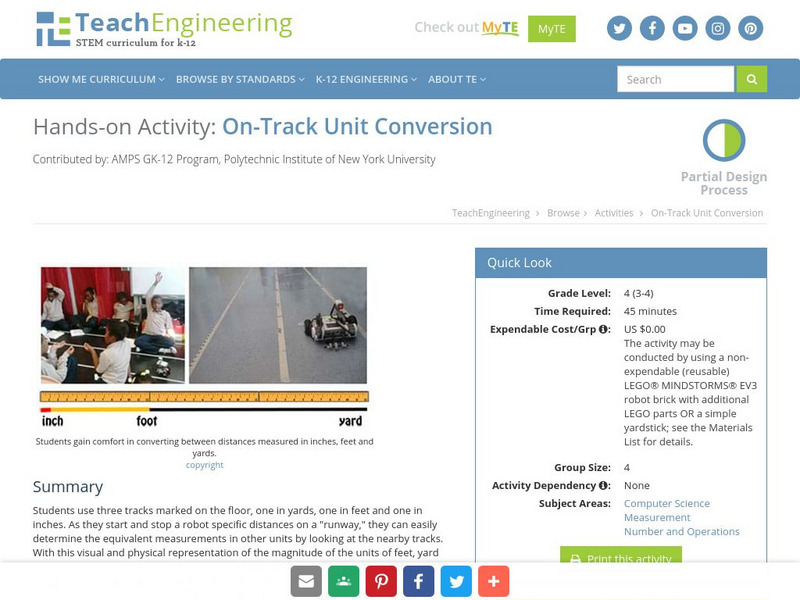
Teach Engineering: On Track Unit Conversion
Students use three tracks marked on the floor, one in yards, one in feet and one in inches. As they start and stop a robot specific distances on a "runway," they can easily determine the equivalent measurements in other units by looking...

Center for Innovation in Engineering and Science Education, Stevens Institute of Technology
Ciese: Wonderful World of Weather Project
If you're studying the weather, this is an excellent project for students to develop their understanding of how weather is measured. They will use real time data from their location as well as from around the world to learn about weather...
University of Cambridge
University of Cambridge: Maths and Sports: Charting More Success
This activity follows on from Charting Success and encourages students to consider and analyse representations of data from the world of sport, to make sense of the stories they tell, and to analyse whether the right representation has...
University of Cambridge
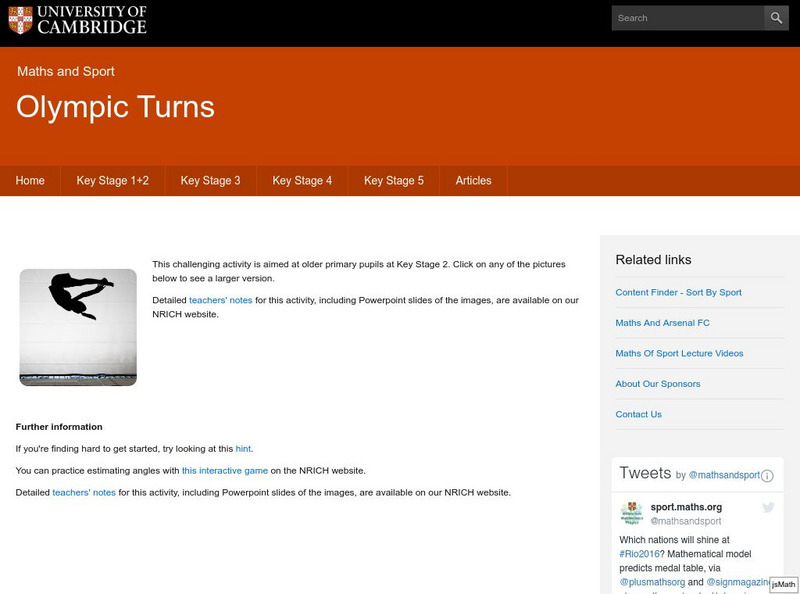
University of Cambridge: Maths and Sports: Olympic Turns
What angles can you see in these photos of Olympic sports? Can you estimate them? This challenging activity is aimed at older primary pupils at Key Stage 2.
TeachEngineering
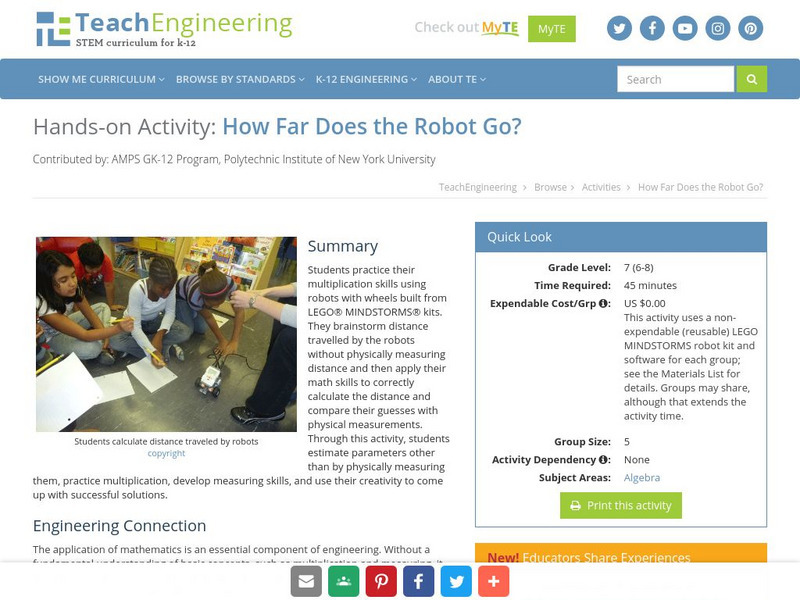
Teach Engineering: How Far Does the Robot Go?
Students practice their multiplication skills using robots with wheels built from LEGO MINDSTORMS NXT kits. They brainstorm distance travelled by the robots without physically measuring distance and then apply their math skills to...
TeachEngineering
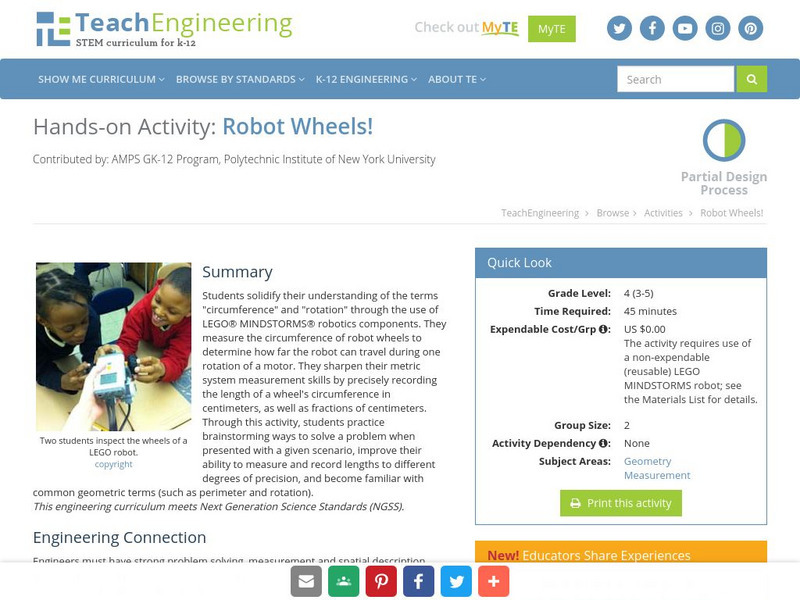
Teach Engineering: Robot Wheels!
Students solidify their understanding of the terms "circumference" and "rotation" through the use of LEGO MINDSTORMS NXT robotics components. They measure the circumference of robot wheels to determine how far the robot can travel during...
TeachEngineering
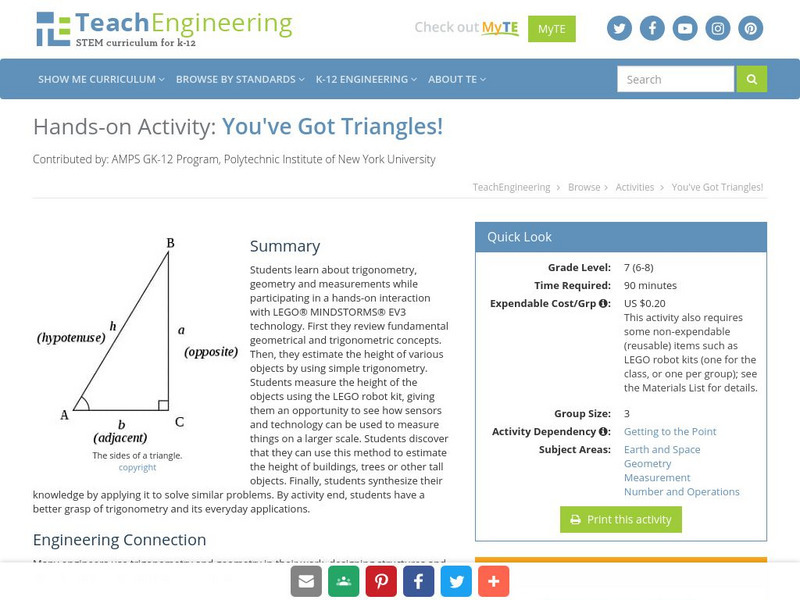
Teach Engineering: You've Got Triangles!
Students learn about trigonometry, geometry and measurements while participating in a hands-on interaction with LEGO MINDSTORMS NXT technology. First they review fundamental geometrical and trigonometric concepts. Then, they estimate the...
TeachEngineering
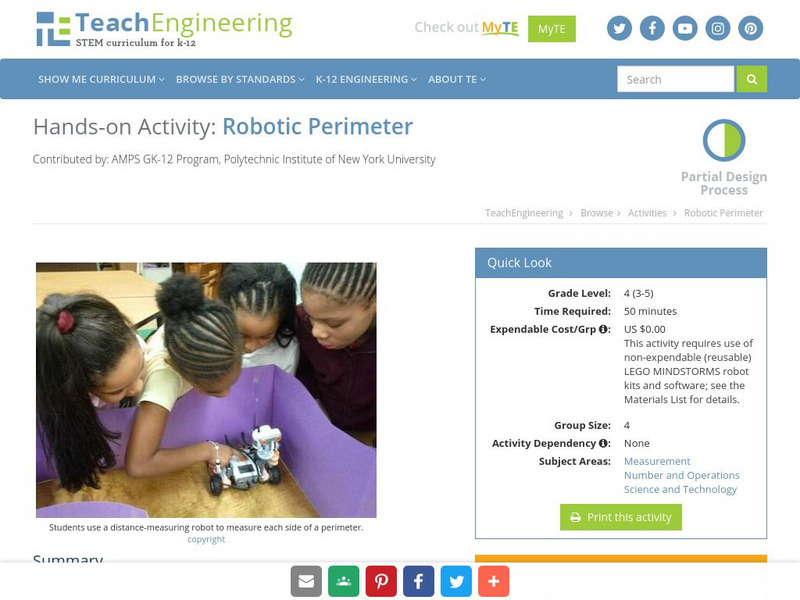
Teach Engineering: Robotic Perimeter
Students learn and practice how to find the perimeter of a polygonal shape. Using a ruler, they measure model rooms made of construction paper walls. They learn about other tools, such as a robot, that can help them take measurements....

Buck Institute
Buck Institution for Education: Pblu: Biz World
BizWorld is an example of a project-based learning lesson where students learn by building a student-run business and keep a record of the financials throughout the project so as to accurately measure the value of each company.
TeachEngineering
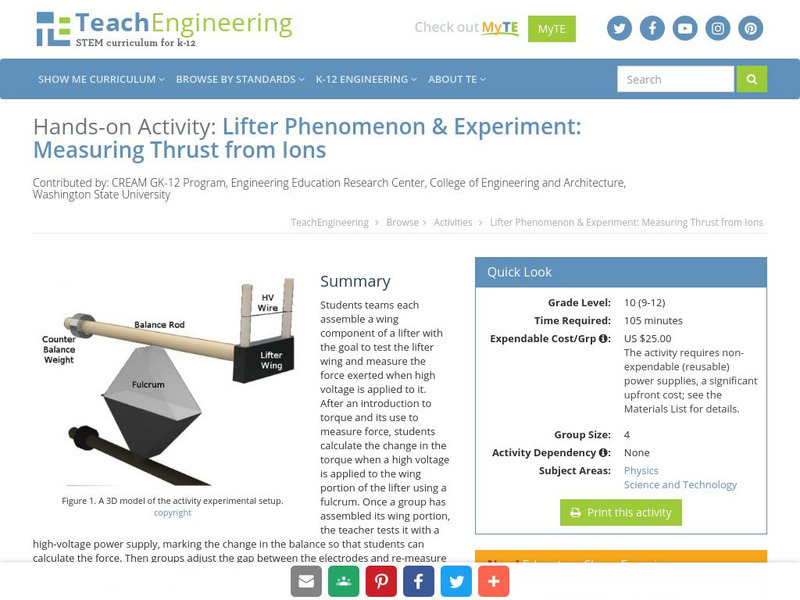
Teach Engineering: Lifter (Ehd Thrusters)
Students teams each assemble a wing component of a lifter with the goal to test the lifter wing and measure the force exerted when high voltage is applied to it. After an introduction to torque and its use to measure force, students...
TeachEngineering
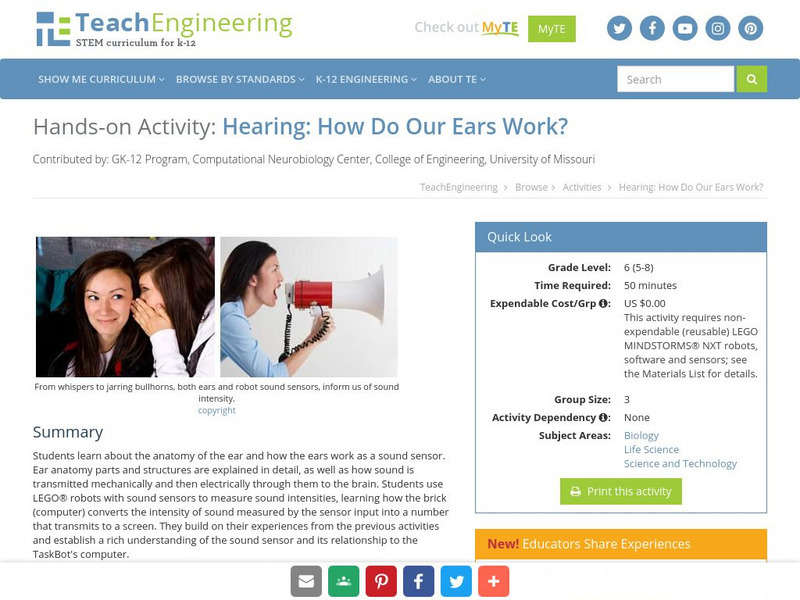
Teach Engineering: Hearing: How Do Our Ears Work?
Students learn about the anatomy of the ear and how the ears work as a sound sensor. Ear anatomy parts and structures are explained in detail, as well as how sound is transmitted mechanically and then electrically through them to the...
TeachEngineering
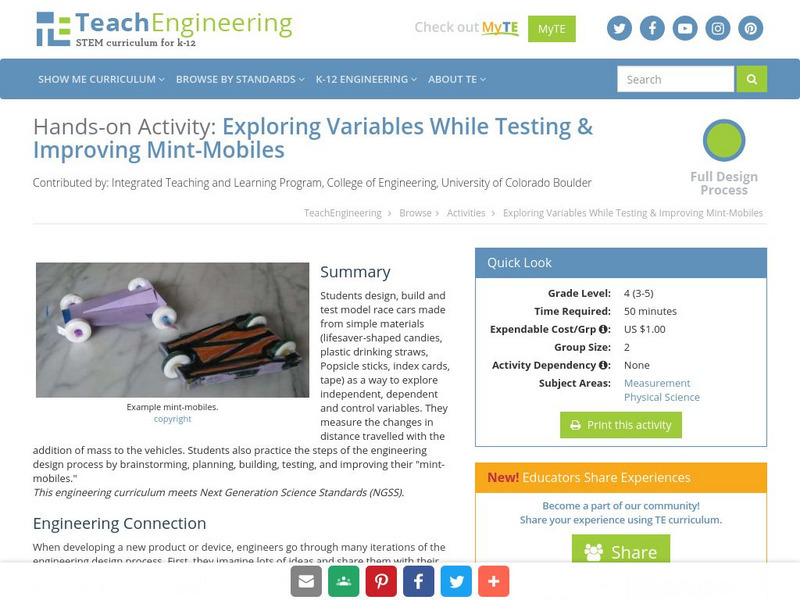
Teach Engineering: Mint Mobiles
Students design, build and test model race cars made from simple materials (lifesaver-shaped candies, plastic drinking straws, Popsicle sticks, index cards, tape) as a way to explore independent, dependent and control variables. They...
TeachEngineering
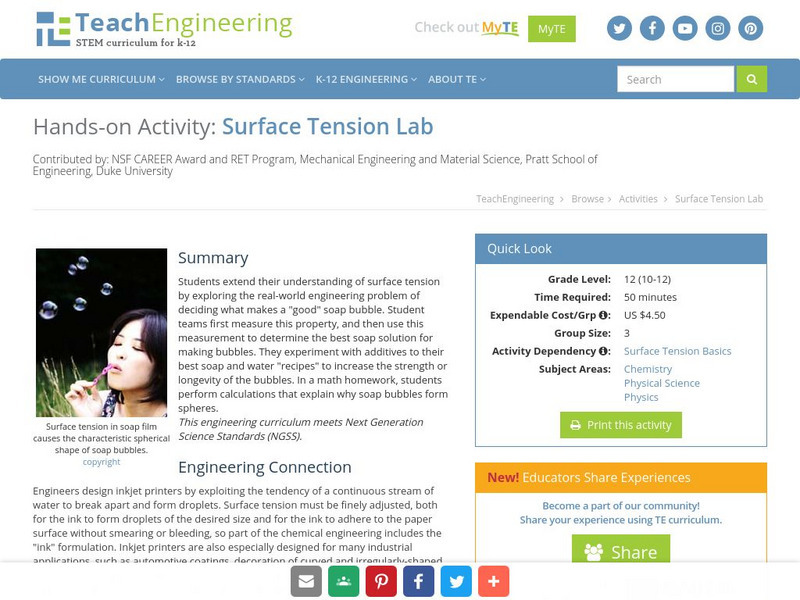
Teach Engineering: Surface Tension Lab
Students extend their understanding of surface tension by exploring the real-world engineering problem of deciding what makes a "good" soap bubble. Student teams first measure this property, and then use this measurement to determine the...
TeachEngineering
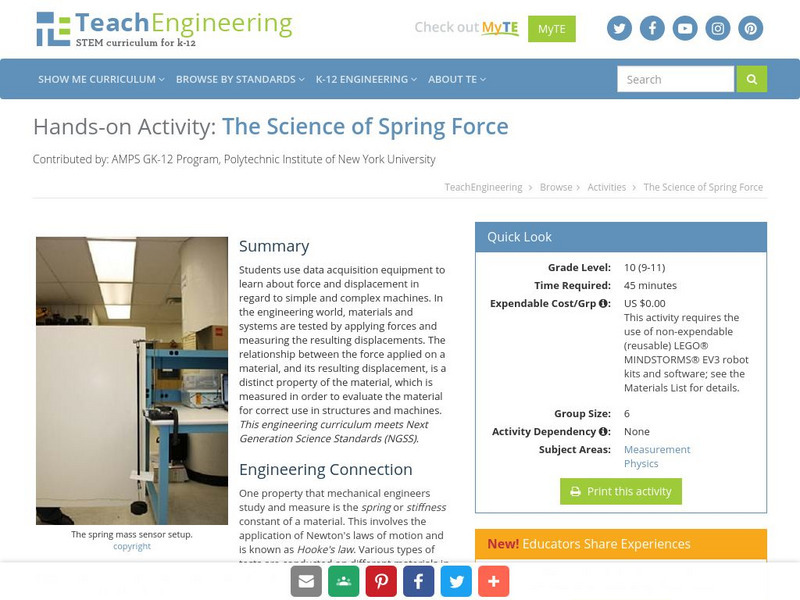
Teach Engineering: The Science of Spring Force
Students use data acquisition equipment to learn about force and displacement in regard to simple and complex machines. In the engineering world, materials and systems are tested by applying forces and measuring the resulting...
TeachEngineering
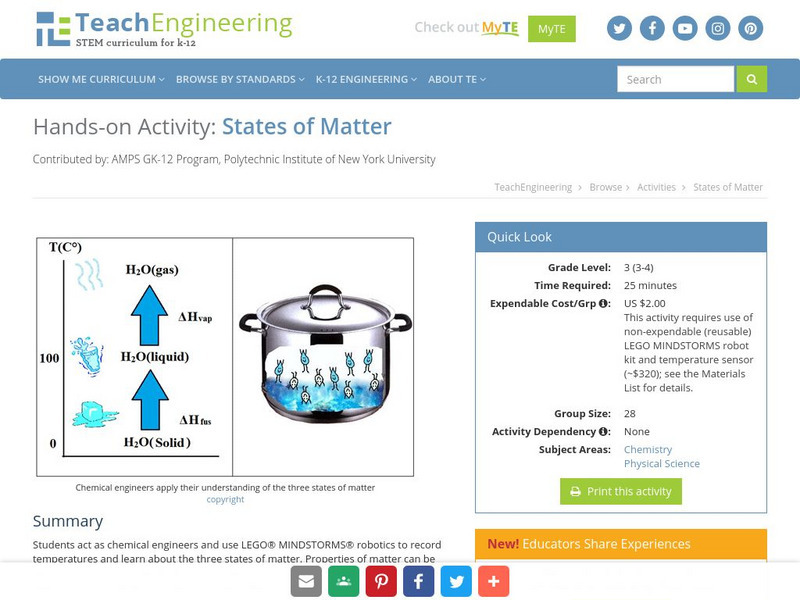
Teach Engineering: States of Matter
Students act as chemical engineers and use LEGO MINDSTORMS NXT robotics to record temperatures and learn about the three states of matter. Properties of matter can be measured in various ways, including volume, mass, density and...
TeachEngineering
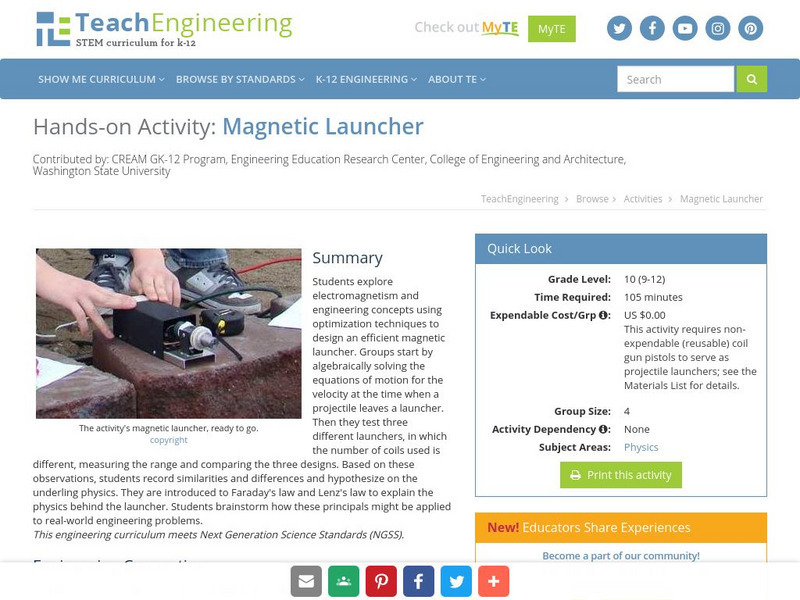
Teach Engineering: Magnetic Launcher
Students explore electromagnetism and engineering concepts using optimization techniques to design an efficient magnetic launcher. Groups start by algebraically solving the equations of motion for the velocity at the time when a...
TeachEngineering
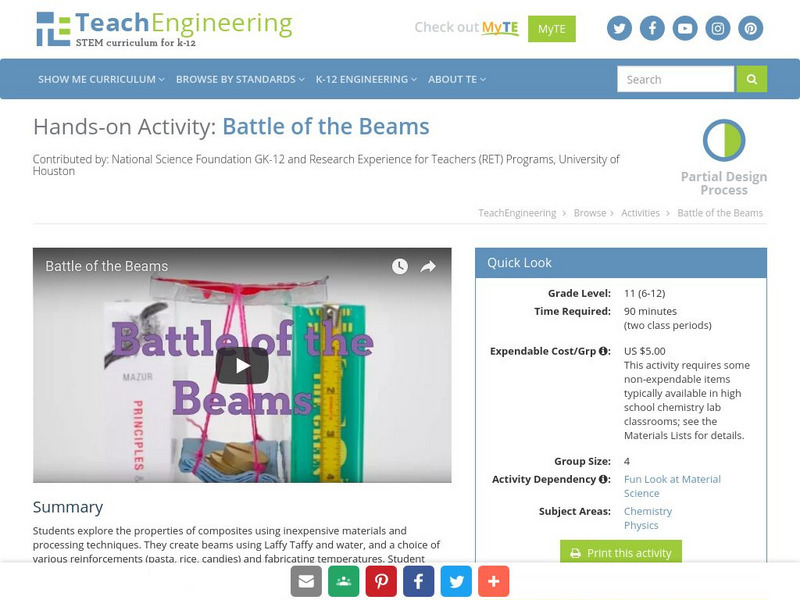
Teach Engineering: Battle of the Beams
Students explore the properties of composites using inexpensive materials and processing techniques. They create beams using Laffy Taffy and water, and a choice of various reinforcements (pasta, rice, candies) and fabricating...