Hi, what do you want to do?





Howard Hughes Medical Institute
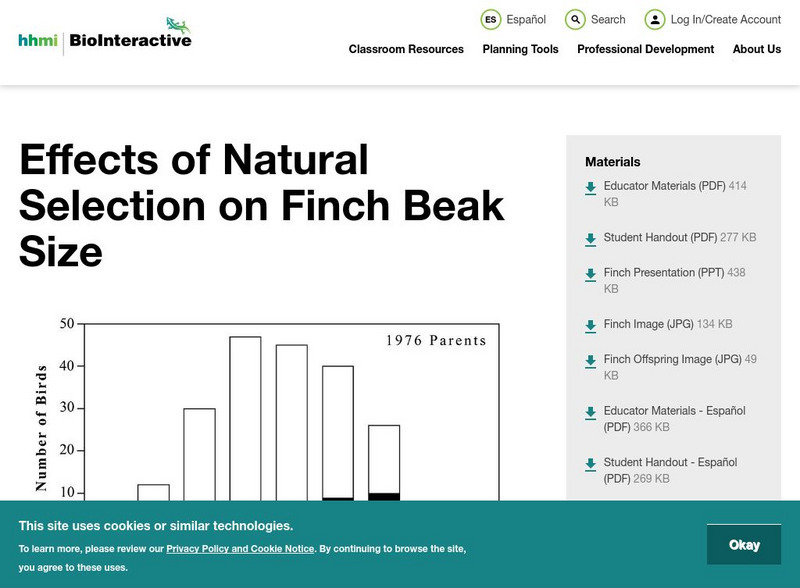
Hhmi: Bio Interactive: Effects of Natural Selection on Finch Beak Size
In this activity, students examine research on finches on the island of Daphne Major in the Galapagos Islands. The depth of the finches' beaks was measured before and after a drought. This data is displayed in graphs and students are...
Encyclopedia of Life
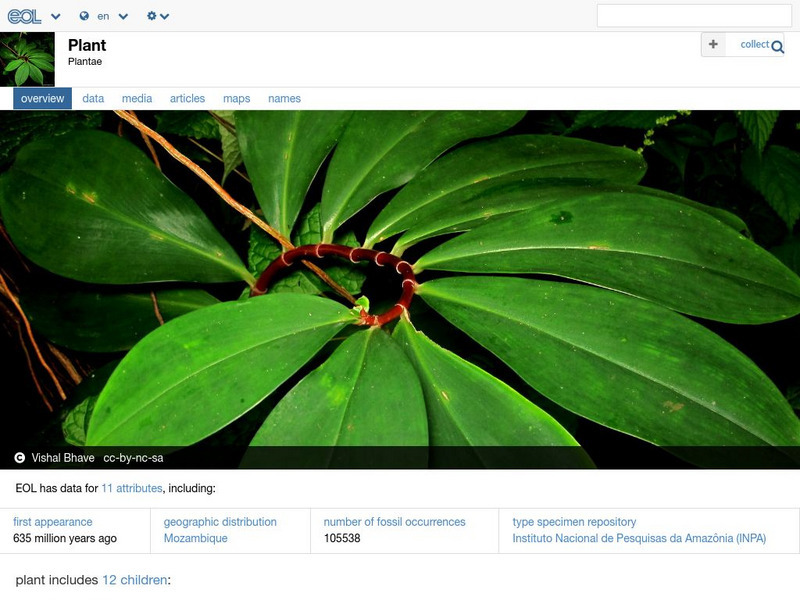
Encyclopedia of Life: Plants
Thorough resource examines plants with a description, pictures, and maps. Includes facts on ecology, evolution, functional adaptations, and external links.
National Institutes of Health
National Library of Medicine: Rewriting the Book of Nature
Explore the work of Charles Darwin and the theory of evolution. This comprehensive resource includes information about Darwin's life in addition to the process of species evolution.
Alabama Learning Exchange
Alex: Naturally, I Select You: Tactile Modeling of Natural Selection
In this simulation lesson, middle schoolers investigate the role of natural selection and survival within a frog population living in a changing environment. Includes student handouts along with an assessment piece.

PBS
Nature: Cheetah
What are some of the cheetah's distinctive characteristics? Come and check out this resource featuring fun facts and information about the cheetah.

Alabama Learning Exchange
Alex: You Don't Taste the Way You Look!
This Evolution lesson uses edible materials to demonstrate how a mimic acquires survival advantage. This particular lesson provides students an easy approach to learn and retain this information.

Other
Historia Del Idioma Espanol
An informative study, in Spanish, of the history of the Spanish language, its origins, its evolution, and its history in America. There is also an article about the Argentine adaptations of the language, and another link that covers the...

Concord Consortium
Concord Consortium: Stem Resources: The Virtual Greenhouse
A virtual greenhouse to study how plants adapt to live in different environments. Students will "plant" three different types of plants that thrive with different amounts of sunlight. Lab includes questions that could be saved and graded...
Science Education Resource Center at Carleton College
Serc: A Comparative Approach to Animal Dissections (A Phylogenic Study)
In this biology inquiry lab, students study evolutionary relationships by making observations of preserved animal specimens, developing a question, then investigating by dissecting the specimens provided. This comparative approach offers...

PBS
Pbs Teachers: Flying High: Taking to the Air
Explore the science of surface tension, the evolution of flight in insects and insects' anatomical adaptations. Construct insect models that illustrate the action of these adaptations and calculate the force per unit area of water surface.

Howard Hughes Medical Institute
Hhmi: Bio Interactive: Pocket Mouse Film With Quiz
Learn about selective pressure and how genes are involved in adaptations by watching this video on pocket mice. The video focuses on the research of Dr. Michael Nachman, "whose work in the field and in the lab has quantified the...

PBS
Pbs Teachers: Scientific American: Prime Time Primates: Monkey See, Monkey Do?
Explore the evolutionary advantage of stereoscopic vision and the fully opposable thumb, and describe how each adaptation might affect the use of tools in humans and primates.
![Huntington Library: Garden Lesson Plans: Rooting Into the Soil [Pdf] Activity](https://statictemp.lp.lexp.cloud/images/attachment_defaults/resource/large/FPO-knovation.png "Huntington Library: Garden Lesson Plans: Rooting Into the Soil [Pdf] Activity")
Huntington Library
Huntington Library: Garden Lesson Plans: Rooting Into the Soil [Pdf]
An experiment to investigate the capacity of different soils to retain water, and how this impacts on the survival, evolution, and adaptations of plants. Extension activities are included.
San Diego Zoo Global
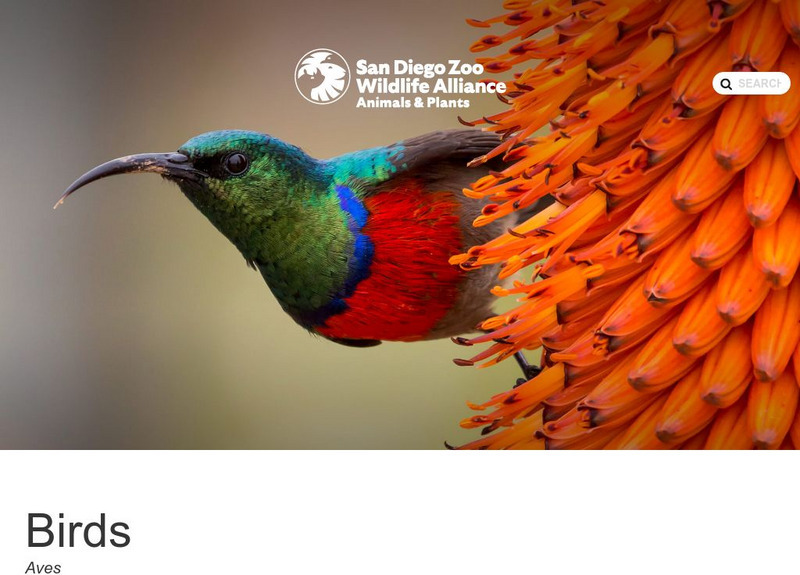
San Diego Zoo: Birds
This resource provides detailed information about birds, as well as several pictures.
Curated OER
Unesco: Iran: Masjed E Jame of Isfahan
Located in the historic centre of Isfahan, the Masjed-e Jame ('Friday mosque’) can be seen as a stunning illustration of the evolution of mosque architecture over twelve centuries, starting in ad 841. It is the oldest preserved edifice...