Hi, what do you want to do?






Curated OER
What Kind of Insect is That?
Fifth graders characterize insects and classify insects according to the Linnaean system. They use hand lenses or microscopes to examine insect body parts.

Curated OER
"Habitats"
Students complete a unit of lessons on animals and animal conservation. They observe a square meter of ground outside the school, set up a model environment, analyze an owl pellet, grow bread mold, and explore various websites.

Curated OER
Wildlife, Wolves, Endangered Species
Students use the Internet to research wildlife and conservation efforts. They examine pictures and graphics to research endangered species and humans role in their lives. They also use math to measure areas of habitats and add the number...
PBS
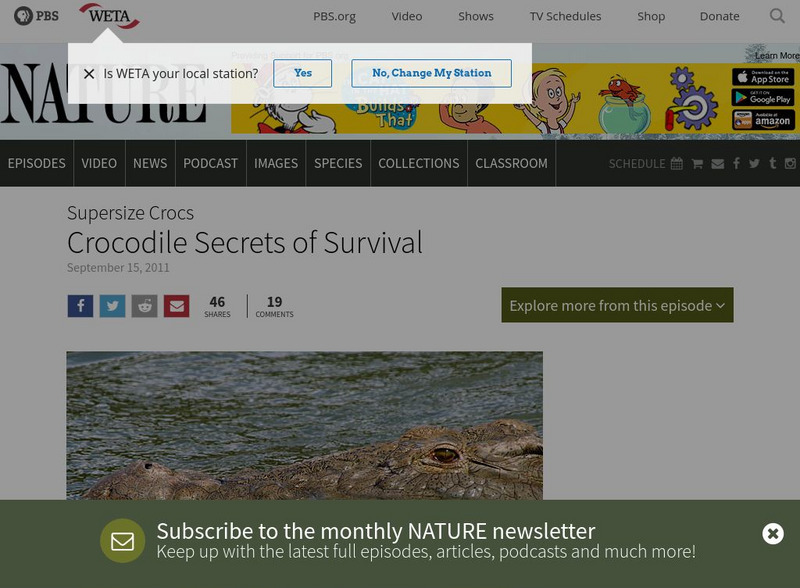
Pbs: Nature: Supersize Crocs: Crocodile Secrets of Survival
Documentary on the search for crocodiles measuring twenty feet or more in length, and the challenges to survival they face, e.g., from hunters. The reasons for their survival from dinosaur times are also examined.

National Geographic
National Geographic: Adaptations: Changes Through Time
People, plants, and animals make minor adaptations all of the time. This lesson will idenitfy why adaptations are critical for survival by diving into pterosaurs.
Science Education Resource Center at Carleton College
Serc: Adaptations of Plants for Survival in Different Environments
In this activity, students investigate plant adaptations by observing plants in different environments comparing the plants to show similarities and differences. Students will learn about the adaptations plants need in order to survive...

Scholastic
Scholastic: Study Jams! Science: Plants: Plant Adaptations
A video and a short multiple-choice quiz on the topic of plant adaptations.
Texas A&M University
Texas A&m: Adding Adaptations to Insects
A lesson plan site that illustrates how certain adaptations will enhance an insects chances for survival.
BBC
Bbc: Gcse Bitesize: Adaptations Adaptations, Interdependence and Competition
Organisms depend on each other for survival. This is called interdependence. Both living and non-living factors will affect the abundance and distribution of organisms in a habitat. Included is a link to a test.

Annenberg Foundation
Annenberg Learner: Journey North: Adaptations: Fit for Survival
This lesson plan will help students explore adaptation, especially as it relates to migration. Students will come to realize that adaptations can be behavioral as well as physical. Students are assigned a particular animal to investigate...
PBS
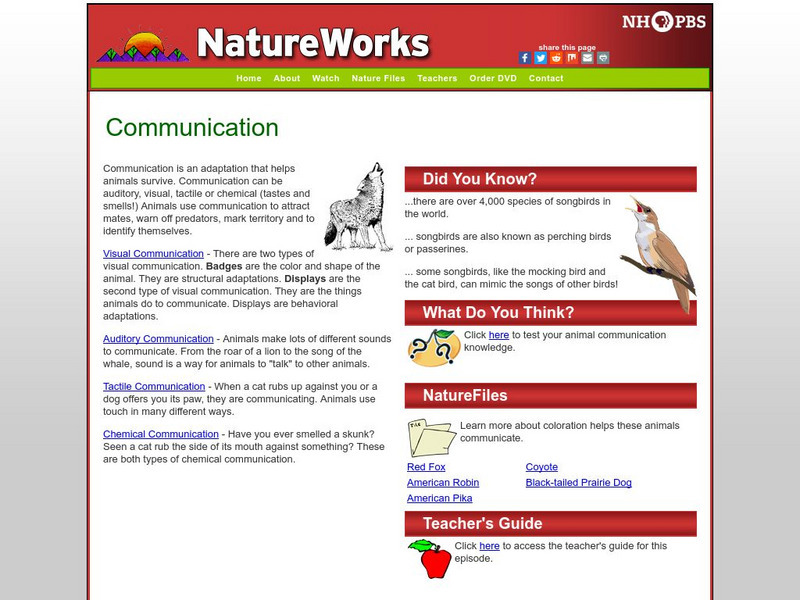
Nh Pbs: Nature Works: Communication
This comprehensive site describes how communication is an adaptation that is important for survival.

E-learning for Kids
E Learning for Kids: Norway Vikings: How Are Animals Adapted to Their Environment?
Learn about the patterns of adaptation in animals in response to changes to their environment. These can be in relation to things such as diet, survival against predators, or a change of habitat.
PBS
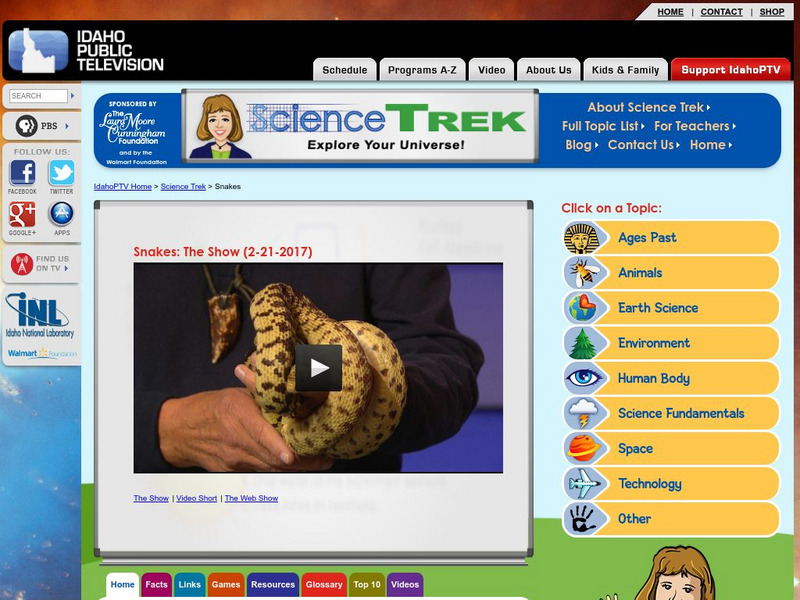
Idaho Ptv: Dialogue for Kids: Snakes
A collection of facts and links on the topic of snakes. The facts cover physical characteristics, movement, how they eat, reproduction, survival adaptations, dangerous snakes, and myths about snakes. Includes a reading list, links for...

American Museum of Natural History
American Museum of Natural History: Creature Feature
A matching game where students match different ocean creatures to their adaptations for survival.

CK-12 Foundation
Ck 12: Life Science: Predation
[Free Registration/Login may be required to access all resource tools.] Predation is another mechanism in which species interact with each other. Predation is when a predator organism feeds on another living organism or organisms, known...

PBS
Pbs Learning Media: Wild Kratts: All About Lizards Lesson Plan
Students explore the diversity of lizards in terms of characteristics, behavior, and habitat. Activities feature five species of lizards and their special body structures needed for survival.
BBC
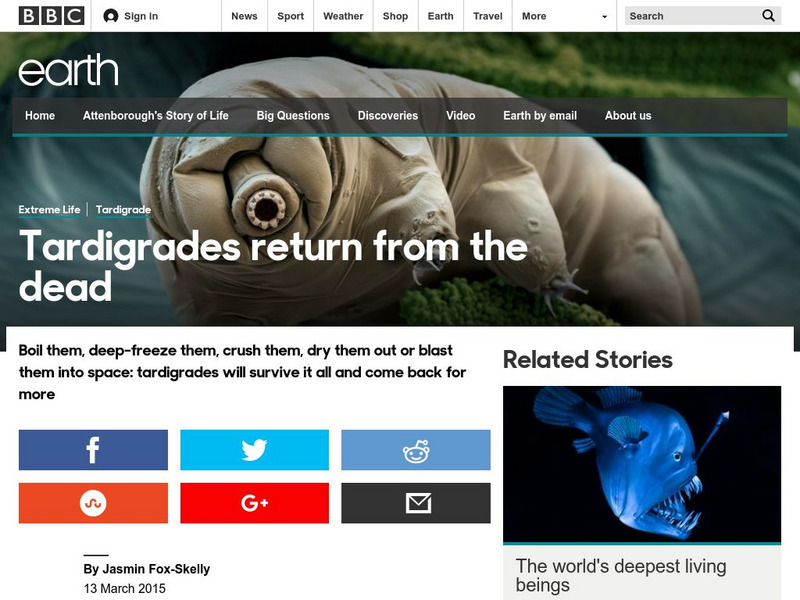
Bbc: Earth: Tardigrades Return From the Dead
Tardigrades are ancient, fascinating creatures that can survive conditions that would kill most life forms, including extreme heat and absolute zero, extreme pressure and a vacuum, and deadly radiation. They can even survive being...
BBC
Bbc Schools: Ks2 Bitesize: Science: Living Things: Plant and Animal Habitats
Place the aliens in the habitats where they can survive the best. Following the activity, read more about plant and animal habitats, and then take a quick quiz to check for understanding.

E-learning for Kids
E Learning for Kids: Science: Nova Zembla Expedition: How Are Different Organisms Suited to Their Habitats?
Alex and Foxy White are walking around looking at animals and learning about their habitats. Join them on their expedition.
Utah Education Network
Uen: Micro Organisms Don't Drink That Water
If you are looking for an introduction to protozoans and algae, this is a good place to start. You'll view some images of them and explore a few of their basic adaptations for survival.

BBC
Bbc: Gcse Bitesize: Genetic Inheritance
Mutations can cause a permanent change in the DNA of an organism. Over many generations, organisms have adapted through mutation which involves small changes between organisms which may allow that organism to compete better for survival....
PBS
Nova: Deep Sea Beastiary
Get descriptions and pictures of numerous deep sea fish. Discover the adaptations that enable them to survive at tremendous depths.

Other
Explore Learning: Rainfall and Bird Beaks
Explore how environmental conditions affect the adaptation of birds in this simulation. The amount of annual precipitation on an island is controlled by you while you track changes in the thickness of bird beaks over a five-year period....
Environmental Education for Kids
Eek!: Under in the Mud Read Aloud | Story Edventures
Under in the Mud by Laureanna Raymond-Duvernell takes you into the wintering world of ten Wisconsin animals as you listen to her read the book and talk about the animals in it. Learn about how animals hibernate, migrate, and adapt to...