Hi, what do you want to do?






Curated OER
Iowa: Reading Comprehension
For this Iowa reading comprehension worksheet, students read a 2-page selection regarding the state and then respond to 10 true or false questions.

Curated OER
Who Eats Whom in the Open Ocean?
Students examine how organisms interact with one another in the ocean. In this science lesson, students discuss predators and prey in the ocean. Students discuss food webs and how organisms interact with each other.

Curated OER
Species on the Edge
Students examine sea turtles. In this endangered species lesson, students analyze sea turtle habitats. Students hypothesize why sea turtles could go extinct.

Curated OER
Feeding Frenzy
Students are divided into two teams in which its members are to gather as many objects in the pool as possible gaining points for different objects.

Curated OER
Skagway School Hatchery Involvement
Tenth graders are given the opportunity to use what they are learning in their other academic courses, as well as in the hatchery class.

Curated OER
How the Environment Effects our Feelings
First graders compare images and discuss their feelings created by an artist's work. They explore the correlation between experiencing feelings in art and literature and feelings caused by changes in weather.

Curated OER
Bald Eagle Basic Skills Math Practice
Students solve basic skills math problems involving eagles. They read and discuss facts about eagles and view a video. They complete the Eagle Math worksheet and check their answers. They create additional problems and solve them.

Curated OER
Into the Pond
Seventh graders use a pond to explore macroinvertebrates and other organisms. They use a dichotomous key to classify the organisms and maintain a journal recording their findings.

Curated OER
Designing Tools for Ocean Exploration
High schoolers research the methods and tools used in ocean exploration. They, in groups, simulate an ocean exploration and consider what tools facilitate the exploration's objectives.

Curated OER
Environmental Science/Water Pollution
Students study natural habitats, aquatic life, renewable and non-renewable resources. They discuss conservation efforts for sea otters and desert toad in this units.

University of Michigan
Michigan Sea Grant: Teaching Great Lakes Science: Fish Identification
In this lesson, students examine the physical characteristics of fish that live in the Great Lakes and identify common features that help species to survive in that environment. Downloadable resources include a fish poster, fish family...
![University of Texas: Potato Fish Adaptations [Pdf] Lesson Plan](https://static.lp.lexp.cloud/images/attachment_defaults/resource/large/FPO-knovation.png "University of Texas: Potato Fish Adaptations [Pdf] Lesson Plan")
University of Texas at Austin
University of Texas: Potato Fish Adaptations [Pdf]
Using their knowledge of fish's adaptations, students create their own imaginary fish!
CK-12 Foundation
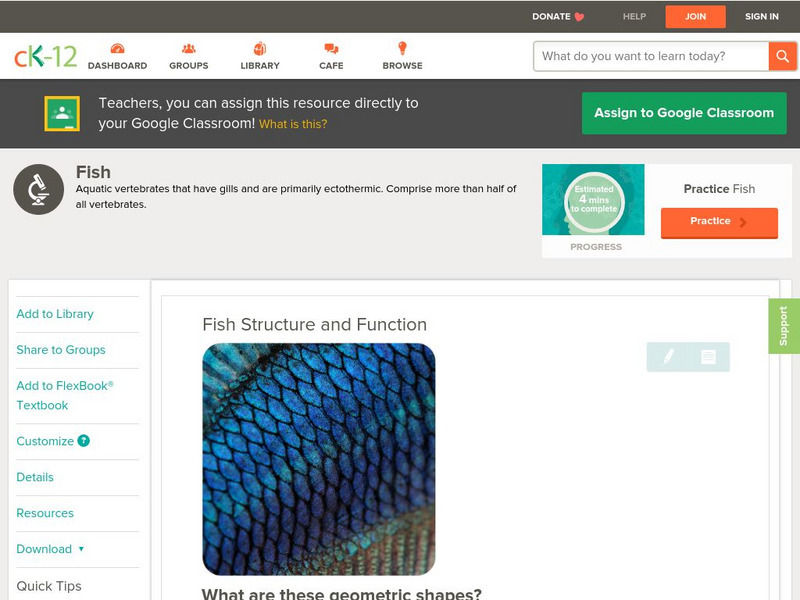
Ck 12: Biology: Fish Structure and Function
[Free Registration/Login may be required to access all resource tools.] Describes the characteristics of fish suited for aquatic lifestyles.
CK-12 Foundation
Ck 12: Biology: Fish Structure and Function
[Free Registration/Login may be required to access all resource tools.] Describes the characteristics of fish suited for aquatic lifestyles.

University of Florida
Florida Museum of Natural History: Fish Adaptations
This site has pictures that illustrate the many ways fish have adapted to make the most of life in their environments. The explanations are short and easy to understand.
American Museum of Natural History
American Museum of Natural History: Crazy Camouflage
Create a flounder fish that's hard to spot. In this hands-on activity, students gather evidence to explore how camouflage helps animals survive.
PBS
Pbs Learning Media: Animal Adaptations: Fishing Cat
Learn how the semi-aquatic fishing cat evolved millions of years ago to live in the wetlands of South and Southeast Asia in this video from NATURE: The Story of Cats (4:18). The accompanying activity prompts students to write an...
CK-12 Foundation
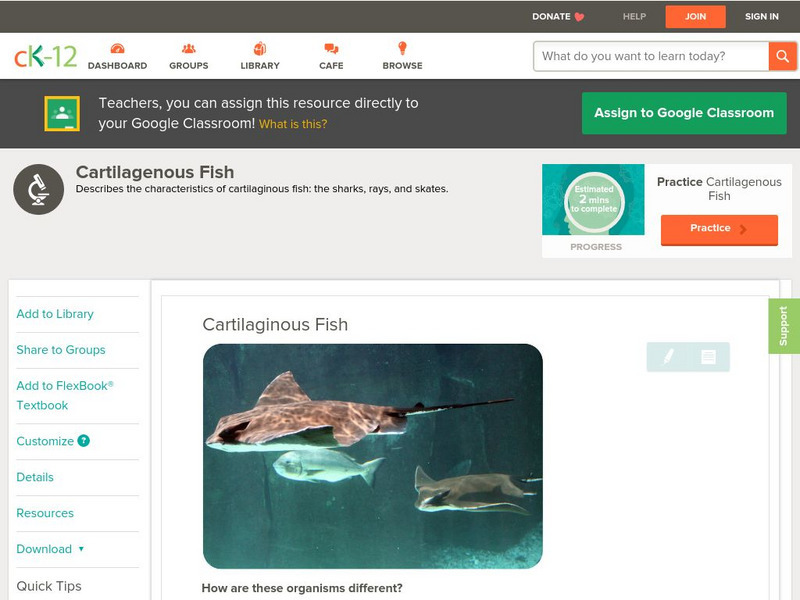
Ck 12: Life Science: Cartilaginous Fish
[Free Registration/Login may be required to access all resource tools.] Cartilaginous fish range in size from the dwarf lanternshark, at 6.3 inches, to the 50-foot whale shark. These fish have a jaw and evolved from the jawless fish....
Woods Hole Oceanographic Institution
Woods Hole Oceanography Institute: Adaptations to Light
View several pictures of ocean life through the eyes of scientists and staff at Woods Hole Oceanography Institute. This particular slideshow highlights how ocean creatures change their colors in order to either hide from or frighten...

University of Southern California
Structure of Matter: Animals
A slide show that demonstrates the development of physical structure in the animal world, moving from sponges through mammals.
Denver Zoo
Denver Zoo: Fishing Cat
The Denver Zoo features a comprehensive overview of the fishing cat focusing on its habitat, range, adaptations, diet, physical characteristics, and more.

Alabama Learning Exchange
Alex: Fred the Fish a Little River Trip
Little River is home to 47 kinds of fish including the threatened "Blue Shiner" Cyprinella caerulea. These fish depend on the good water quality at Little River. This skit allows students to observe pollution's effects on a small scale...
Science Education Resource Center at Carleton College
Serc: Light at the Bottom of the Deep, Dark Ocean?
What types of adaptations enable deep-sea fishes to survive and collect food in the darkness of the deep ocean? Interactive, hands-on lesson plan takes students on an exploration of deepwater adaptations by searching for Skittles in a...
Utah Education Network
Uen: Science Vocabulary Game
Fourth graders will play a review memory game with Utah's Grade 4 Science Standard V vocabulary words during this lesson. Words associated with living things and classifications of living things are included in this lesson.