Hi, what do you want to do?






Curated OER
A Symphony of Decomposers
Students discover decomposition. In this environmental lesson, students explore different types of decomposers and their role within the ecosystem. Students also discover how waste interferes with the decomposition process.

Curated OER
"The Emperor's New Clothes and Mahler's Ninth Symphony" Writing to Explain, Confidently and Efficiently, Even Physics!
Students combine their study of physics with their study of best practices when writing to inform. They communicate with experts using e-mail before creating a brochure based on their study of universal gravitation.

Curated OER
What Is a Pond?
Students identify animals and plants that live in a pond. In this marine biology activity, students create a chart of animals and plants they think they would see at the pond. Students create a "pond symphony" by imitating the sounds...

American Museum of Natural History
Trip Up Your Brain
Sometimes different parts of the brain disagree. See what this disagreement looks like using a remote learning resource to experience how brains often take shortcuts. Pupils complete the activity, observe their results, and then read...

San Francisco Symphony
Lesson Ideas for Any Music
Music is a wonderful tool you can add to enhance the learning process for every subject. Here is a list of music selections that are categorized by subject, along with some neat teaching suggestions. You'll find songs suited to...

Curated OER
Reading the Waves
Pupils view video segments which reveal the parts of sound and what factors control sound. The viewing and post-viewing activities serve to reinforce the video segments using worksheets and hands-out experiments.

Curated OER
Music of the Estuary
Students explore the sounds of the estuary. In this wetlands lesson, students discuss how to simulate the sounds of nature. Students write and record a musical score featuring the sounds of the wetlands.

Curated OER
Science and music
In this science and music learning exercise, students answer multiple choice questions about how science and music are related through the brain and animals. Students complete 4 questions.

BSCS Science Learning
Bscs: Frog Symphony
This inquiry focuses on analyzing spatial and temporal data for frog calls to determine the best time of day and location to hear a symphony of frogs. Click on the link for teaching guides and handouts.
Other
Bscs: Frog Symphony
For this self-directed lesson, young scholars use maps and graphs of data to investigate the habitats and time of year and day to hear a full chorus of frogs. A handout with everything the student needs to complete this lesson is...
TeachEngineering
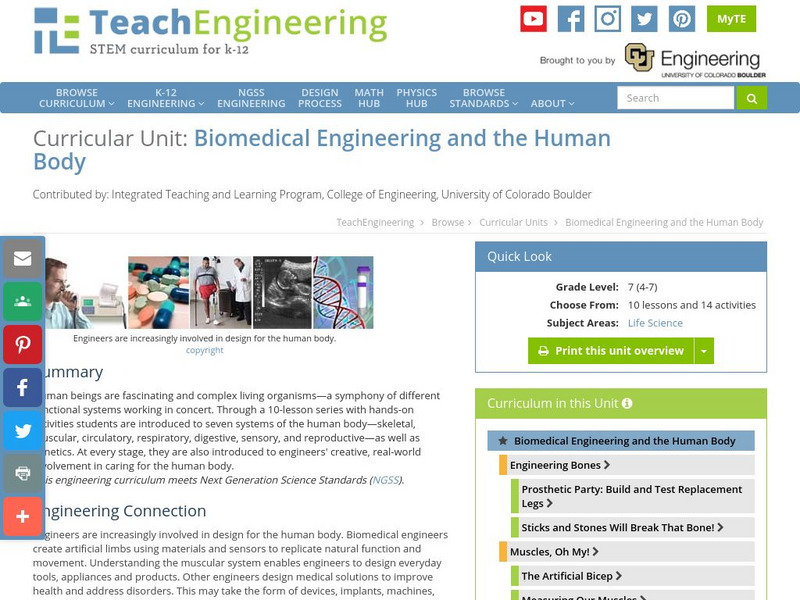
Teach Engineering: Biomedical Engineering and the Human Body
Human beings are fascinating and complex living organisms-a symphony of different functional systems working in concert. Through a 10-lesson series with hands-on activities students are introduced to seven systems of the human...
TeachEngineering
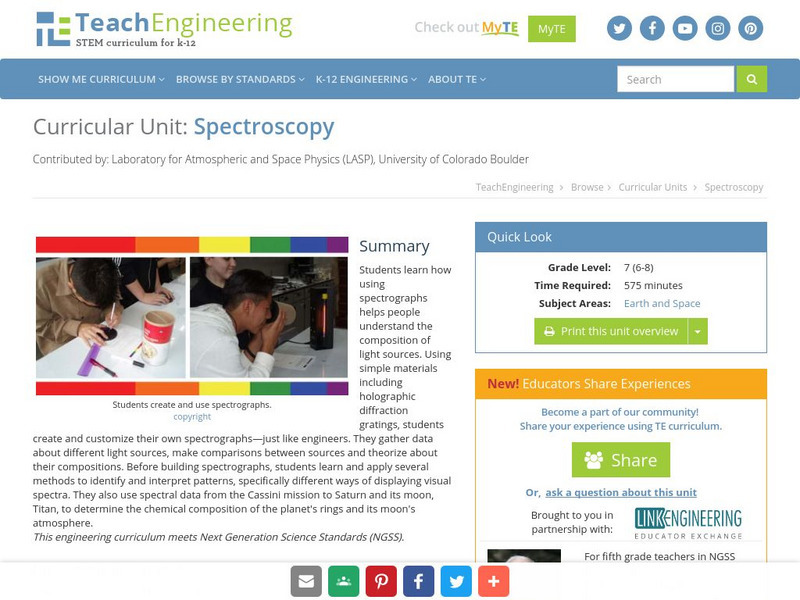
Teach Engineering: Spectroscopy
Students learn how using a spectrograph helps us understand the composition of light sources. Using simple materials and holographic diffraction gratings (available online at a variety of sites, including Edmund Scientifics and the...
Nine Planets
The Nine Planets: Venus
In-depth information site on Venus, complete with a thorough glossary, links to a wide array of related sites, thumbnail picture files linked to larger images, and even a short audio file from a classic symphony.
Other popular searches
- Symphony Orchestra
- +Symphony Orchestra
- Afro American Symphony
- Parts of a Symphony
- Surprise Symphony
- The Symphony
- Afro American Symphony
- Beethoven 5th Symphony
- Clapping Symphony
- Haydn Surprise Symphony
- Beethoven'sninth Symphony
- Pastoral Symphony