Hi, what do you want to do?






American Geosciences Institute
American Geosciences Institute: Cold Front and Warm Front
Read and understand the differences between a cold and a warm front.
TeachEngineering
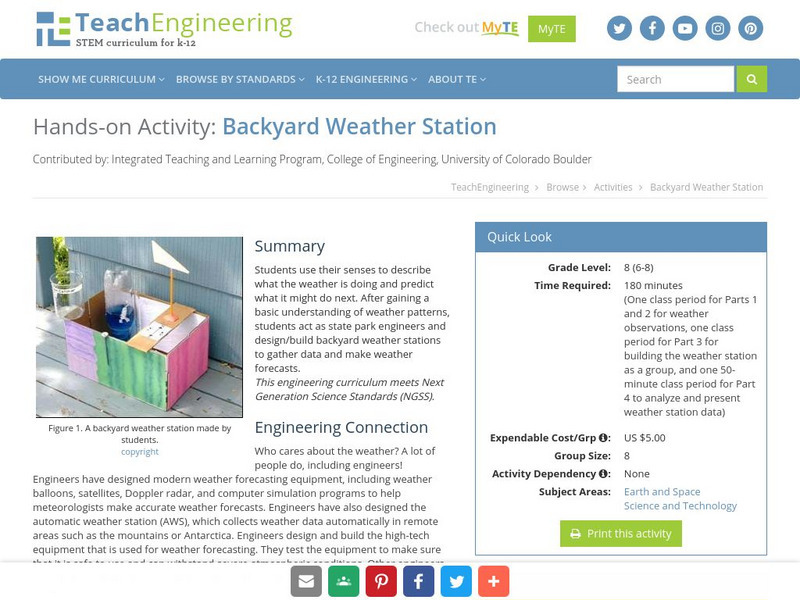
Teach Engineering: Backyard Weather Station
In this hands-on activity, students use their senses to describe what the weather is doing and to predict what it might do next. After gaining a basic understanding of weather patterns, students will become state park engineers and build...

Science Struck
Science Struck: Important Facts About the Stationary Front
Read about how a stationary air front forms when warm and cold air masses meet but neither can overpower the other. Explains what its characteristics are and the impact it can have on weather conditions.
University Corporation for Atmospheric Research
Ucar: Modeling a Weather Front
In this demonstration, students observe how temperature changes can create a weather front, in particular how the mixing of warm and cold air can produce thunderstorms.
TeachEngineering
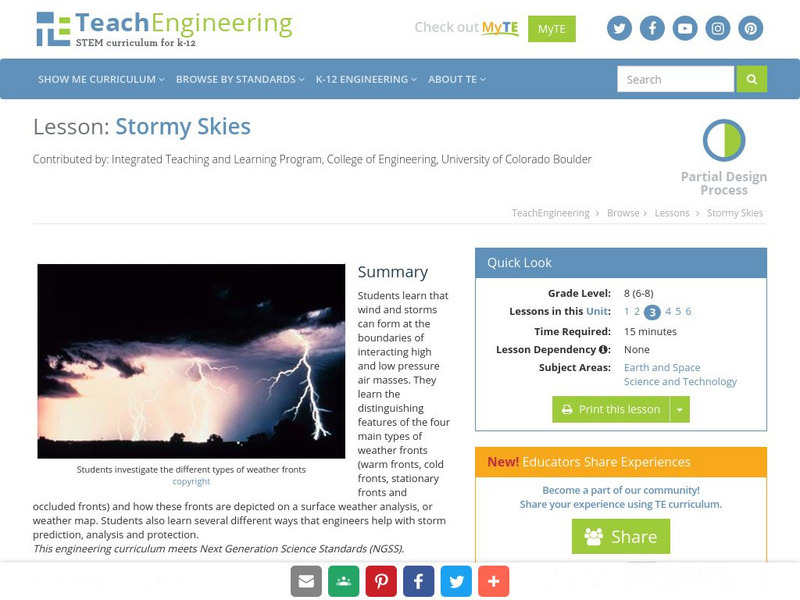
Teach Engineering: Stormy Skies
Students learn that wind and storms can form at the boundaries of interacting high and low pressure air masses. They learn the distinguishing features of the four main types of weather fronts (warm fronts, cold fronts, stationary fronts...