Hi, what do you want to do?






Curated OER
Nanofibers: Why Go Small?
Students explore the surface ratio of an object. In this surface area to volume activity students construct a data table, make calculations and create a graph.

Curated OER
European Climates
Ninth graders study the climate regions of Europe. For this geography skills lesson, 9th graders determine how weather and climate are influenced as they research the climate zones of specific locations and write about the ways that...

Curated OER
What is a Cloud?
Third graders identify a cloud and explore how they form. They create an acrostic poem about clouds.

Curated OER
Condensation
Pupils explain how water changes from vapor to liquid with a change in temperature by engaging in this experiment. They use a worksheet imbedded in this instructional activity to guide their inquiry.

Curated OER
Don't Marry the Mole!
Third graders examine the power of solar energy. In groups, they create their own pizza box solar oven to discover the power of the sun and how it is a source for heat and light. To end the lesson, they use the internet to examine...

Curated OER
The Chemistry of Fire and Other Oxidation Reactions
High schoolers explore the process of combustion.

Curated OER
The Mystery of the Sponge
First graders observe while water is absorbed into a sponge. They experiment by putting a sponge on yardstick and watch while water dries and the weight changes.

Curated OER
Helping the Soil
In this soil conservation activity, students study and analyze two excellent ways to enhance soil conservation: compost heap and leaf-mould. Students review all the ingredients in making both.
American Chemical Society
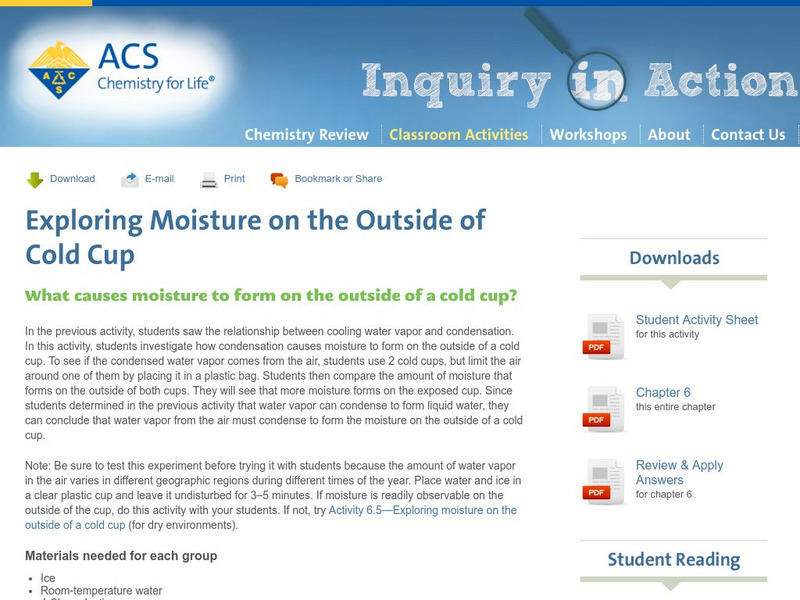
Inquiry in Action: Exploring Moisture on the Outside of Cold Cup
In this activity, students investigate how condensation causes moisture to form on the outside of a cold cup. To see if the condensed water vapor comes from the air, students use 2 cold cups, but limit the air around one of them by...
American Chemical Society
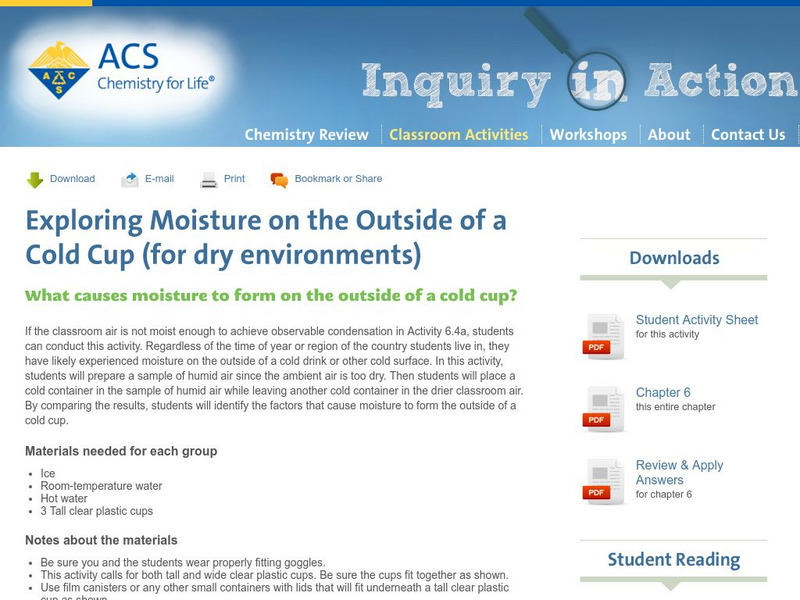
Inquiry in Action: Explore Moisture on Outside of a Cold Cup (Dry Environment)
Regardless of the time of year or region of the country students live in, they have likely experienced moisture on the outside of a cold drink or another cold surface. In this activity, students will prepare a sample of humid air since...

University Corporation for Atmospheric Research
Ucar: Clouds in the Air: Why Are They There?
An experiment that demonstrates why there are clouds in the sky. Start with air, invisible water vapor, particles we call condensation nuclei, and air pressure...the cloud comes later!
Dan Satterfield
Dan's Wild Wild Weather Page: Humidity
Use this site to find out how humidity works and perform some activities related to humidity.
Dan Satterfield
Dan's Wild Weather: Humidity
Explains how dew point is used to show the amount of moisture in the air. Gives an activity for measuring the dew point at home.
University Corporation for Atmospheric Research
Ucar: Create a Portable Cloud
In this hands-on activity, students experiment to discover how moisture, pressure, temperature, and condensation nuclei play a role in cloud formation.
TeachEngineering
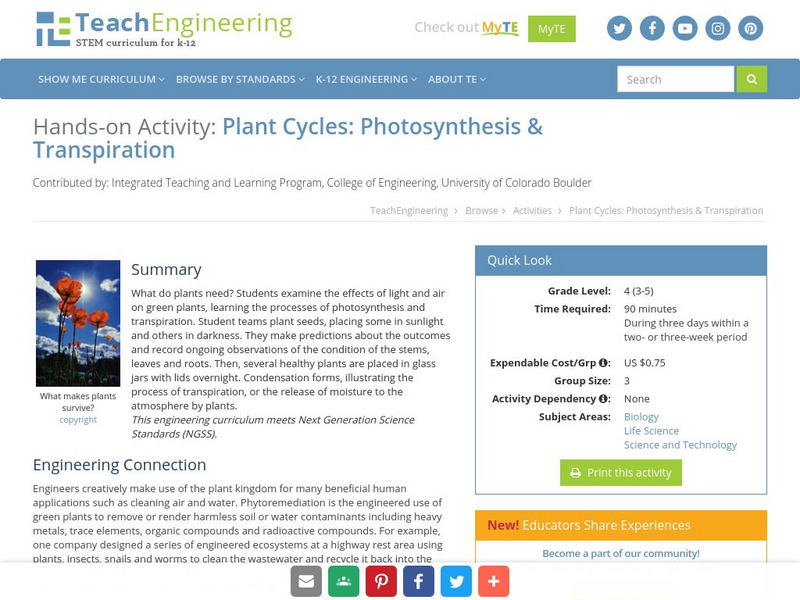
Teach Engineering: Plant Cycles: Photosynthesis & Transpiration
What do plants need? Students examine the effects of light and air on green plants, learning the processes of photosynthesis and transpiration. Student teams plant seeds, placing some in sunlight and others in darkness. They make...