Hi, what do you want to do?






Curated OER
Seeing Dots
Your algebra learners interpret algebraic expressions, in order to compare their structures, using a geometric context. They also discern how the two expressions are equivalent and represent a pattern geometrically and algebraically.

Noyce Foundation
Tri-Triangles
Develop an understanding of algebraic sequences through an exploration of patterns. Five leveled problems target grade levels from elementary through high school. Each problem asks young mathematicians to recognize a geometric pattern....

5280 Math
Interesting Times
Gain a little interest in functions with a real-life task. Young scholars analyze home loan data with a geometric sequence and series. They use the models to make predictions about the total loan payments at certain intervals in a...

5280 Math
Polygon Polynomials
Patterns in polygons lead to patterns in polynomials. Presented with a series of polygons, individuals create polynomial expressions to represent their patterns. The algebra project consists of nine problems that incorporate polynomial...

Oregon Department of Education
Building Number Sense
It's never too early to begin a child's math education. This collection of fun hands-on activities engage youngsters in building their number sense as they learn how to count objects, identify numerals, compare amounts, and much more.

Computer Science Unplugged
Twenty Guesses—Information Theory
How do we determine how much information to include and what can be left out? By playing a game of 20 questions, the class generates the best strategies for finding a number. They then move on to guessing the next letter in a short...
University of Cambridge
University of Cambridge: Nrich: Games Frogs
Use this interactive game to improve your knowledge and understanding of patterns and algebra. Can you describe a rule to follow where you make the least moves? Just follow the instructions below it.

Other
Math Portal: Arithmetic Progressions
A mini-lesson on arithmetic progressions includes a definition, examples with solutions, and a set of interactive problems at the completion of each lesson.
TeachEngineering
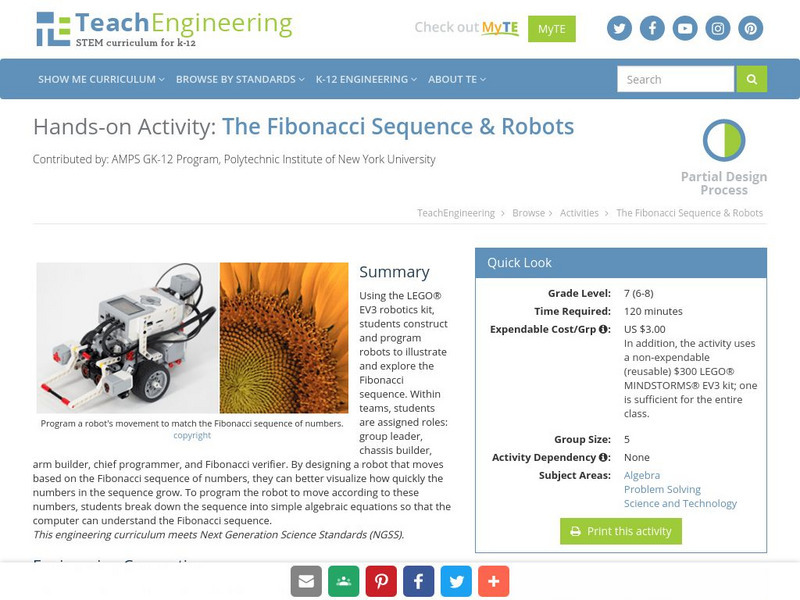
Teach Engineering: The Fibonacci Sequence & Robots
Using the LEGO NXT robotics kit, students construct and program robots to illustrate and explore the Fibonacci sequence. Within teams, students are assigned roles: group leader, chassis builder, arm builder, chief programmer, and...