Hi, what do you want to do?






Khan Academy
Khan Academy: Guaman Poma and the First New Chronicle and Good Government
This letter written by Guaman Poma is the most famous manuscript from South America dated to this time period in part because it is so comprehensive and long, but also because of its many illustrations. View pictures of the illustrations...
![Digital History: By What Right [Pdf] Website](https://statictemp.lp.lexp.cloud/images/attachment_defaults/resource/large/FPO-knovation.png "Digital History: By What Right [Pdf] Website")
Digital History
Digital History: By What Right [Pdf]
Two opposing philosophies concerning the relationship between government and its citizens were expressed by Thomas Hobbes and John Locke in the 17th century. Compare these two philosophies and see how they were related to the colonists'...
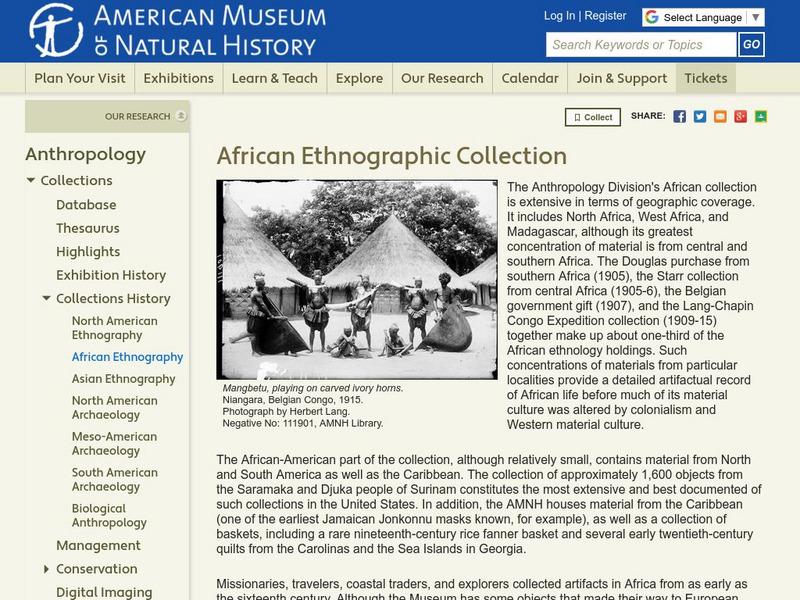
American Museum of Natural History
American Museum of Natural History: African Ethnography
The Anthropology Division's African collection is extensive in terms of geographic coverage. It includes North Africa, West Africa, and Madagascar, although its greatest concentration of material is from central and southern Africa. The...
Library of Congress
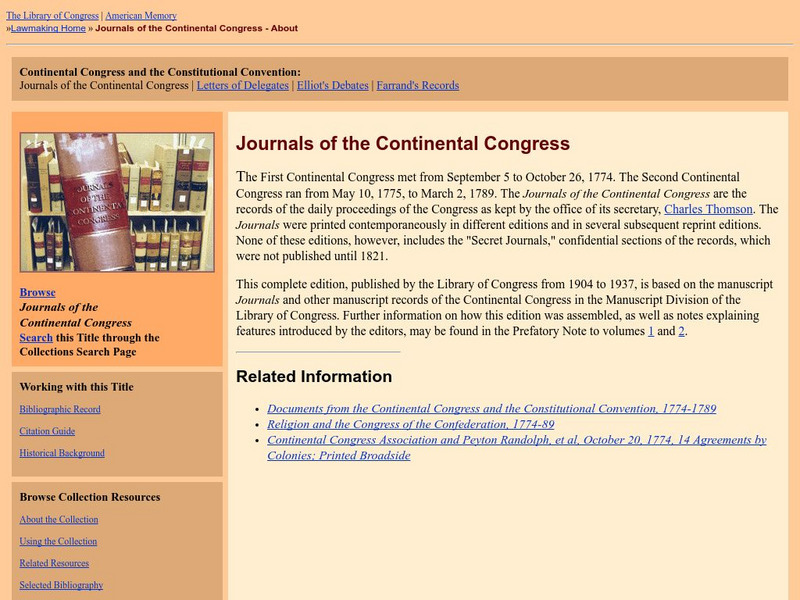
Loc: Journals of the Continental Congress
These journals from the Continental Congress of the United States will provide students with a greater understanding of the foundations of American government as established in the late 18th century. Includes handwritten documents by...
Independence Hall Association
U.s. History: Liberty Bell Timeline
Independence Hall Association provides a listing of important colonial dates. Also listed are the historical events which the Bell commemorates throughout American History.
A&E Television
History.com: What Did the Three Continental Congresses Do?
During the Revolutionary War, the Continental Congress became America's de facto government. Over a period of 15 years, from 1774 to 1789, the Continental Congress underwent a profound evolution. Starting out as a temporary group that...
BBC
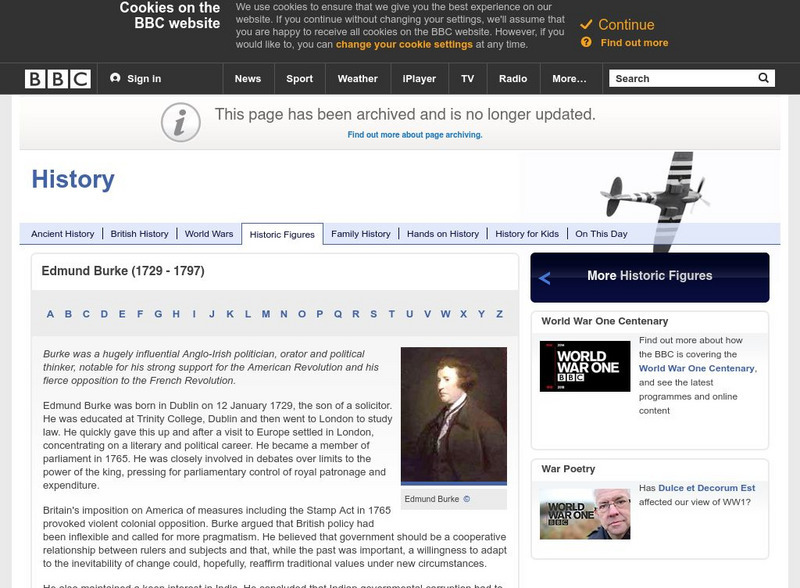
Bbc: History: Edmund Burke (1729 1797)
A one-page summary of the life and philosophy of influential eighteenth-century Anglo-Irish Parliamentarian Edmund Burke, whose theories of government led him to sympathize with the American colonists against the British crown, to...
Digital History
Digital History: The Road to Revolution
A review of the Age of Revolution, particularly as it was perceived in the American colonies. See how the various actions taken by the British government to control the colonists resulted in uniting the colonists and set the stage for...

Library of Congress
Loc: The Constitution: Counter Revolution or National Salvation
Using primary texts and prior study of Colonial America and the Revolution, students examine "what type of government would best represent the ideals of the American Revolution." Worksheets, discussions, and role-playing within this...
Other
Liberty Online: A Summary View of the Rights of British America
Written before the Declaration of Independence, this lengthy essay by Thomas Jefferson argued that the British Government was treating America unfairly. This site contains full text and footnotes within text hyperlinked to panel at...
The History Cat
The History Cat: Countdown to Revolution
Begins with a description of the British system of mercantilism that was imposed on the American colonies along with the taxes levied through the Stamp Act and the Sugar Act. The Americans complained that it was taxation without...
Independence Hall Association
U.s. History: The Beginnings of Revolutionary Thinking
The American Revolution was close to 200 years in the making. Read about the philosophies and attitudes toward government, as well as the diverse populations who came to the British colonies, that eventually fomented rebellion.
Digital History
Digital History: Was the Revolution Justified?
A terrific look at the twenty-seven specific reasons Thomas Jefferson cited in the Declaration of Independence and the support for those reasons of why the colonists felt justified in breaking the bonds with Great Britain.
Bill of Rights Institute
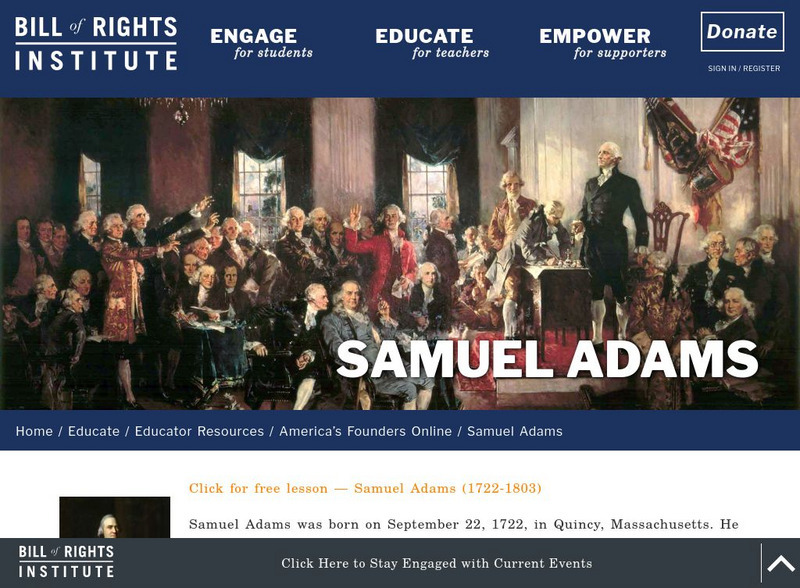
Bill of Rights Institute: Samuel Adams
Samuel Adams was born on September 22, 1722, in Quincy, Massachusetts. He entered Harvard College at the age of 14. During the 1760s, Adams became a leader of the Patriot resistance to the British government's attempt to tax the American...
Read Works
Read Works: Some Laws Are Intolerable
[Free Registration/Login Required] An informational text about the British Acts that lead to the Boston Tea Party and to the writing of the Declaration of Independence. A question sheet is available to help students build skills in...
Yale University
Avalon Project: Mayflower Compact 1620
Read the actual words of these earliest Americans and their attempt at self-government with the writing of the Mayflower Compact. Link directly to other colonial charter pages.
University of Nebraska
Digital Commons: The Constitutions of the Free Masons (1734)
The 1734 American edition of the freemasons' constitution in electronic form, a reprint of the 1723 version from London, England. An abstract is provided here, and a link for downloading the complete document. The abstract states that...

US Department of State
U.s. Department of State: Albany Plan of Union, 1754
Learn all about the Albany Plan of Union from this article from the U.S. Department of State. Find out why it was proposed, what the plan would provide for, and the results.
Bill of Rights Institute
Bill of Rights Institute: John Adams
Short, overweight, and quick-tongued, John Adams hardly fits the model of the typical Founder. But Adams's contributions to American independence and the formation of the United States government were great. Adams penned defenses of...
Yale University
Yale New Haven Teachers Institute: Connecticut Constitution, 1639 1789
Develops the concept of "constitutionalism" as related to the U.S. Constitution and Connecticut's role in the Constitutional Congress and Convention. An overview of Connecticut's colonial history, and judicial origins and organization,...
Other
Pennsylvania Historical and Museum Commission: William Penn
This resource presents a biographical essay about William Penn that highlights his role in the establishment of Pennsylvania.