Hi, what do you want to do?





Read Works
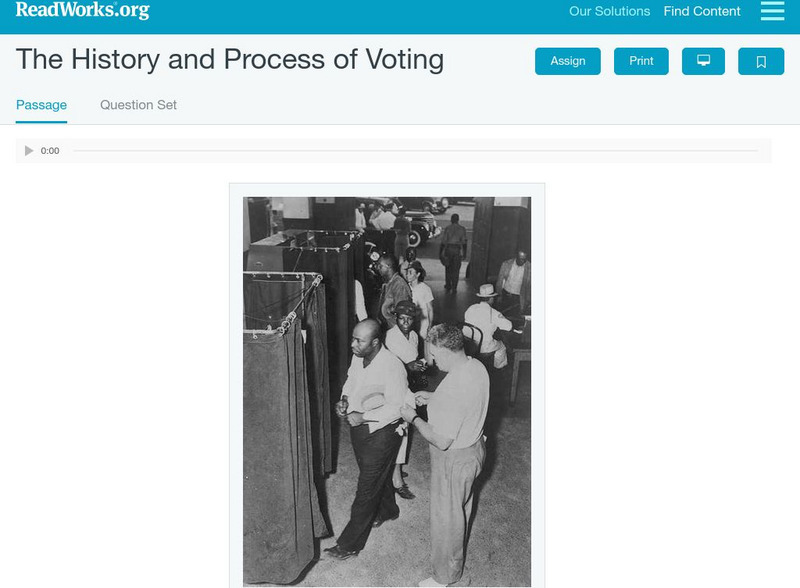
Read Works: The History and Process of Voting
[Free Registration/Login Required] This passage focuses on the American federal voting process including its history and how the process works. It is followed by a comprehension question set.
Other
History Today: Native Americans and the Federal Government
Andrew Boxer traces the origins of a historical issue still as controversial and relevant today as in past centuries. At the start of the twentieth century there were approximately 250,000 Native Americans in the USA - just 0.3 per cent...

A&E Television
History.com: Native Americans Weren't Guaranteed the Right to Vote in Every State Until 1962
Native people won citizenship in 1924, but the struggle for voting rights stretched on much longer. Native Americans couldn't be U.S. citizens when the country ratified its Constitution in 1788, and wouldn't win the right to be for 136...
Henry J. Sage
Sage American History: Keys to Understanding the Constitution
Article for students will help them to understand the important points of the Constitution. Discussion on the preamble, amendments, amendment process, voting, laws and the powers and limitations of government.
Henry J. Sage
Sage American History: American Economic Growth 1820 1860
Article outlines the boom in early American economic growth as a result of Northern industry in manufacturing, steam power, transportation and the role of government between 1820 and 1860.

Henry J. Sage
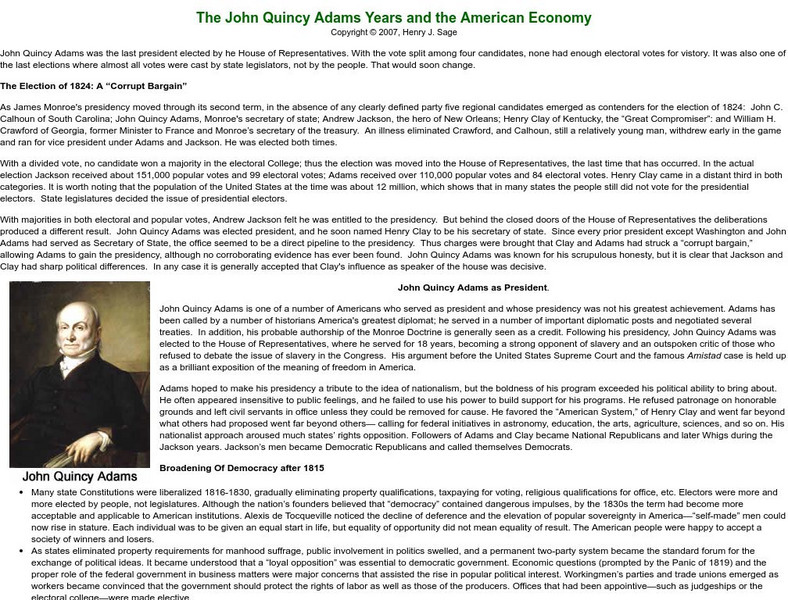
Sage American History: The John Quincy Adams Years and the American Economy
Article on American economic expansion during the presidency of John Quincy Adams. The author discusses the election of 1824, economic growth and the role of government.
Henry J. Sage
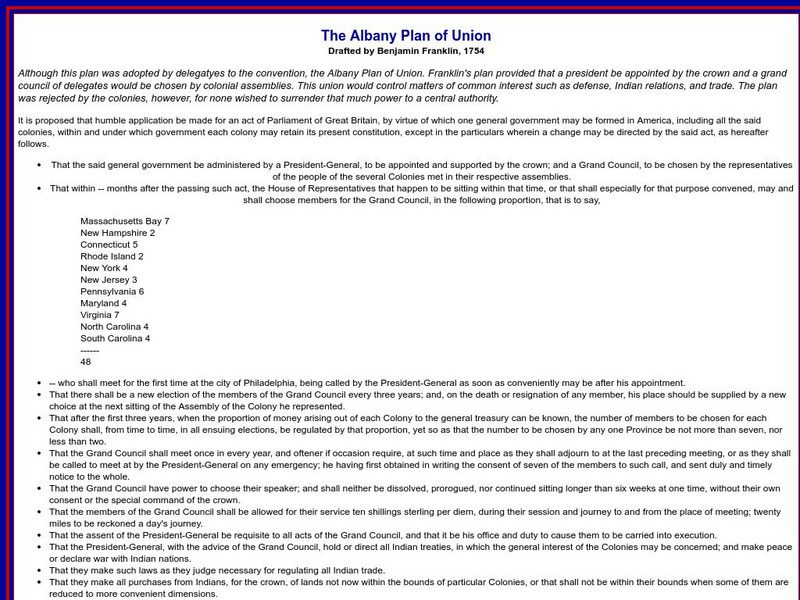
Sage American History: The Albany Plan of Union
Text of plan of governance proposed by Benjamin Franklin to the delegates of the convention in 1754.
A&E Television
History.com: Continental Congress
From 1774 to 1789, the Continental Congress served as the government of the 13 American colonies and later the United States. The First Continental Congress, which was comprised of delegates from the colonies, met in 1774 in reaction to...
A&E Television
History.com: History on a Plate: How Native American Diets Shifted After European Colonization
For centuries, Indigenous people's diets were totally based on what could be harvested locally. Then white settlers arrived from Europe. Native people pass down information - including food traditions - from one generation to the next...
A&E Television
History.com: What Did the Three Continental Congresses Do?
During the Revolutionary War, the Continental Congress became America's de facto government. Over a period of 15 years, from 1774 to 1789, the Continental Congress underwent a profound evolution. Starting out as a temporary group that...
A&E Television
History.com: History Shorts: The First Hispanic Congressman Fights for His Seat
Representation matters, and Romauldo Pacheco proved that as the first Hispanic Congressman in American history. [1:00]
A&E Television
History.com: How Aids Activists Used "Die Ins" to Demand Attention to the Growing Epidemic
As the AIDS crisis took hold in the 1980s, killing thousands of Americans and ravaging gay communities, the deadly epidemic went unaddressed by U.S. public health agencies -- and unacknowledged by President Ronald Reagan -- for years. In...
A&E Television
History.com: This Day in History: Stephen Austin Imprisoned by Mexicans
Read this short account of when the Mexican government imprisoned the Texas colonizer Stephen Austin in Mexico City.
A&E Television
History.com: How Interstate Highways Gutted Communities and Reinforced Segregation
America's interstate highway system cut through the heart of dozens of urban neighborhoods. Congress approved the Federal-Aid Highway Act of 1956, authorizing what was then the largest public works program in U.S. history. It promised to...

Khan Academy
Khan Academy: Us History: 1754 1800: The Constitutional Convention
Shortly after the end of the Revolutionary War, American leaders realized that the nation needed a new, stronger Constitution. But what would the new system of government look like?
A&E Television
History.com: 10 Things You May Not Know About the Nuremberg Trials
The post-World War II trials marked the first-ever prosecutions for genocide and crimes against humanity. Held directly after World War II, the Nuremberg Trials were a series of 13 military tribunals in which nearly 200 German...
US Department of State
U.s. Dept. Of State: u.s. Relations With Honduras
Read the State Department's perspective on the relationship between the Honduran and American governments. (February 2019)
Other
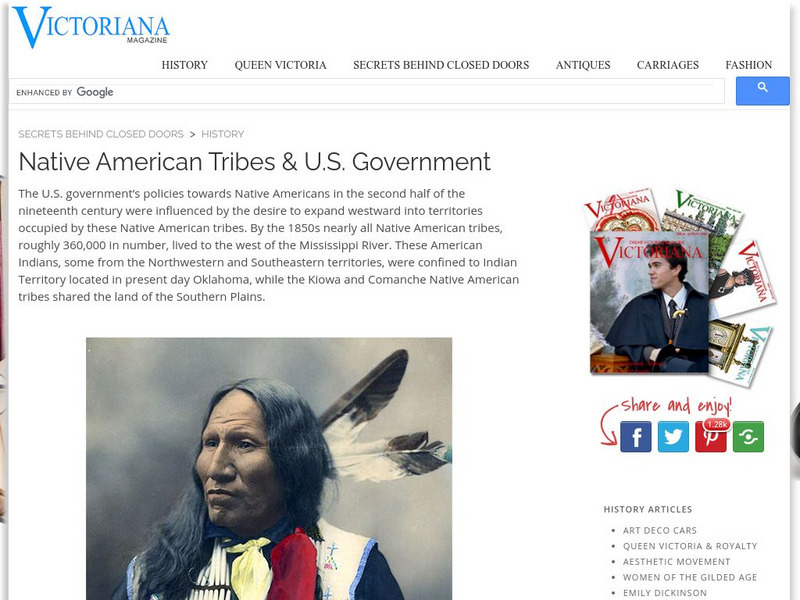
Victoriana Magazine: Native American Tribes and u.s Government
The U.S. government's policies towards Native Americans in the second half of the nineteenth century were influenced by the desire to expand westward into territories occupied by these Native American tribes. By the 1850s nearly all...
University of Groningen
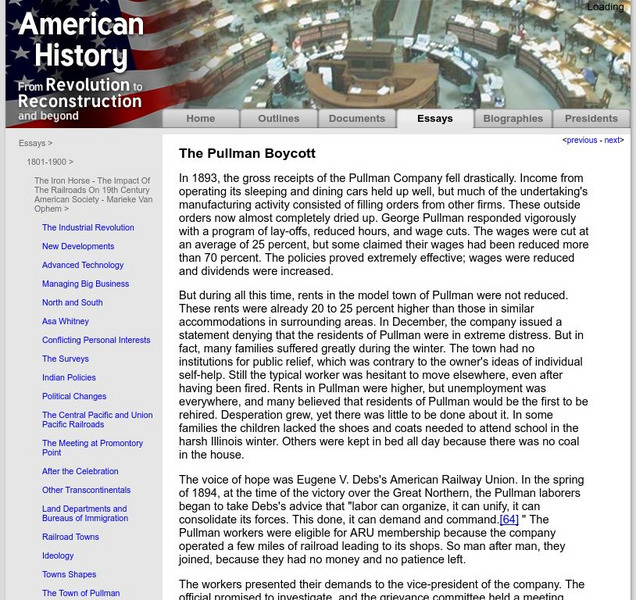
American History: Essays: The Iron Horse: The Pullman Boycott
From a lengthy essay on the history of the railroad in the United States. This section provides a good description of the events of 1893-1894, including the reasons for the boycott of Pullman cars, the people involved, and how the...
University of Groningen
American History: Essays: The Iron Horse: After the Celebration
From a lengthy essay on the history of the railroad in the United States. This section describes the financial woes of Union Pacific after the railroad was completed, and what the government did to recoup some of its loans. Also...
University of Groningen
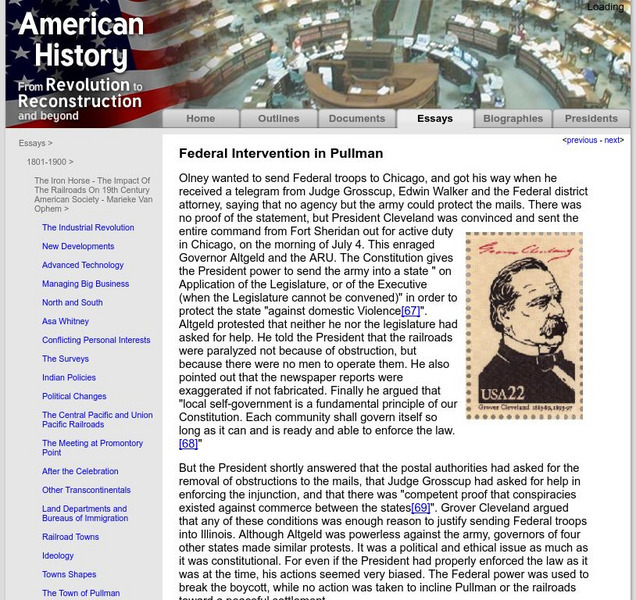
American History: Essays: The Iron Horse: Federal Intervention in Pullman
From a lengthy essay on the history of the railroad in the United States. This section describes President Grover Cleveland's role in sending federal troops to suppress the Pullman boycott, resulting in increased chaos from the...
University of Groningen
American History: Essays: Andrew Jackson and Bankwar: Removal of Deposits
After the re-election of Andrew Jackson in 1832, he began the process of having government deposits removed from the Second Bank.
Other
Federal Grantmaking: The Long View of History [Pdf]
Article discusses federal grant programs and policy. Requires Adobe Reader. [PDF]
CZBrats
The Americans in Panama: Taking the Canal Zone
This page is a chapter from the book entitled "The Americans in Panama." It provides information about the colonial period of Panamanian history. "Panama's relations with the parent government at Bogota, from 1821, the year of...