Hi, what do you want to do?






Curated OER
The Wildlife Web I
Learners explore the relationship between producers and consumers. In this activity, they trace the ingredients in the foods they eat to plants. Supplement to Natureworks episode from New Hampshire Public Television, but activities may...

Curated OER
Wildlife, Wolves, Endangered Species
Students use the Internet to research wildlife and conservation efforts. They examine pictures and graphics to research endangered species and humans role in their lives. They also use math to measure areas of habitats and add the number...

Curated OER
In Your Own Backyard
Students observe organisms in their habitat and record their observations. They then draw conclusions about the organism's habitat needs and food sources.

Curated OER
How the Environment Effects our Feelings
First graders compare images and discuss their feelings created by an artist's work. They explore the correlation between experiencing feelings in art and literature and feelings caused by changes in weather.

Curated OER
Loggerhead Nest Management Program
Learners identify the sea turtle management documentary and complete an activity for each slide. They plot the location of nests laid on the island they patrol and discuss their rationale for management decisions. Finally, students...

Curated OER
Reading Comprehension: Elephants
In this comprehension worksheet, students read a web site passage about elephants, then complete a set of 10 true/false questions.

Better Lesson
Better Lesson: Would Your Animal Survive Here? Day 1
Determine whether an animal can survive in a different environment than its own based on its inherited traits.

Better Lesson
Better Lesson: Survival of the Fittest
Fins, gills, claws, wings, each has a special purpose in helping an animal to survive. Students will look at how animals have different parts that help them to adapt to their habitat, and to avoid predators or capture prey. Included in...
Utah Education Network
Uen: Animal Adaptations
A multitude of activities provide help with understanding animal adaptations.

E-learning for Kids
E Learning for Kids: Norway Vikings: How Are Animals Adapted to Their Environment?
Learn about the patterns of adaptation in animals in response to changes to their environment. These can be in relation to things such as diet, survival against predators, or a change of habitat.

BBC
Bbc Schools: Ks2 Bitesize: Science: Living Things: Plant and Animal Habitats
Place the aliens in the habitats where they can survive the best. Following the activity, read more about plant and animal habitats, and then take a quick quiz to check for understanding.
Encyclopedia of Earth
Encyclopedia of Earth: Adaptations of Desert Amphibians and Reptiles
The evolution of amphibians from prehistoric days is described, and the challenges they face when living in a desert environment, of which the ability to reproduce is the greatest. How they manage to survive in a desert is explained in...
McGraw Hill
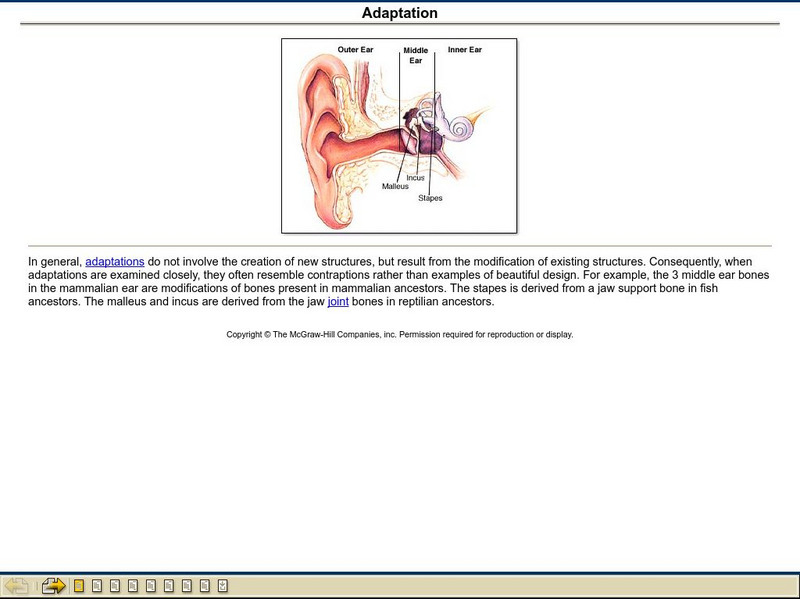
The Mc Graw Hill Companies, Inc.: Adaptation
Evolution, natural selection, sexual selection, coevolution, convergent evolution, mimicry, and coloration, are the topics examined in this thorough site. Assess your comprehension of the material presented by delving into the learning...
Concord Consortium
Concord Consortium: Stem Resources: Variations and Adaptations
Experiment with variations in grass to see which size grows best with different amounts of water. Understand that grass that can live in different levels and change to its environment has a better chance of surviving. Also, experiment...

Alabama Learning Exchange
Alex: Surviving in the World!
After learning about the survival traits of the chameleon, students will work in groups to research the survival traits of other animals on the Internet and will create a slide show using the collected information to share with the...
CPALMS
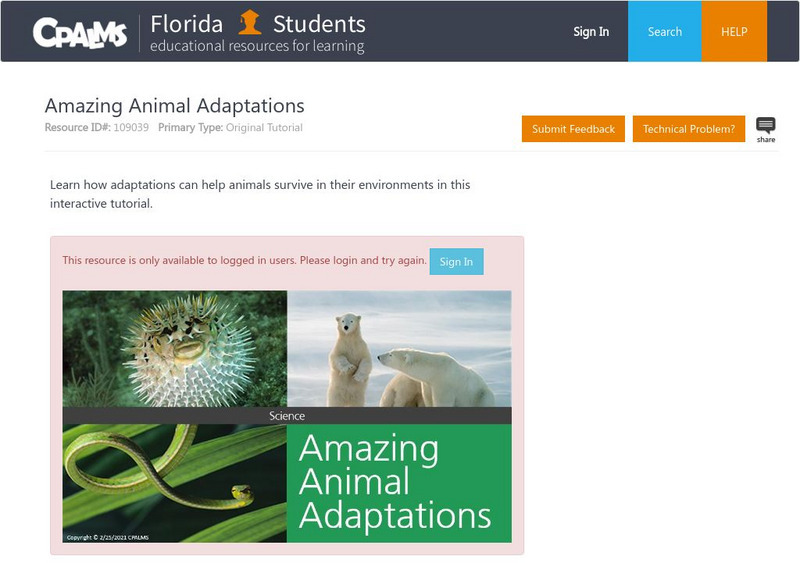
Florida State University Cpalms: Florida Students: Amazing Animal Adaptations
Explore various characteristics and adaptations that help organisms survive in different environments.
Encyclopedia of Earth
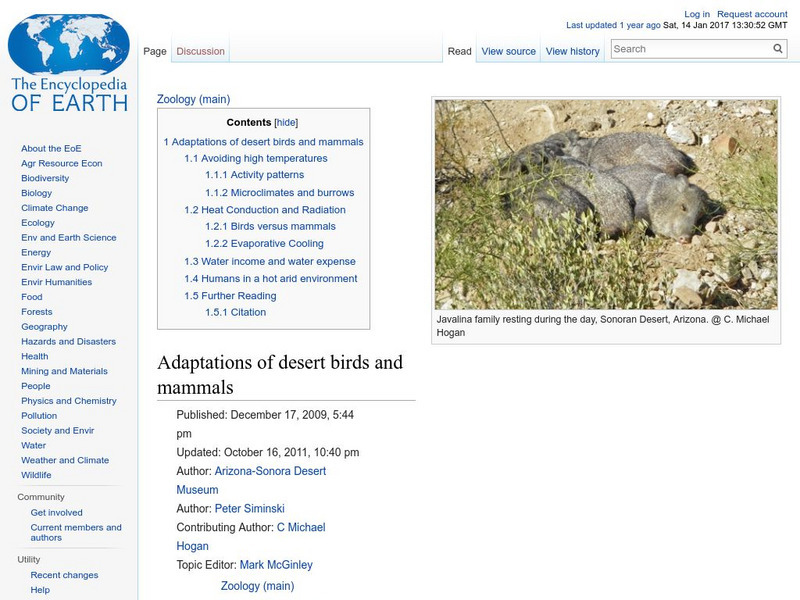
Encyclopedia of Earth: Adaptations of Desert Birds and Mammals
The ways in which animals have adapted so as to survive in a desert environment are described in this article. Mechanisms that humans have to help them cool themselves in a desert are also explained. (Published: December 17, 2009)
TeachEngineering
Teach Engineering: Arctic Animal Robot
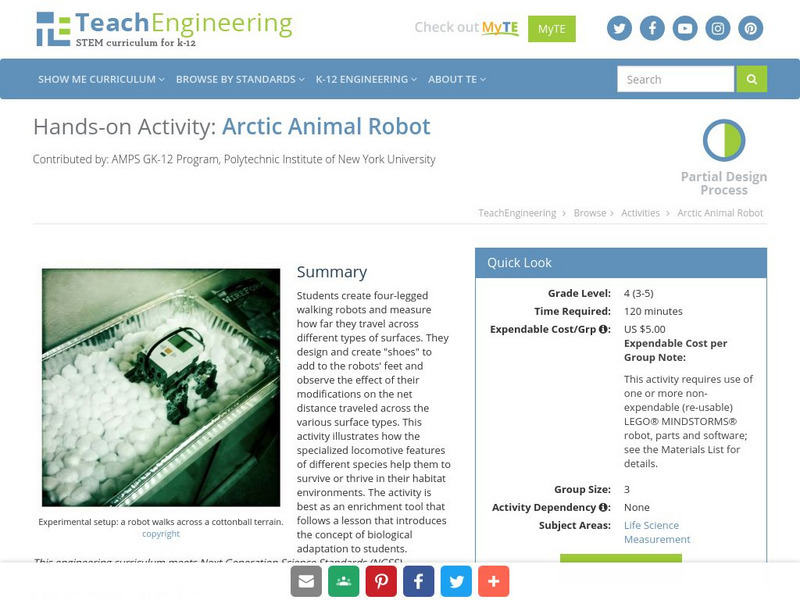
Students create four-legged walking robots and measure how far they travel across different types of surfaces. They design and create "shoes" to add to the robots' feet and observe the effect of their modifications on the net distance...
BioMan Biology
Bio Man Biology: Snurfle Islands
Create a Snurfle and see whether it can survive in different environments. As you play the game, you will learn about natural selection and animal adaptations. At the end of the game, try the multiple-choice quiz to check your...

Alabama Learning Exchange
Alex: Now You See Me, Now You Don't!
An animal's physical characteristics, such as its body color, may give it a better chance of survival. For example, the body colors of many animals blend with their background. In this investigation, students will see that body color may...
Center for Literacy and Disability Studies, University of North Carolina at Chapel Hill
Tar Heel Reeder: Animal Adaptations
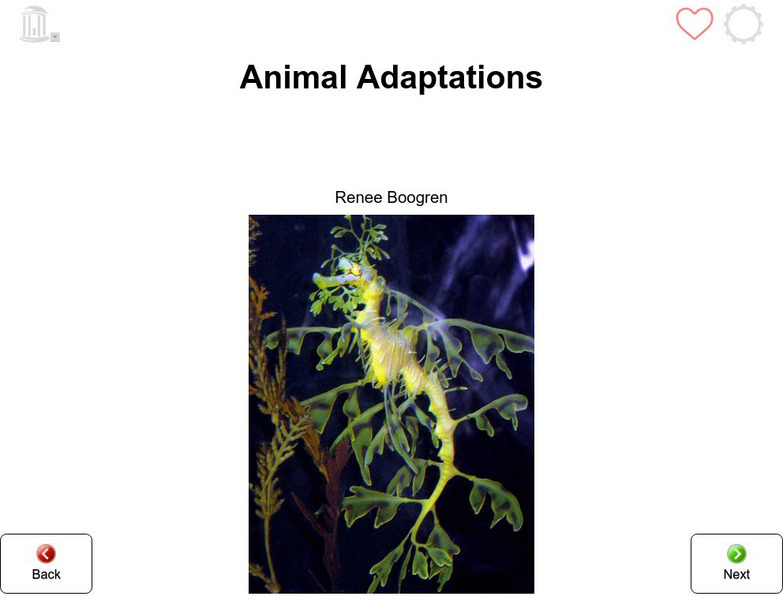
Read this ebook to view examples of structural and behavioral adaptations that help animals survive.

Annenberg Foundation
Annenberg Learner: Journey North: Adaptations: Fit for Survival
This lesson plan will help students explore adaptation, especially as it relates to migration. Students will come to realize that adaptations can be behavioral as well as physical. Students are assigned a particular animal to investigate...
Online Learning Haven
Adaptations: Sea Turtles
An interesting that examines the structural and behavioral adaptations of the sea turtle. The problems of survival faced by the hatchlings is also delved into in this site.
BBC
Bbc: Earth: Tardigrades Return From the Dead
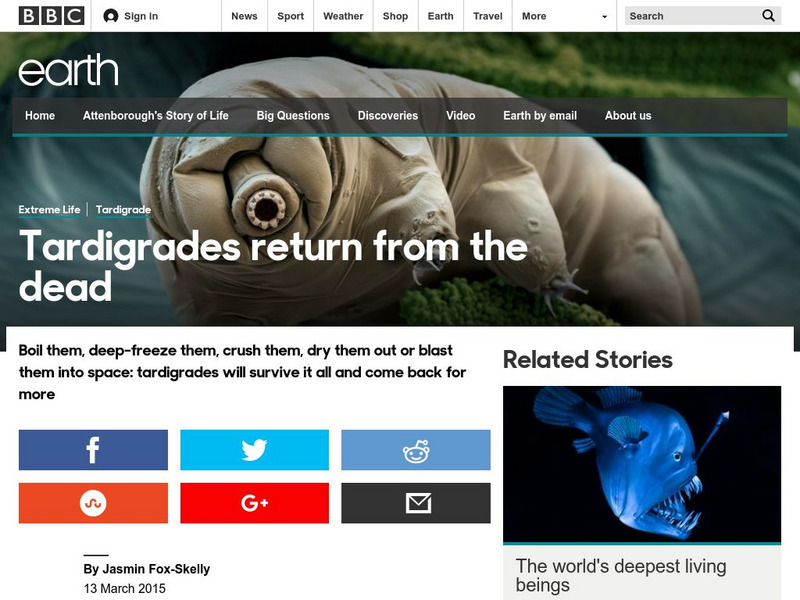
Tardigrades are ancient, fascinating creatures that can survive conditions that would kill most life forms, including extreme heat and absolute zero, extreme pressure and a vacuum, and deadly radiation. They can even survive being...