Hi, what do you want to do?






Curated OER
World of Protists
Students observe a jar of pond water and predict how much life they think exists in the jar and watch a "Bill Nye: The Science Guy" video regarding protists. They participate in an online virtual pond dip where they begin to familiarize...

Curated OER
Intelligent Design Fumbles; Evolution Still Going Strong
Pupils examine how all life is related and how species are classified. They also discover how traits are passed down from one person to the next. They examine the evolution the arthropod has going through.

Curated OER
Classification Number Two
A three-page quiz assessing budding biologists' understanding of classification. Middle-level learners may need a little additional time on this, but should be able to handle the concepts with ease.

Curated OER
Zoology Word Search Puzzle
In this science learning exercise, students look for the words that are related to the concept of zoology that is reviewed in the sheet. They also acquire new vocabulary.
CK-12 Foundation
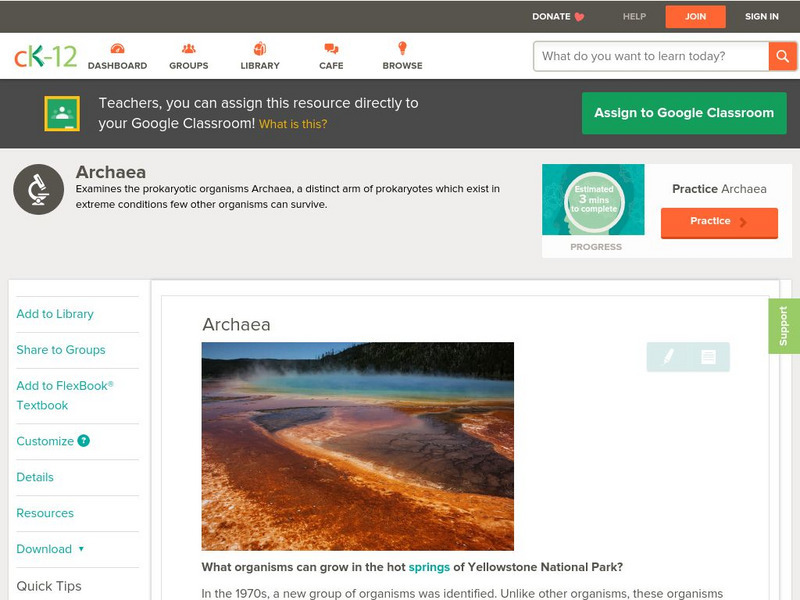
Ck 12: Life Science: Archaea
[Free Registration/Login may be required to access all resource tools.] For many years, archaea were classified as bacteria. Like the bacteria, archaea lacked a nucleus and membrane-bound organelles and, therefore, were prokaryotic...

BiologyWise
Biology Wise: Archaebacteria and Eubacteria Difference
Explains what archaebacteria and eubacteria are and presents a chart showing how they differ in structure and characteristics.

University of California
Ucmp: Introduction to the Archaea
Berkley offers an introduction to archaebacteria--ancient bacteria--including the history of the topic, scientific findings, and where to find archaeans. Includes images and links.

Khan Academy
Khan Academy: Prokaryote Classification and Diversity
Different groups of prokaryotes. Evolutionary relationships of bacteria and archaea. Extremophiles.

Khan Academy
Khan Academy: Prokaryote Reproduction and Biotechnology
Learn how prokaryotes reproduce by binary fission, and find out the use of E. coli bacteria in molecular biology.
Estrella Mountain Community College
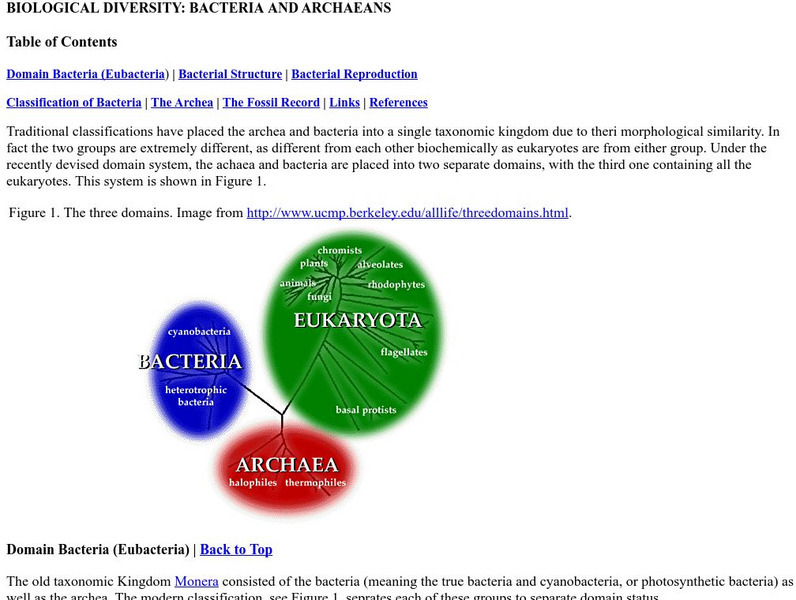
Online Biology Book: Biological Diversity: Bacteria and Archaeans
In this online biology textbook, learn about the two prokaryotic domains of life, which include eubacteria and acrhaebacteria.
CK-12 Foundation
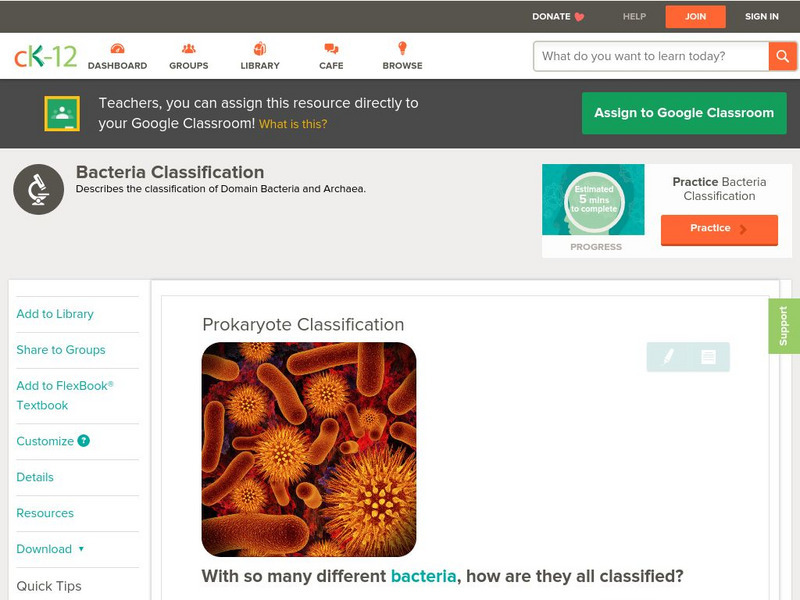
Ck 12: Biology: Prokaryote Classification
[Free Registration/Login may be required to access all resource tools.] Overview of classifying prokaryotes and prokaryotic domains.
BiologyWise
Biology Wise: Characteristics of Archaebacteria
Explains what archaebacteria are, the different phyla, and the characteristics of archaebacteria.
Encyclopedia of Earth
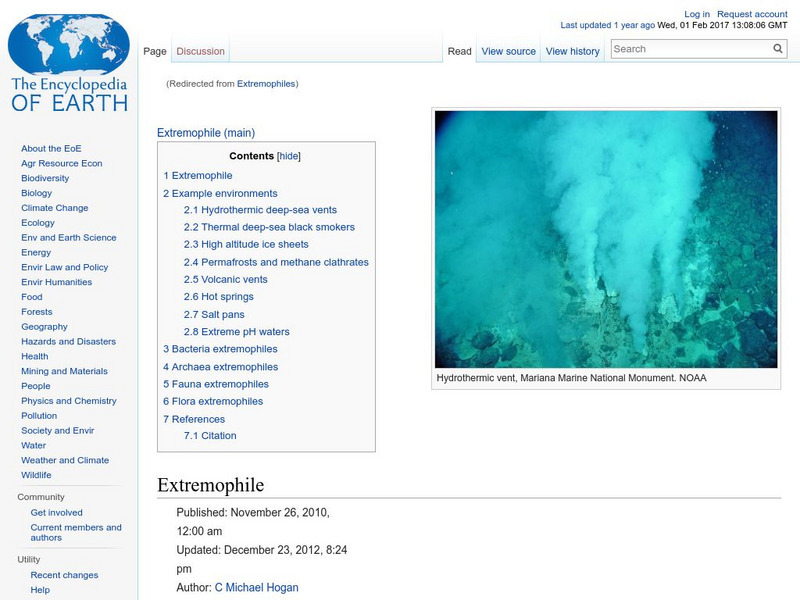
Encyclopedia of Earth: Evolutionary Biology: Extremophile
Article describing some of the extreme environments where extremophile organisms can live, and giving examples from bacteria, archaea, flora, and fauna. (Published: November 26, 2010)
CK-12 Foundation
Ck 12: Episd: Prokaryote Classification
[Free Registration/Login may be required to access all resource tools.] Students will understand where bacteria live, the different types of prokaryotes, and extremephilic bacteria.

Tree of Life Project
The Tree of Life Web Project
The Tree of Life is a multi-authored, Internet distributed project containing information about phylogeny and biodiversity. The Tree of Life can be used to locate information about a particular group of organisms through their taxonomy.
CK-12 Foundation
Ck 12: Life Science: Domains of Life
[Free Registration/Login may be required to access all resource tools.] Humans are in the same domain as trees and algae. What could they possibly have in common? It is the location of their DNA inside their cells. Their cells all have a...
Khan Academy
Khan Academy: Prokaryote Interactions & Ecology
Learn about cooperation and "multicellularity" in prokaryotes including mutualisms, commensalisms, parasitisms. Also find out the role of prokaryotes in the carbon and nitrogen cycles.
Annenberg Foundation
Annenberg Learner: Rediscovering Biology: Unit 4: Microbial Diversity
A complete learning module on microbial diversity that includes a downloadable textbook chapter, teacher guide, and lesson activities. The chapter can also be viewed online. In addition, there are animations, images, a video, and...

PBS
Nova: The Lives of Extremophiles
An interview with a microbiologist who studies bacteria that decompose hydrogen sulfide gas and other noxious chemicals. The interview focuses on her research and her career.
Khan Academy
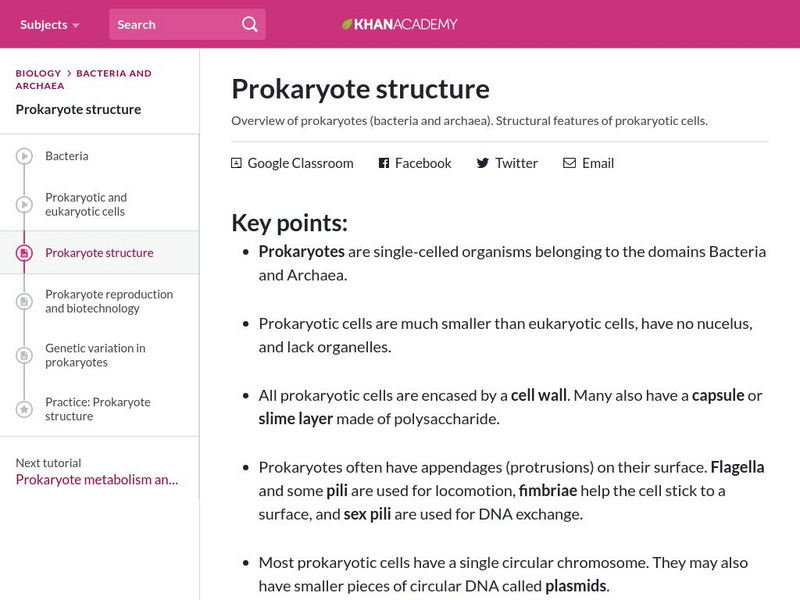
Khan Academy: Prokaryote Structure
This tutorial gives an overview of prokaryotes (bacteria and archaea) along with an explanation of structural features of prokaryotic cells.

Open Curriculum
Open Curriculum: New Kingdoms
Between 1866 and 1977, a total of four new kingdoms were added to the original plant and animal kingdoms identified by Linnaeus. The new kingdoms include Protista (protists), Fungi, Monera (eubacteria), and Archaea (archaebacteria)....
CK-12 Foundation
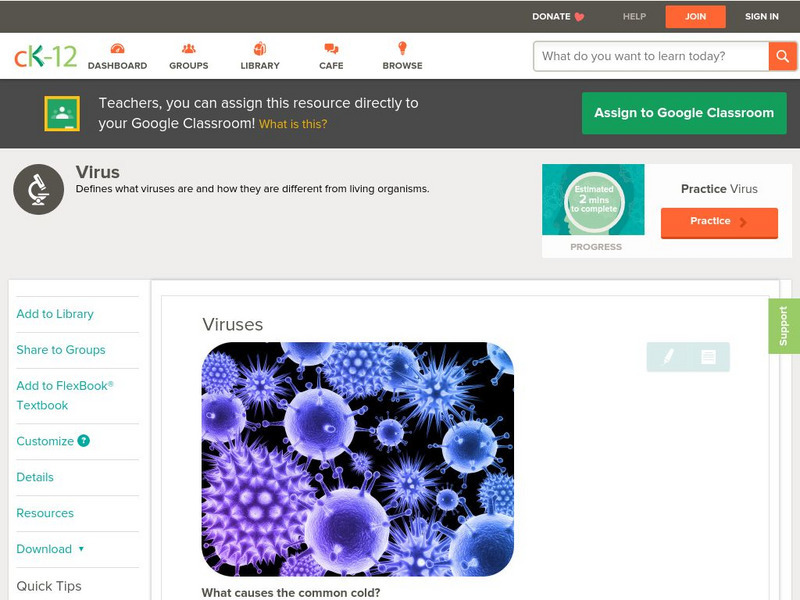
Ck 12: Life Science: Viruses
[Free Registration/Login may be required to access all resource tools.] We have all heard of viruses. The flu, the common cold, and many other diseases are caused by viruses. But what is a virus? Do you think viruses are living? Which...
BiologyWise
Biology Wise: Three Domains of Life
Describes the characteristics of Archaea, Bacteria, and Eukarya, the three domains of life.
University of California
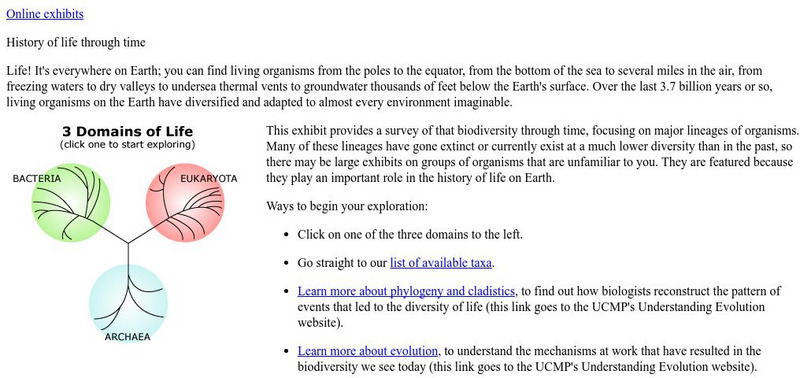
Ucmp: The Biosphere: Life on Earth
Learn about different forms of life that coexist with us on Earth. This Berkeley article provides links to brief write-ups on the three domains of living organisms: Eukaryota, Bacteria, and Archaea.