Hi, what do you want to do?





CK-12 Foundation
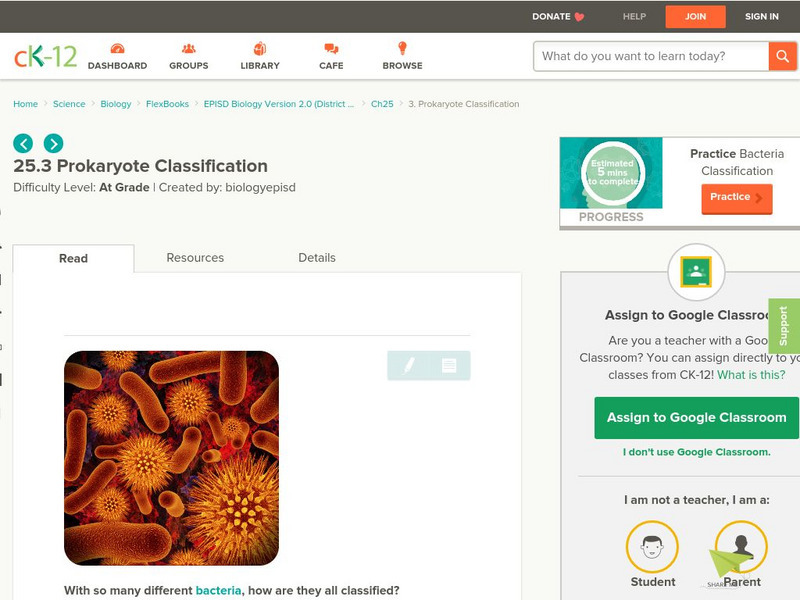
Ck 12: Episd: Prokaryote Classification
[Free Registration/Login may be required to access all resource tools.] Students will understand where bacteria live, the different types of prokaryotes, and extremephilic bacteria.
Untamed Science
Untamed Science: Biology: Evolution: History of Life: Origins
Learn about the scientific hypotheses of the origin of life on Earth. [5:55]

Open Curriculum
Open Curriculum: New Kingdoms
Between 1866 and 1977, a total of four new kingdoms were added to the original plant and animal kingdoms identified by Linnaeus. The new kingdoms include Protista (protists), Fungi, Monera (eubacteria), and Archaea (archaebacteria)....
CK-12 Foundation
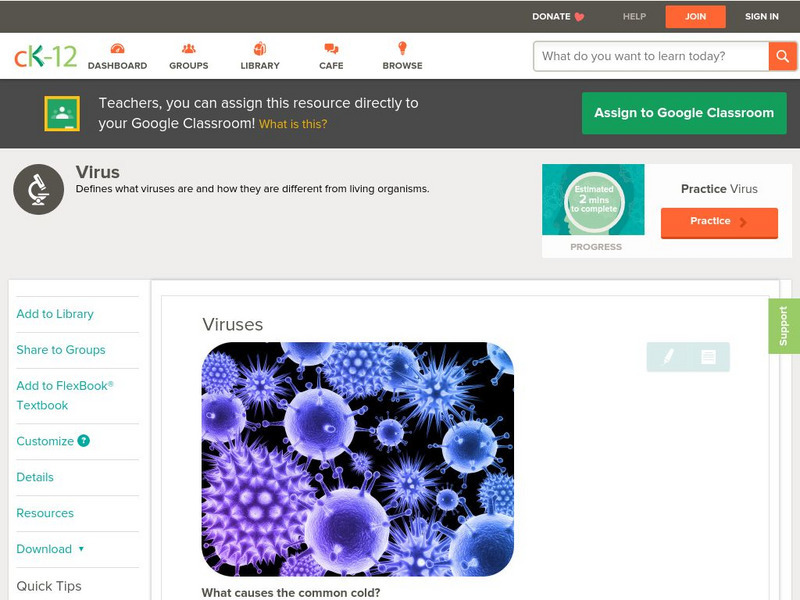
Ck 12: Life Science: Viruses
[Free Registration/Login may be required to access all resource tools.] We have all heard of viruses. The flu, the common cold, and many other diseases are caused by viruses. But what is a virus? Do you think viruses are living? Which...

Tree of Life Project
The Tree of Life Web Project
The Tree of Life is a multi-authored, Internet distributed project containing information about phylogeny and biodiversity. The Tree of Life can be used to locate information about a particular group of organisms through their taxonomy.
Annenberg Foundation
Annenberg Learner: Rediscovering Biology: Unit 4: Microbial Diversity
A complete learning module on microbial diversity that includes a downloadable textbook chapter, teacher guide, and lesson activities. The chapter can also be viewed online. In addition, there are animations, images, a video, and...
City University of New York
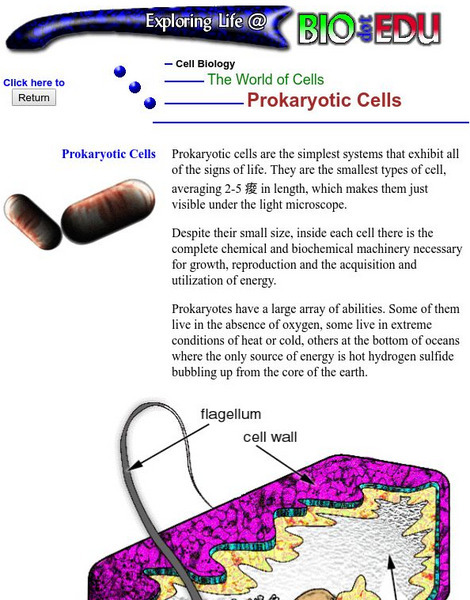
Brooklyn College: The World of Cells: Prokaryotic Cells
A very nice introduction to this group organized in a concise, easy to follow format.
![Panhandle Area Educational Consortium: The Six Kingdoms of Life [Pdf] Handout](https://static.lp.lexp.cloud/images/attachment_defaults/resource/large/FPO-knovation.png "Panhandle Area Educational Consortium: The Six Kingdoms of Life [Pdf] Handout")
Other
Panhandle Area Educational Consortium: The Six Kingdoms of Life [Pdf]
Scientists look at the evolutionary history of organisms to divide them into kingdoms. For awhile, there has been 5 kingdoms, but many scientist are now using 6 kingdoms.
University of California
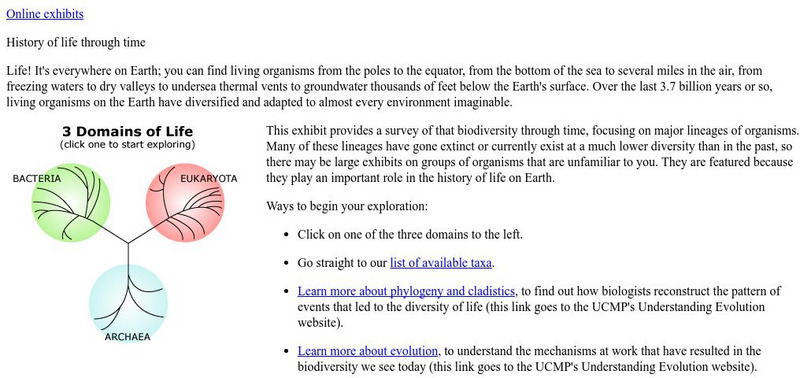
Ucmp: The Biosphere: Life on Earth
Learn about different forms of life that coexist with us on Earth. This Berkeley article provides links to brief write-ups on the three domains of living organisms: Eukaryota, Bacteria, and Archaea.
Other
Microbe World: Experiments
In this hands on site, students will have the opportunity to be amateur microbiologists by performing a number of experiments. Supplies needed can found in the home or at a nearby store.
University of Utah
University of Utah: Genetic Science Learning Center: The Evolution of the Cell
Learn about the endosymbiotic theory. This theory explains the evolution of cells from a mitochondria and chloroplast working together in a symbiotic relationship to the current cell structure.

Tom Richey
Slide Share: Overview of Six Kingdoms
This slideshow provides an overview of the six kingdoms.
Curated OER
Secondary Science Program: The Six Kingdoms
A short overview of the six kingdoms in our scientific classification system: Plants, Animals, Protists, Fungi, Archaebacteria, and Eubacteria. A good explanation of how organisms are placed in their particular kingdom.
Curated OER
Secondary Science Program: The Six Kingdoms
A short overview of the six kingdoms in our scientific classification system: Plants, Animals, Protists, Fungi, Archaebacteria, and Eubacteria. A good explanation of how organisms are placed in their particular kingdom.
Curated OER
Secondary Science Program: The Six Kingdoms
A short overview of the six kingdoms in our scientific classification system: Plants, Animals, Protists, Fungi, Archaebacteria, and Eubacteria. A good explanation of how organisms are placed in their particular kingdom.
Curated OER
Secondary Science Program: The Six Kingdoms
A short overview of the six kingdoms in our scientific classification system: Plants, Animals, Protists, Fungi, Archaebacteria, and Eubacteria. A good explanation of how organisms are placed in their particular kingdom.
University of Arizona
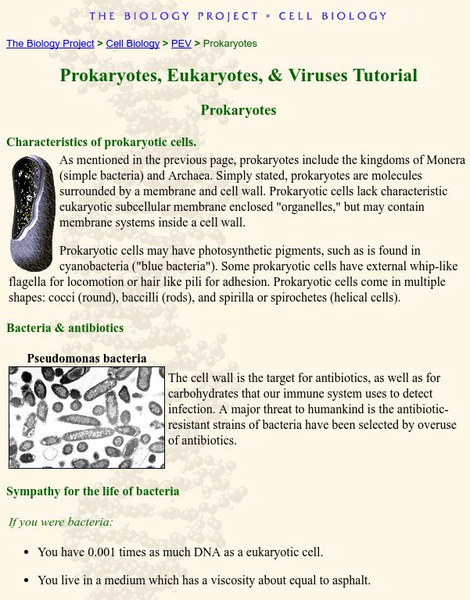
The Biology Project: Prokaryotes
A brief overview of the prokaryotes. The resource contains some interesting facts that will help you understand the great contrast that exists in the prokaryotic way of life.

Khan Academy
Khan Academy: Prokaryote Reproduction and Biotechnology
Learn how prokaryotes reproduce by binary fission, and find out the use of E. coli bacteria in molecular biology.
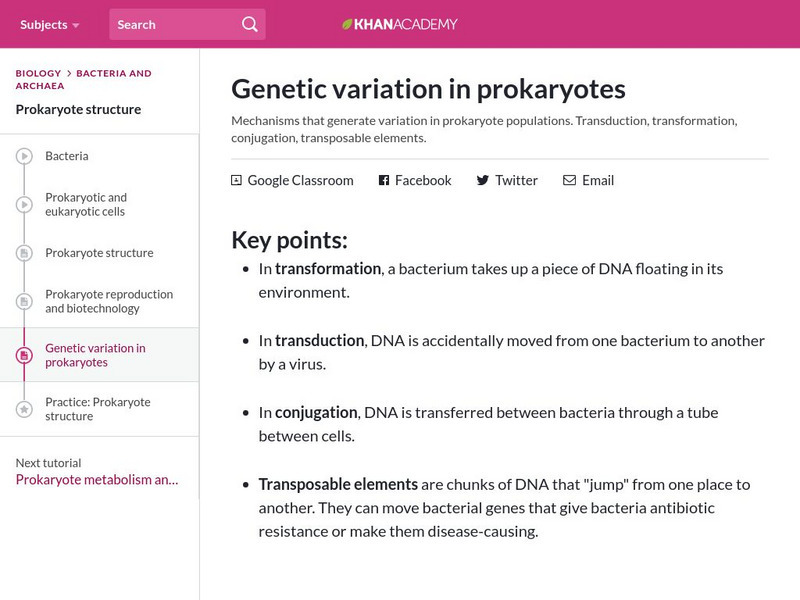
Khan Academy
Khan Academy: Genetic Variation in Prokaryotes
Study the mechanisms that generate variation in prokaryote populations. Also learn about transduction, transformation, conjugation, as well as transposable elements.
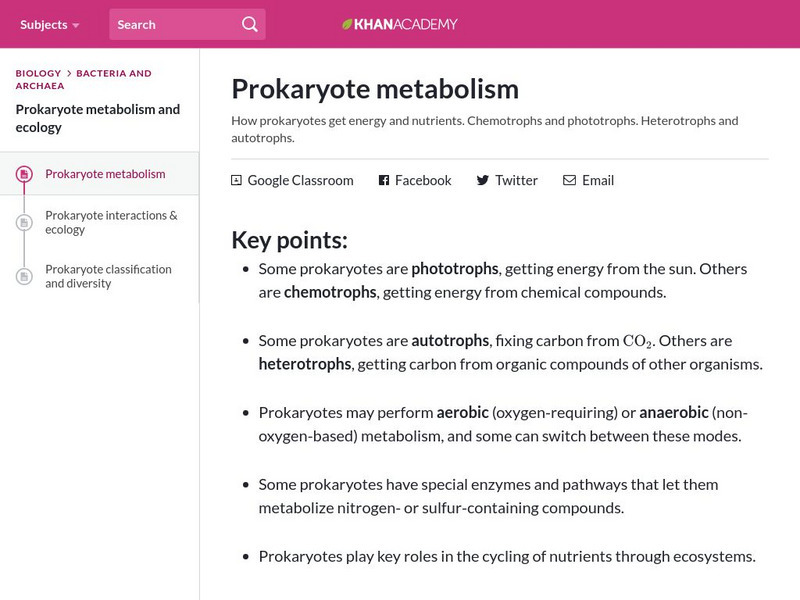
Khan Academy
Khan Academy: Prokaryote Metabolism
Learn how prokaryotes get energy and nutrients, and find out the difference among chemotrophs, phototrophs, heterotrophs and autotrophs.
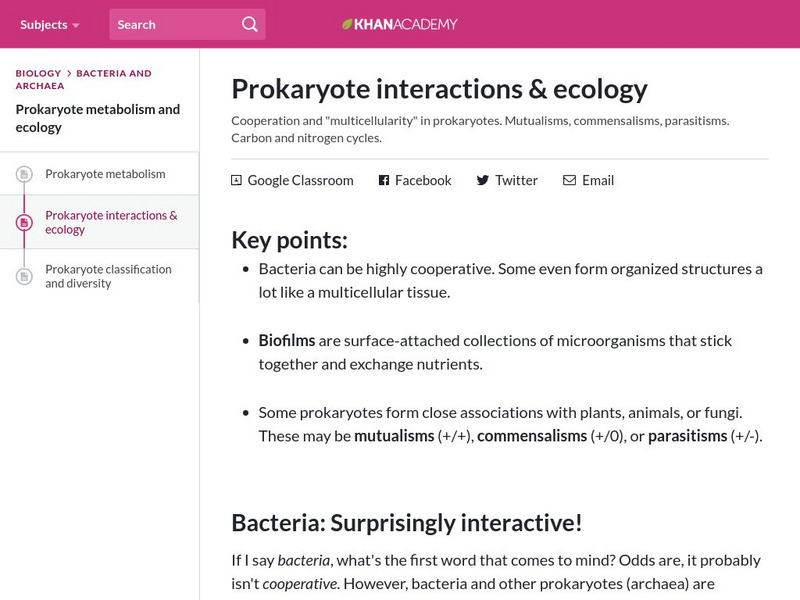
Khan Academy
Khan Academy: Prokaryote Interactions & Ecology
Learn about cooperation and "multicellularity" in prokaryotes including mutualisms, commensalisms, parasitisms. Also find out the role of prokaryotes in the carbon and nitrogen cycles.