Hi, what do you want to do?






Oswego City School District
Regents Exam Prep Center: Area of Polygons and Circles
How would you find the area of a polygon or circle? Explore this concept with engaging activities at this test prep site. Here you will find detailed problem solving strategies with accompanying visuals, a reference table with formulas,...
Texas Instruments
Texas Instruments: Give Me a Hand or Leaf Me Alone
In this activity, students' find the surface area of geometric shapes cut from card paper and relate it to its mass. They use this data to find the surface area of irregularly shaped objects.

Oswego City School District
Regents Exam Prep Center: Area of Polygons and Circles
A lesson focusing on the area of polygons and the circumference of circles. Engaging, interactive practice worksheet, lesson plan, and related classroom activity complete this lesson.

Alabama Learning Exchange
Alex: Shape Makers
For this Five E's AMSTI lesson, students discover relationships between shapes. Students discover multiple ways to combine shapes to fill the area of a given shape using real and virtual pattern blocks, and share their solutions with...

OER Commons
Oer Commons: Polygons
Seventh graders find the area of regular polygons, recalling what they already know about the area of geometric shapes and generalizing a formula for any regular polygon.
Government of Alberta
Learn Alberta: Math Interactives: Exploring Surface Area, Volume, and Nets
Investigate the concepts of area, volume, 3D shapes, and nets using this interactive Learn Alberta math. The solid shapes focused on this exploration include rectangular and triangular prisms, rectangular and triangular pyramids,...
Illustrative Mathematics
Illustrative Mathematics: G Mg How Many Leaves on a Tree? (Version 2)
In this task, students must estimate the number of leaves on a large tree, taking into account various complex factors such as the area shaded by the tree, the area of irregularly shaped leaves, the uneven distribution of leaves, the...

Illustrative Mathematics
Illustrative Mathematics: G Mg Hexagonal Pattern of Beehives
Beehives are made of walls, each of the same size, enclosing small hexagonal cells where honey and pollen are stored and bees are raised. This problem examines some of the mathematical advantages of the hexagonal tiling in a beehive....
The Math League
The Math League: Surface Area
This tutorial explains the concept of surface area, and then goes through multiple shapes offering the specific surface area formula for each one.

Texas A&M University
Wtamu Virtual Math Lab: Beginning Algebra: Formulas
This tutorial will show you how using formulas can help you solve problems. Include formulas for various geometric shapes and steps showing how to use them.
Illustrative Mathematics
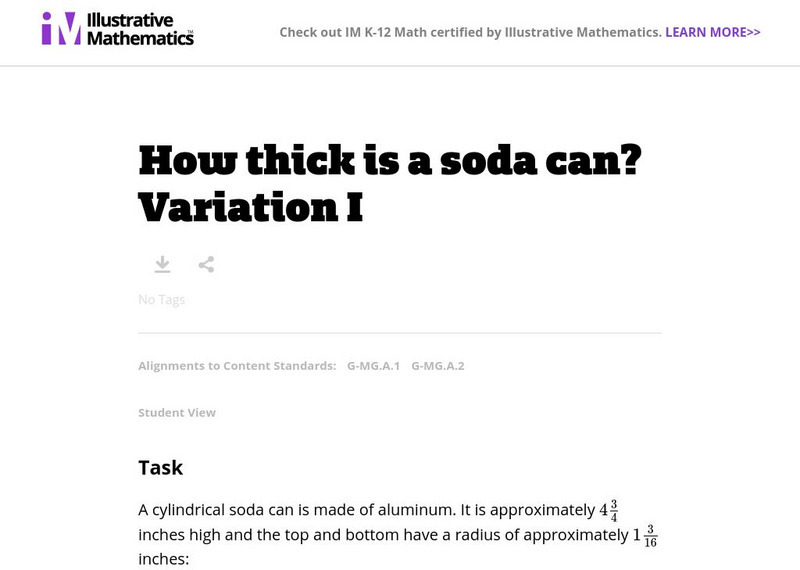
Illustrative Mathematics: G Mg How Thick Is a Soda Can? Variation I
In this task, students are given the dimensions of a soda can and are asked to estimate its thickness. They must first find the surface area and the volume of aluminum. Aligns with G-MG.A.1 and G-MG.A.2.

National Council of Teachers of Mathematics
The Math Forum: Building a Pyramid
This Math Forum instructional activity gives instructions on how to build a paper pyramid. Bonuses included finding the surface area and volume of the pyramid.

PBS
Pbs Parents: Early Math
Help nurture the development of early math skills -- from infant to grade 2. Site provide information about math literacy and developmental stages. For each age range, you will find several online games and printable activities for core...
abcteach
Abcteach: Geometry
[Free Registration/Login Required] This resource has an assortment of teacher-created geometry activities for elementary and primary students. Printable two-dimensional shapes, area and perimeter worksheets, board games, rules and...
Texas Instruments
Texas Instruments: What Goes Around Comes Around but Can You Measure It?
In this activity, students find the area and the perimeter for several geometric shapes. They also determine the surface area and volume of spheres.
Illustrative Mathematics
Illustrative Mathematics: G Mg How Many Cells Are in the Human Body?
About how many cells are in the human body? The purpose of this task is for learners to apply the concepts of mass, volume, and density in a real-world context. Aligns with G-MG.A.2.

Rice University
Rice University: Cynthia Lanius: Geometry Online
This is a site for geometry lovers. Chock-full of puzzles, games, interesting geometry facts, and online activities.
Illustrative Mathematics
Illustrative Mathematics: G Mg How Many Leaves on a Tree?
This is a mathematical modeling task aimed at making a reasonable estimate for something which is too large to count accurately, the number of leaves on a tree, taking into account the tree size and the density of the leaves. Aligns with...

Alabama Learning Exchange
Alex: Geometric Quilts
Students will use a square to investigate other polygonal shapes that can be formed. Students will work with these polygons to make designs that will later constitute cooperatively designed quilts. The quilts will be made by translating,...
TeachEngineering
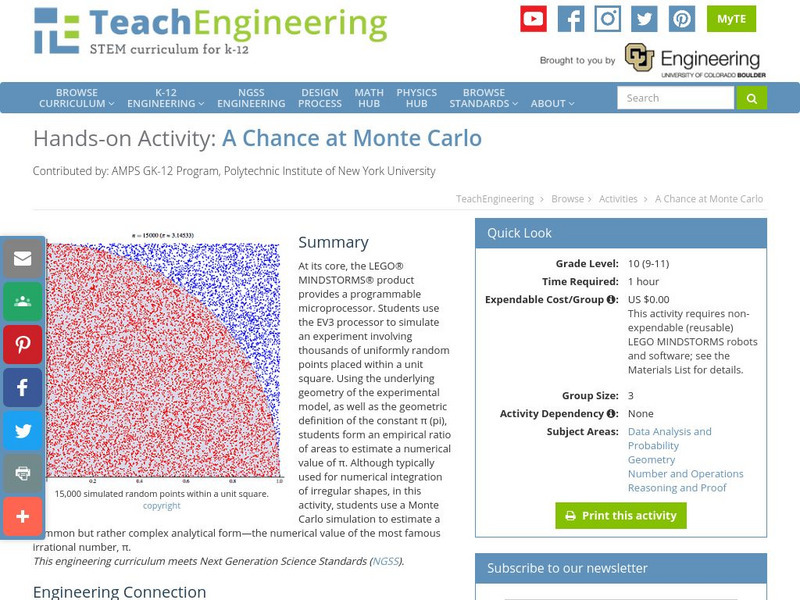
Teach Engineering: A Chance at Monte Carlo
At its core, the LEGO MINDSTORMS product provides a programmable microprocessor. Students use the EV3 processor to simulate an experiment involving thousands of uniformly random points placed within a unit square. Using the underlying...
National Council of Teachers of Mathematics
The Math Forum: The Cylinder Problem: Middle School Lesson
This lesson offers an interesting, hands-on experience for middle school students studying cylinders. Students will create cylinders, and measure and compare their volumes.
Better Lesson
Better Lesson: Filling Shadows With More and Less
First graders use their understanding of composing and decomposing shapes to cover a given area. Today's instructional activity is bringing together many of the geometric skills from previous lessons.
Illustrative Mathematics
Illustrative Mathematics: G Mg How Thick Is a Soda Can? Variation Ii
In this task, students are given an aluminum soda can and are simply asked how they could determine how thick the can is. Aligns with G-MG.A.1 and G-MG.A.2.