Hi, what do you want to do?






Curated OER
Delta, Delta, Delta
Students construct equilateral triangles and a 'laser' triangle. In this reflection lesson students build a retro-reflector using mirrors.
Georgia Department of Education
Ga Virtual Learning: Astronomy: The Earth
In this interactive tutorial students will learn what causes the seasons, diurnal cycles and how the constellations move through the sky. Learn we are able to see other planets and how astronomical events affected life on the Earth.

NASA
Nasa: Astronomy Picture of the Day: Crab Nebula and Geminga in Gamma Rays
Explains that pulsars would be the brightest objects in the sky if we could see gamma-rays.

NASA
Nasa: Astronomy Picture of the Day: Gamma Ray Quasar
A photograph and description of quasar 3C279 viewed in gamma-rays. It was unexpectedly discovered and was one of the brightest objects in the gamma-ray sky until it suddenly faded.
NASA
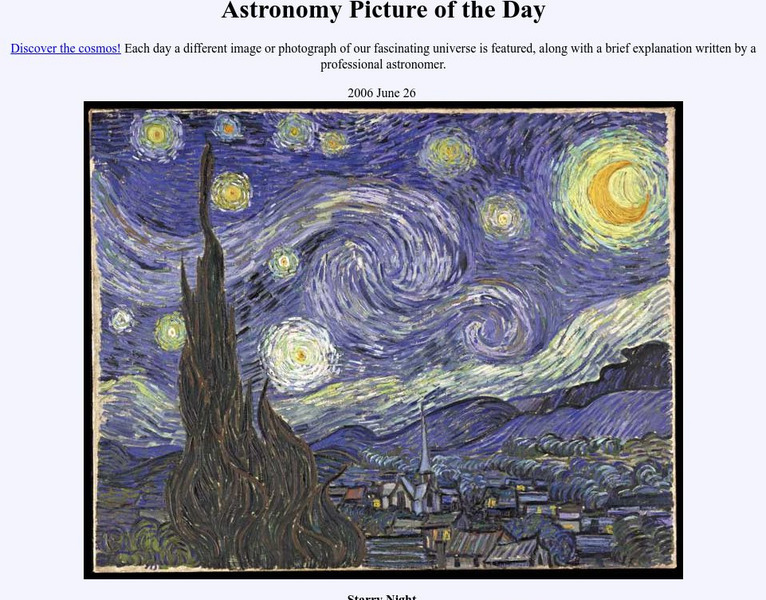
Nasa: Astronomy Picture of the Day: "The Starry Night" by Vincent Van Gogh
Discover why the scientists at NASA awarded Van Gogh's famous painting of the night sky, "The Starry Night," a spot on its astronomy-picture-of-the-day site.
Other
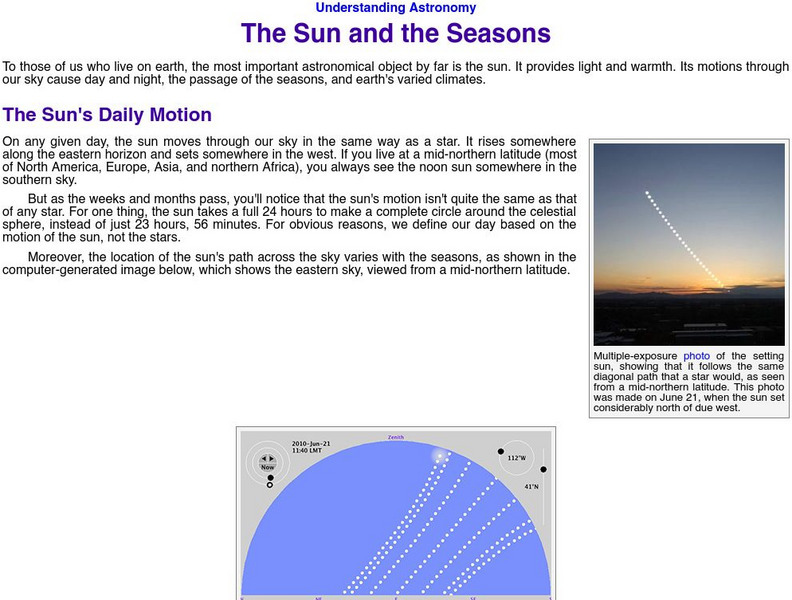
Weber State University: The Sun and the Seasons
To those of us who live on earth, the most important astronomical object by far is the sun. This article explains how the motion of the sun through our sky cause day and night, the passage of the seasons, and earth's varied climates.
NASA
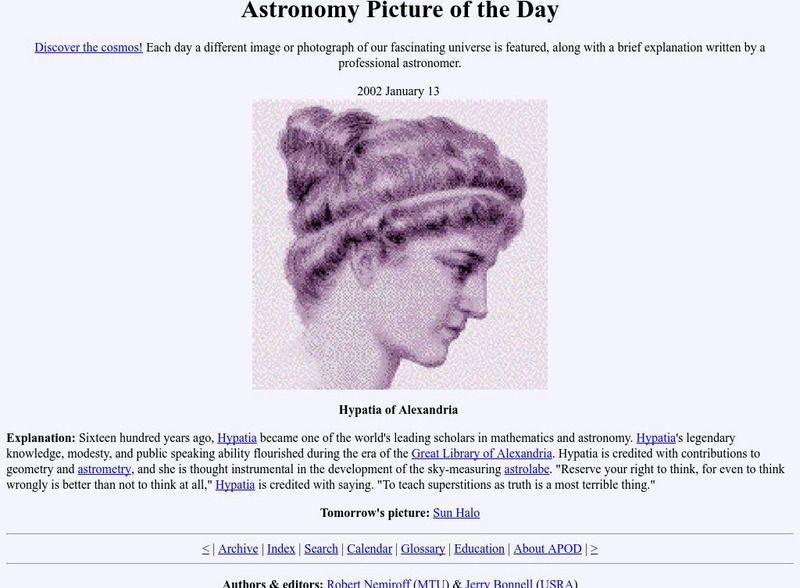
Nasa: Astronomy Picture of the Day: Hypatia
Learn more about Hypatia when you check out this resource. This site features a picture and a brief synopsis of this famous scientist.

PBS
Pbs Learning Media: The Pattern of the Moon's Changing Appearance
Students use an interactive model to gather evidence about the visible Moon's changing pattern over 30 days in this resource from Astronomy Education at the University of Nebraska-Lincoln. They use this evidence to record and make...
Science Buddies
Science Buddies: Changing Constellations
Do you like to look up into the night sky? There are so many stars, it can be mind boggling. Some ancient people marked time by the changes in star patterns. We still use changes in constellation patterns to mark astronomical time. This...
American Association of Physics Teachers
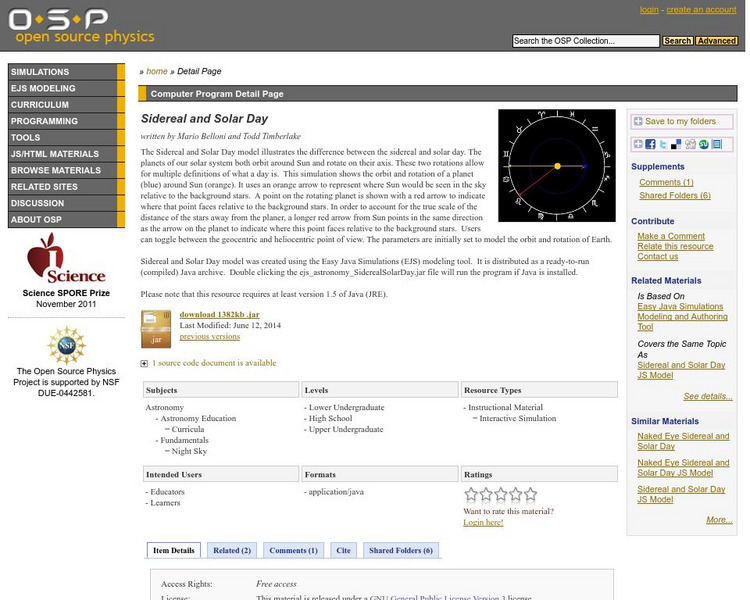
Com Padre Digital Library: Open Source Physics: Astronomy: Sidereal Solar Day
A computer based simulation demonstrating the difference between a sidereal day and a solar day.