Hi, what do you want to do?






CK-12 Foundation
Ck 12: Earth Science: Atoms to Molecules Study Guide
Understand the basic structure of atoms and molecules in the Earth's crust.
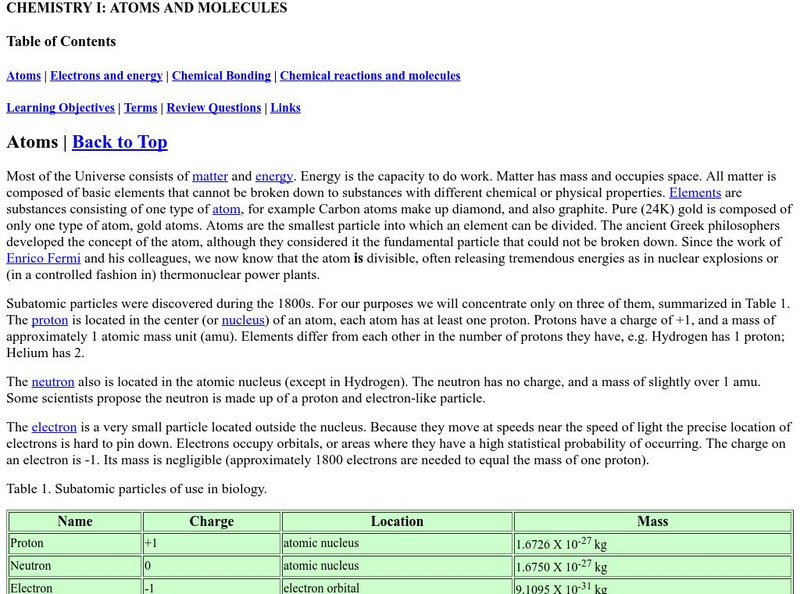
Estrella Mountain Community College
Online Biology Book: Chemistry I: Atoms and Molecules
In this online biology textbook, learn about atoms and molecules as they relate to life. Find out about topics such as electrons and energy, chemical bonding, and chemical reactions.
Concord Consortium
Concord Consortium: Molecular Workbench: Electrons in Atoms and Molecules
A model that explores why electrons are so important in chemistry. Investigate electron clouds, what happens when two atoms come together, and chemical polarity.
Mocomi & Anibrain Digital Technologies
Mocomi: Molecules
When two or more atoms combine they give rise to a molecule. A molecule can be made up of many atoms of the same element. There are 112 elements known to man, so can you imagine the different permutations and combinations of molecules...
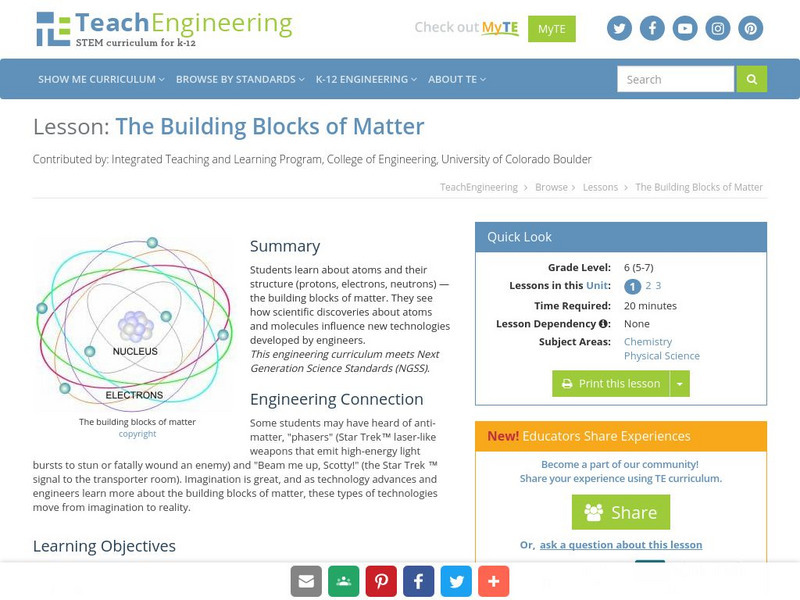
TeachEngineering
Teach Engineering: The Fundamental Building Blocks of Matter
This lesson plan explores the fundamentals of atoms and their structure. The building blocks of matter (protons, electrons, neutrons) are covered in detail. Young scholars think about how atoms and molecules can influence new...

Concord Consortium
Concord Consortium: Stem Resources: Electric Current
In this interactive, students can explore how current, voltage, and resistance are related in a model showing the flow of electrons in an electric circuit. They will learn about Ohm's law and how other forms of energy can be made from...

PBS
Pbs: Scientific American Frontiers: Teaching Guide: Tasty Models (9 12)
In this hands-on lesson, students use candy to construct models of nutrients (carbohydrates, proteins, and fats). Create visualizations that will aid in learning about dehydration synthesis and bond saturation in fat molecules. Includes...

TED Talks
Ted: Ted Ed: What Is the Shape of a Molecule?
George Zaidan and Charles Morton shape our image of molecules. [3:47]
American Chemical Society
Middle School Chemistry: Energy Levels, Electrons, and Covalent Bonding
Young scholars discover the concept that two atoms can attract and form a covalent bond.
American Chemical Society
Middle School Chemistry: Represent Bonding With Lewis Dot Diagrams
Students draw and interpret Lewis dot diagrams for individual atoms and both covalent and ionic compounds.
CK-12 Foundation
Ck 12: Life Science: 2.1 Elements and Compounds
Learn how basic elements form molecules to support life.
Concord Consortium
Concord Consortium: Newton's Laws at the Atomic Scale
Explore how Newton's three laws apply to the world of atoms and molecules. Start with the originally contradictory observation of Brownian motion. Then, each law is addressed at the atomic level.

Other
Chemguide: Electronegativity
This page explains what electronegativity is, and how and why it varies around the Periodic Table. It looks at the way that electronegativity differences affect bond type and explains what is meant by polar bonds and polar molecules.
Science Buddies
Science Buddies: Study Chirality With a Homemade Polarimeter
Some molecules can be either left- or right-"handed." The left- and right-handed molecules have the same number and type of atoms, and their chemical structures look identical, but they are actually mirror images of each other. Many...
American Chemical Society
Middle School Chemistry: What Is Density?
Calculate the density of cubes made of different materials to determine what type of material it contains. Using this information explain that the size, mass, and arrangement of the atoms or molecules of a substance determines its density.
PBS
Pbs Learning Media: Chemical Bonds
This interactive activity developed for Teachers' Domain demonstrates how attractive forces between atoms create chemical bonds, resulting in the formation of molecules and compounds.

TED Talks
Ted: Ted Ed: What Is the Universe Made Of?
The atoms around you have existed for billions of years- and most originated in the flaming, gaseous core of a star. Dennis Wildfogel tells the captivating tale of these atoms' long journeys from the Big Bang to the molecules they form...
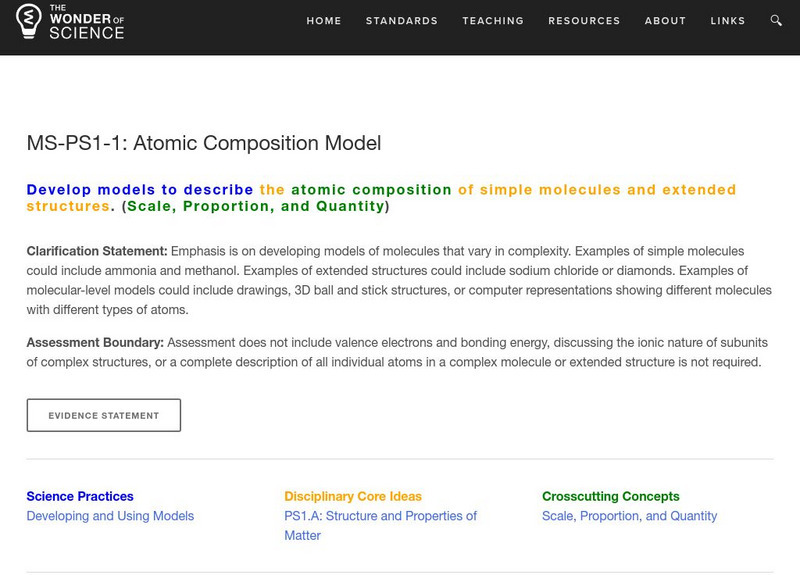
The Wonder of Science
The Wonder of Science: Ms Ps1 1: Atomic Composition Model
A collection of lesson plans for helping students understand atomic composition. Site uses work samples, phenomena, assessment templates, and videos to plan lessons to describe the atomic composition of simple molecules.

Ducksters
Ducksters: Chemistry for Kids: Organic Chemistry
Kids learn about organic chemistry including the importance of carbon, organic molecules, compounds, hydrocarbons, synthesis, and functional groups.
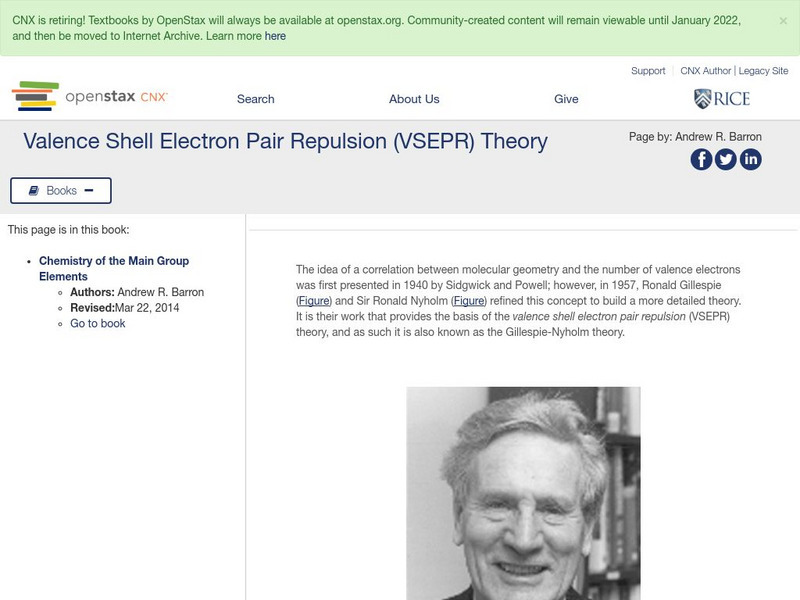
OpenStax
Open Stax: Andrew R. Barron: Valence Shell Electron Pair Repulsion (Vsepr) Theory
Detailed explanation of Valence Shell Electron Pair Repulsion (VSEPR) Theory with examples and questions for the reader to check comprehension. Also includes step-by-step instructions for correctly building molecules using VSEPR Theory....
Smithsonian Institution
Smithsonian Science Education Center: Chemical Reactions in Action
This video is a professional development resource that explores student misconceptions about atoms, molecules, and chemical reactions. It also gives some pedagogical approaches for approaching these subjects. [10:12]
Other popular searches
- Gumdrop Atoms and Molecules
- Making Atoms and Molecules
- Science, Atoms and Molecules
- Science Atoms and Molecules
- Atoms and Molecules Lesson
- Atoms and Molecules Musical
- Combining Atoms and Molecules
- Molecules and Atoms
- Atoms Molecules and Element
- Courting Atoms and Molecules
- Elements Molecules and Atoms