Hi, what do you want to do?






Center for Applied Linguistics
Chemical Interactions: Atoms and Bonding
Watch budding chemists interact with the resource on chemical interactions. In the unit, six lessons provide an overview of basic chemistry, from understanding the development of atomic theory to distinguishing between ionic and covalent...

Columbus City Schools
To Measure its Mass or Volume?
Atoms, elements, and molecules, oh my! Teaching the fundamentals of chemistry to curious sixth graders has never been easier to accomplish. Here is a resource that pulls together everything needed to get them off to a good start,...

Rensselaer Polytechnic Institute
Molecules to the Max!—Educators Resource Guide
From molecules to nanotubes, an engaging unit explores the world of tiny science. Fifteen hands-on experiments and lessons engage young scientists as they learn chemistry. Discussions, worksheets, and data analysis reinforce the concepts...
CK-12 Foundation
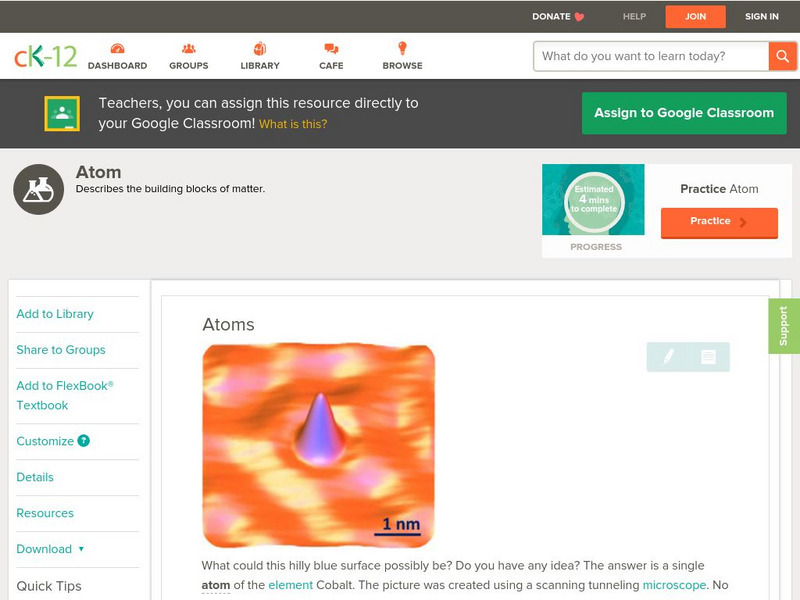
Ck 12: Physical Science: Atoms
[Free Registration/Login may be required to access all resource tools.] Atoms and how they are related to elements, and the particles that make up atoms.
TeachEngineering
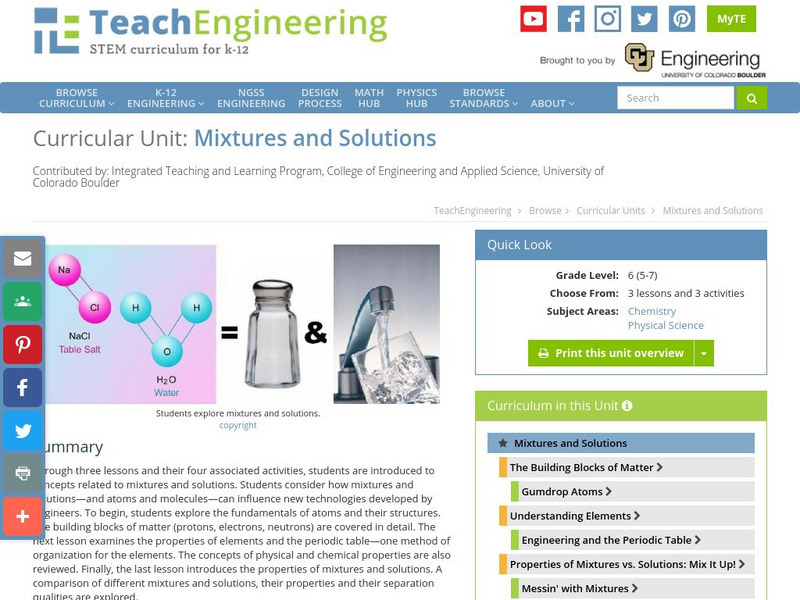
Teach Engineering: Mixtures and Solutions
This unit covers introductory concepts of mixtures and solutions. Students think about how mixtures and solutions, and atoms and molecules can influence new technologies developed by engineers. The first lesson explores the fundamentals...
CK-12 Foundation
Ck 12: Structure of the Atom
[Free Registration/Login may be required to access all resource tools.] Students learn about the important discoveries of subatomic particles, and how they led to our current understanding of the atom.
Lawrence Berkeley National Laboratory
Berkeley Lab: The Particle Adventure
Visit this site for an interactive tour of the atom and all aspects of particle physics. View the animations available with almost every description on this site. A great place for the fundamentals of particles and forces including a...
Scholastic
Scholastic: Study Jams! Science: Matter: Atoms: Protons, Neutrons, Electrons
A video and a short quiz on the parts of an atom, the periodic table, and molecules.
Georgia Department of Education
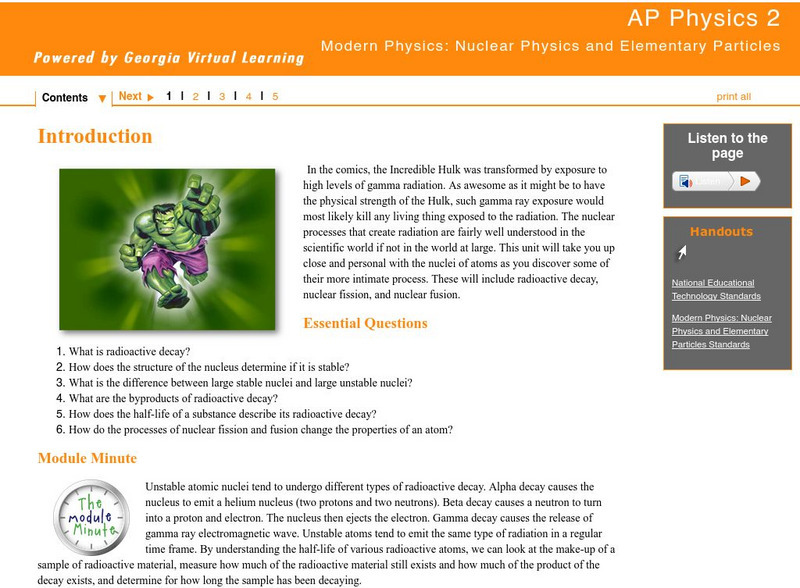
Ga Virtual Learning: Nuclear Physics and Elementary Particles
This interactive unit will take students up close and personal with the nuclei of atoms as they discover some of their more intimate process. These will include radioactive decay, nuclear fission, and nuclear fusion.
CK-12 Foundation
Ck 12: Earth Science: Atoms to Molecules
[Free Registration/Login may be required to access all resource tools.] Examine the composition of matter.
CK-12 Foundation
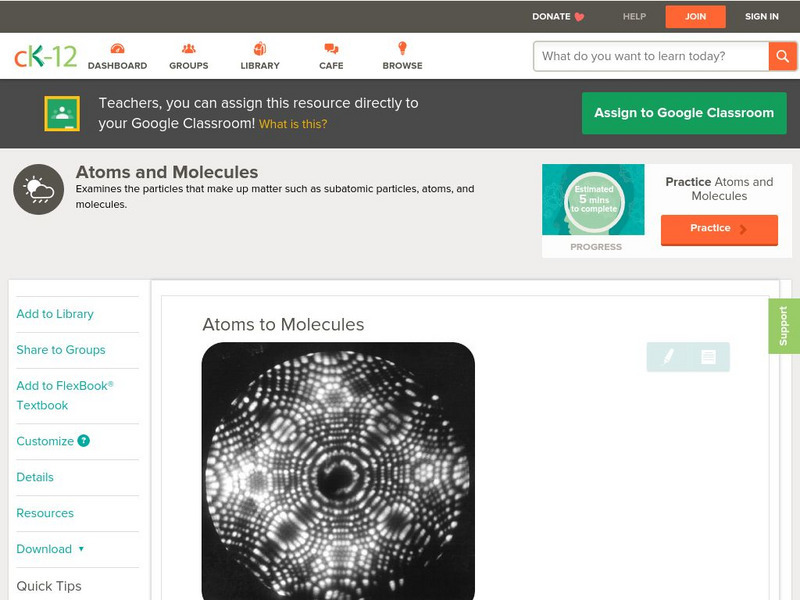
Ck 12: Earth Science: Atoms to Molecules
[Free Registration/Login may be required to access all resource tools.] Examine the composition of matter.
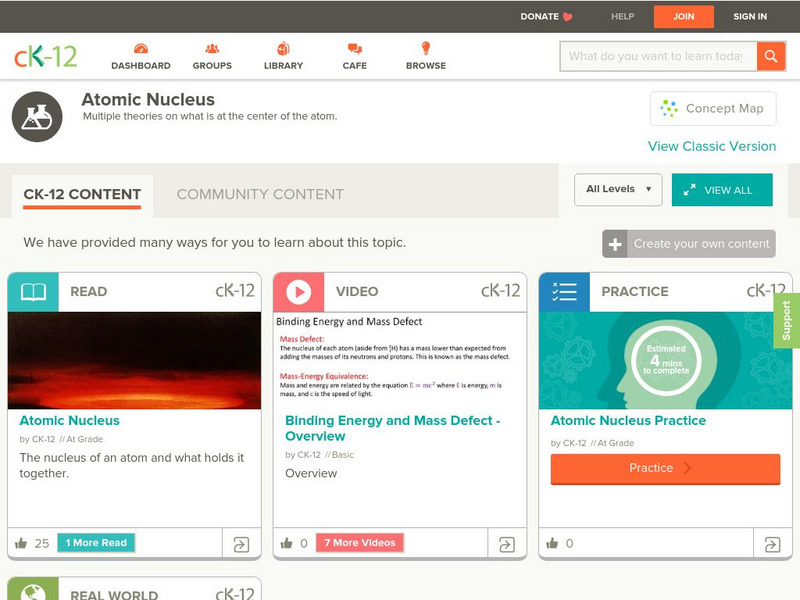
CK-12 Foundation
Ck 12: Physical Science: Atomic Nucleus
[Free Registration/Login may be required to access all resource tools.] Discusses the nucleus of an atom and what holds it together.
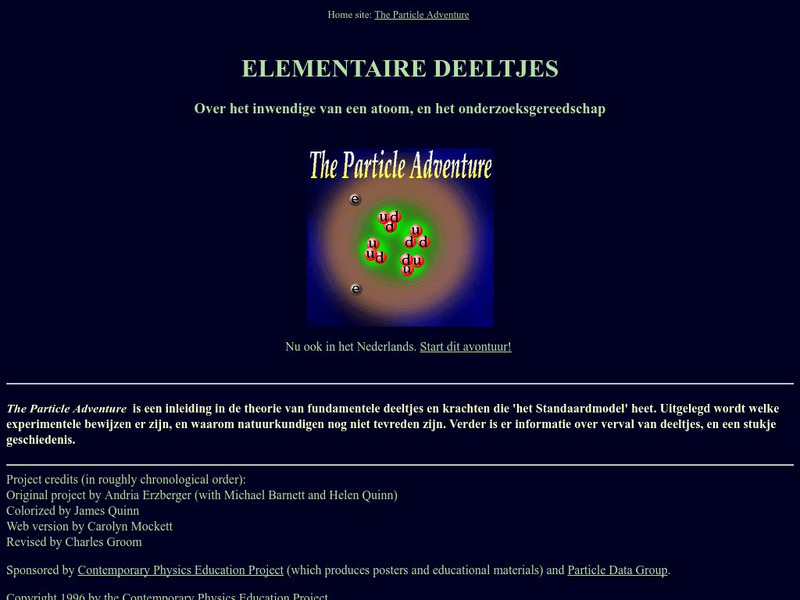
Other
Particle Adventure Dutch Version
Dutch version of the well-known "Particle Adventure" physics website that teaches students about atoms, mass, particle physics, and quantum physics. The site discusses theories related to physics and provides other links related to the...
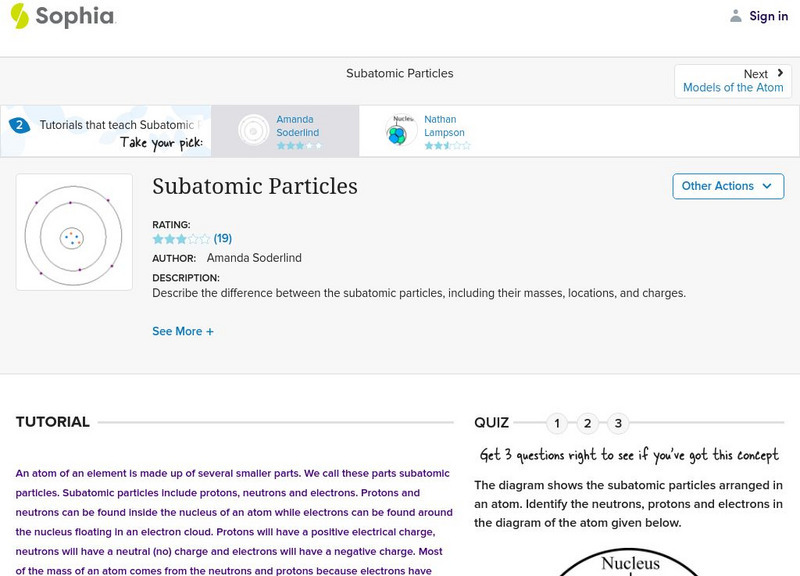
Sophia Learning
Sophia: Subatomic Particles: Lesson 2
Describe the $ifference between the subatomic particles, including their masses, locations, and charges. This lesson is 2 of 7 in the series titled "Subatomic Particles."

Mocomi & Anibrain Digital Technologies
Mocomi: Molecules
When two or more atoms combine they give rise to a molecule. A molecule can be made up of many atoms of the same element. There are 112 elements known to man, so can you imagine the different permutations and combinations of molecules...
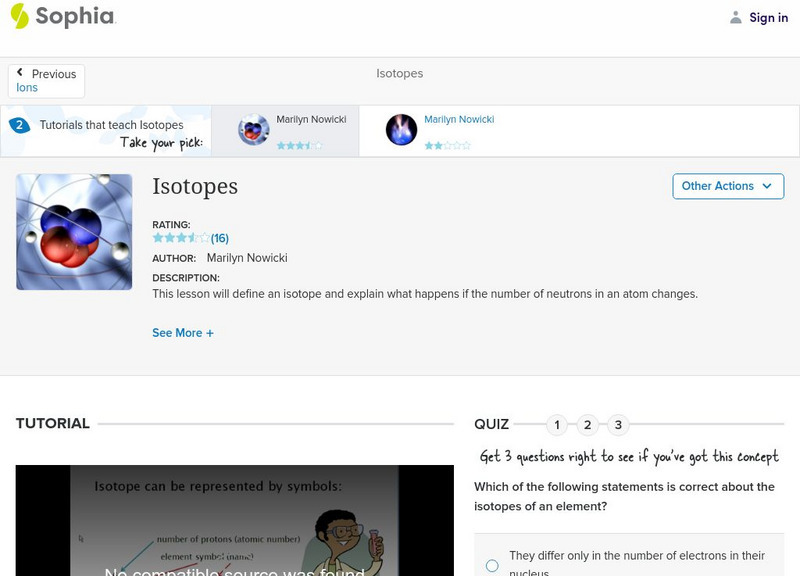
Sophia Learning
Sophia: Isotopes: Lesson 1
This lesson will define an isotope and explain what happens if the number of neutrons in an atom changes. It is 1 of 9 in the series titled "Isotopes."
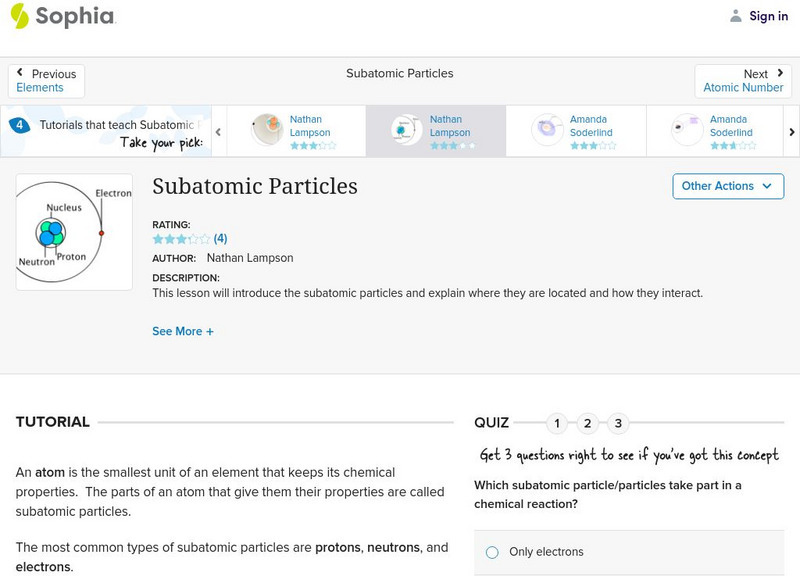
Sophia Learning
Sophia: Subatomic Particles: Lesson 4
This lesson will introduce the subatomic particles and explain where they are located and how they interact. It is 4 of 7 in the series titled "Subatomic Particles."
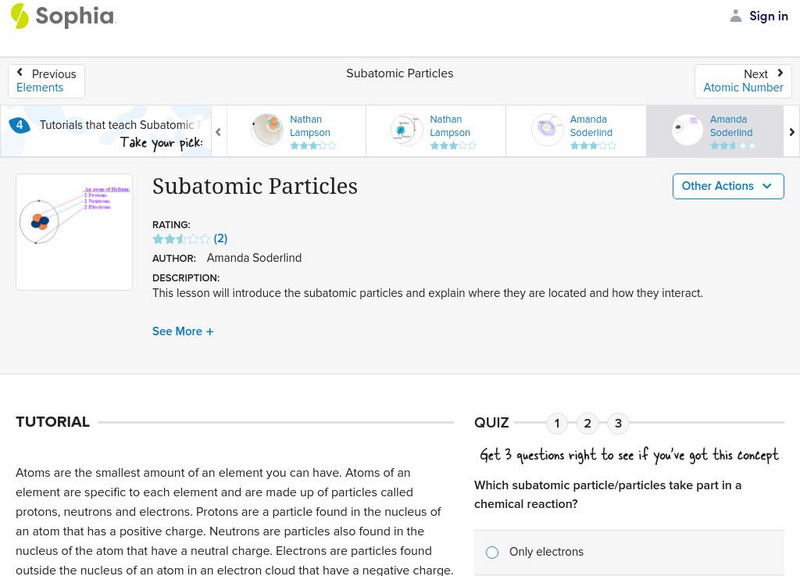
Sophia Learning
Sophia: Subatomic Particles: Lesson 6
This lesson will introduce the subatomic particles and explain where they are located and how they interact. It is 6 of 7 in the series titled "Subatomic Particles."
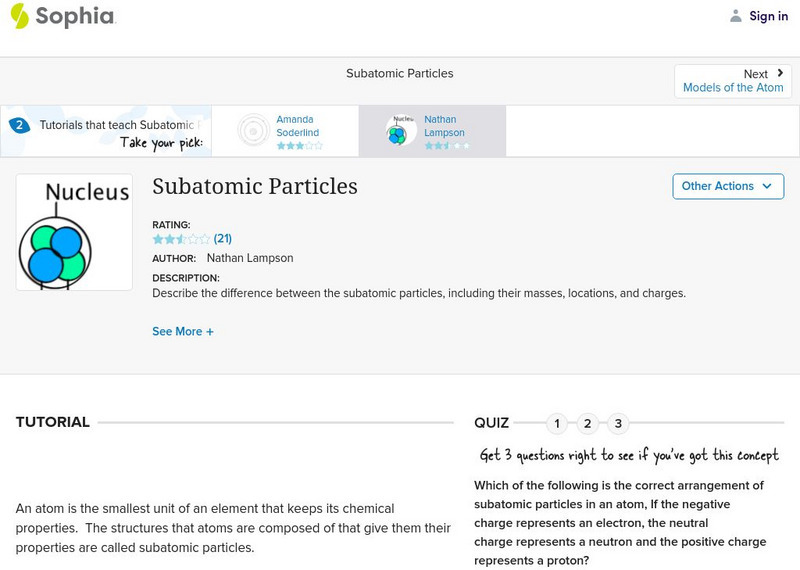
Sophia Learning
Sophia: Subatomic Particles: Lesson 5
Describe the difference between the subatomic particles, including their masses, locations, and charges. This lesson is 5 of 7 in the series titled "Subatomic Particles."
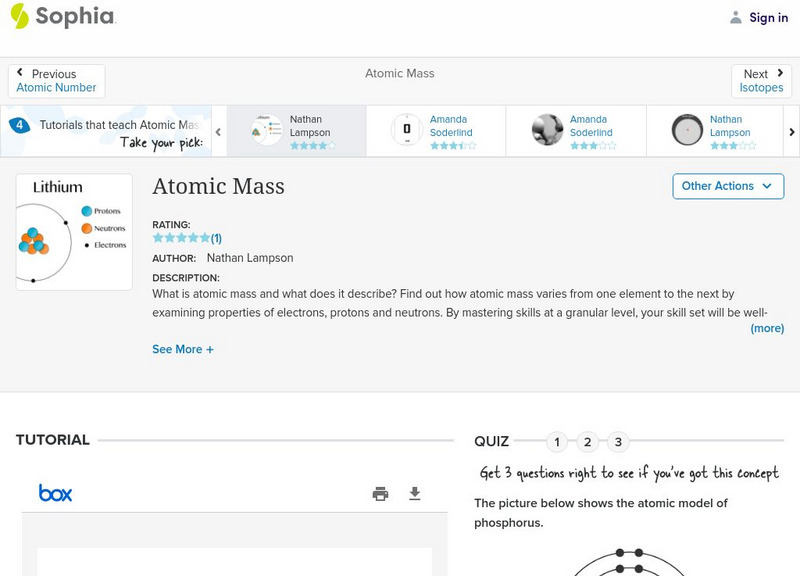
Sophia Learning
Sophia: Atomic Mass: Lesson 4
This lesson explains what is represented by the atomic mass, and how it varies from one element to the next. Module includes a slideshow and a quiz.
Concord Consortium
Concord Consortium: How Does an Object Become Charged?
Activity 1 in this module: What is the effect of changing the composition of an atom? Since all atoms contain protons, neutrons, and electrons, what makes one element different from another is examined.
BBC
Bbc: Gcse Bitesize: Atomic Structure
This lesson focuses on the structure of atoms. All substances are made from atoms. Each atom is made of a nucleus - containing protons and neutrons - surrounded by electrons. It provides a link to an assessment.
BBC
Bbc: Gcse Bitesize: What Does the Periodic Table Tell Us About the Elements?
The number of protons in the atom of an element determines its place in the Periodic Table. The number of electrons in an atom is the same as the number of protons. These electrons are arranged in shells or 'energy levels' around the...