Hi, what do you want to do?





Thinkport Education
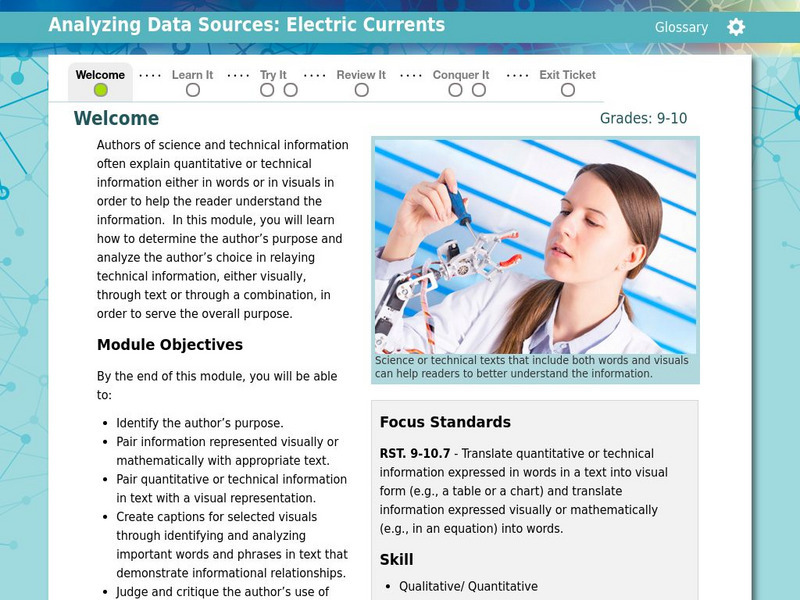
Thinkport: Analyzing Data Sources and Author's Purpose: Electric Currents
In this science-themed literacy lesson, students learn how to determine the author's purpose and follow the development of that purpose.
Tom Richey
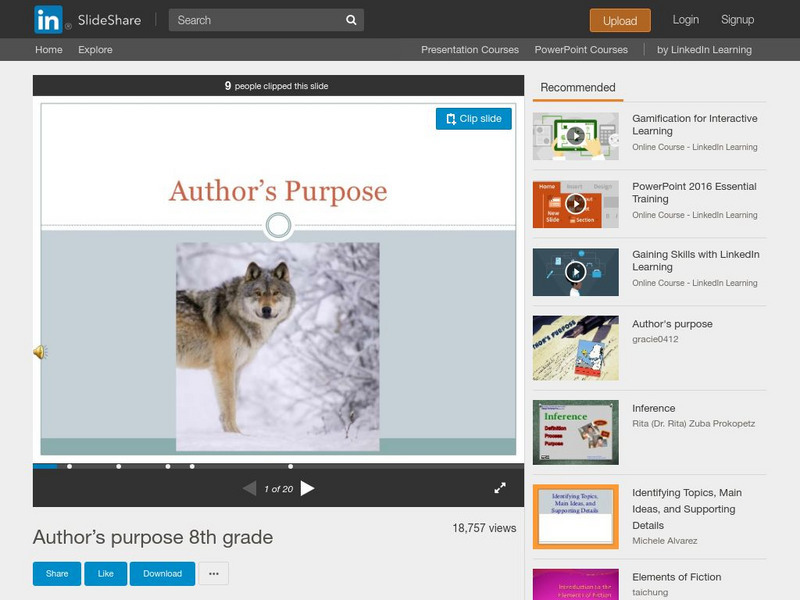
Slide Share: Author's Purpose 8th Grade
A slideshow with twenty slides with information and examples of four different purposes an author can have for writing a text: to entertain, to persuade, to express, or to inform/explain.
Better Lesson
Better Lesson: Unit: The Author's Point Is
Young scholars will focus on Main Idea, Author's Purpose, Identifying supporting details and Organizing details. Students will read a variety of Informational Text (non-fiction) to understand how stated and implied main idea effect the...

Curated OER
Mc Graw Hill: Part 2 Reading: Informational Text: Author Point of View
Learn four questions you can ask while reading an informational text to determine the author's point of view. Includes practice worksheet.
ReadWriteThink
Read Write Think: Defining and Exploring an Author's Stylistic Choices
Contains plans for two lessons that teach students how to recognize an author's use of style in literature. These plans use "Their Eyes Were Watching God" by Zora Neale Hurston as an example, but the basic ideas can be adapted to other...
Curated OER
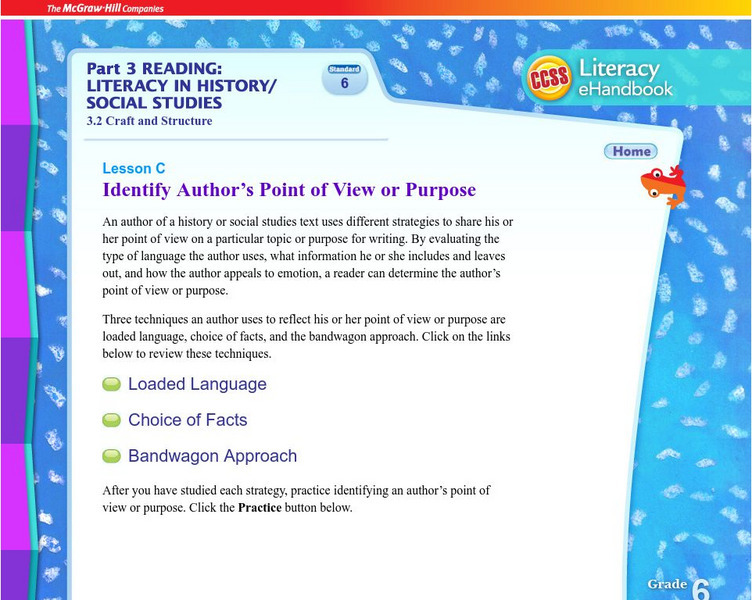
Mc Graw Hill: Identify Author's Point of View
Learn the techniques an author uses to share his or her point of view on a subject then practice identifying an author's purpose on your own.
British Library
British Library: 19th Century Non Fiction Texts: Crime & Punishment
This thematic collection will allow students to read and understand 19th-century non-fiction texts, and support them in identifying key features for a range of genres, audiences, and purposes. Each source is accompanied by original...
British Library
British Library: 19th Century Non Fiction Texts: Work & Welfare
This thematic collection will allow students to read and understand 19th-century non-fiction texts, and support them in identifying key features for a range of genres, audiences, and purposes. Each source is accompanied by original...
British Library
British Library: 19th Century Non Fiction Texts: Gender, Behaviour & Etiquette
This thematic collection will allow learners to read and understand 19th-century non-fiction texts, and support them in identifying key features for a range of genres, audiences, and purposes. Each source is accompanied by original...
British Library
British Library: 19th Century Non Fiction Texts: Education
This thematic collection will allow learners to read and understand 19th-century non-fiction texts, and support them in identifying key features for a range of genres, audiences, and purposes. Each source is accompanied by original...
Utah Education Network
Uen: Human Rights and Discrimination
This unit plan from the Utah Education Network engages students in understanding how authors backgrounds often impact their writing choices. "Human rights" and "discrimination" are the featured topics in the five texts incorporated in...

University of Maryland
Voices of Democracy: John Fitzgerald Kennedy, "Inaugural Address" January 1961
John F. Kennedy's inaugural speech is one of the most famous speeches in American history. Teachers can use this instructional activity to teach Language Arts standards, as well as Social Studies standards. This lesson plan includes...
Alabama Learning Exchange
Alex: Grammar and Literature Through Digital Storytelling
In this lesson plan students create digital stories in cooperative groups using multimedia tools to demonstrate comprehension of the elements of grammar, literature, and technology introduced in the lesson plan. Students become actively...
Annenberg Foundation
Annenberg Learner: Workshop 2: Making Writing Meaningful
Workshop 2 demonstrates how teachers use authentic sources and topics to prompt students to write about things that matter to them, subjects that relate to their lives, relationships, and communities. The topic may be the students -...
Other
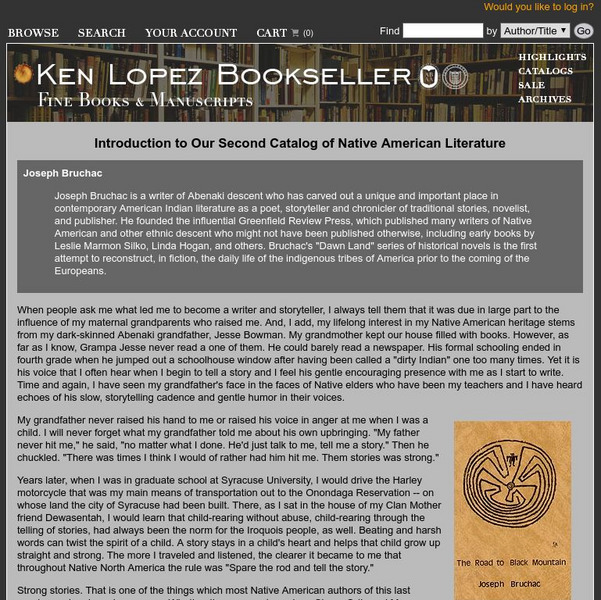
Lopez Books: Joseph Bruchac Essay
Joseph Bruchac gives a detailed description of his life and also discusses his involvement as a writer of Native American literature. Bruchac discusses his time as a volunteer teacher in West Africa, his memories of growing up with his...
Wisconsin Response to Intervention Center
Wisconsin Rt I Center: Text Dependent Questions [Pdf]
Describes a reading strategy where students must respond to text by supporting their ideas with text-based evidence. Lists different categories of questions the teacher can prepare based on the text chosen, with examples for each.
Reading Rockets
Reading Rockets: Looking at Writing: First Grade
First graders write many times a day to express their interests - they are writing with a purpose through stories, letters, and lists. In this section, you'll find writing assessment resources, writing strategies, and additional tip...
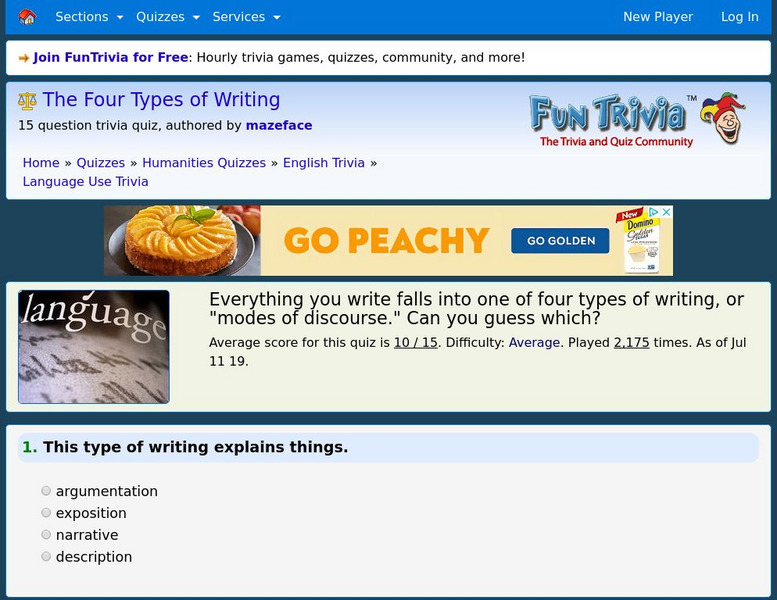
Fun Trivia
Fun Trivia: The Four Types of Writing Trivia Quiz
A fifteen-question quiz in which the reader identifies a type of writing for each situation: argumentation, exposition, narrative, or description. Correct answers are displayed once answers are submitted.
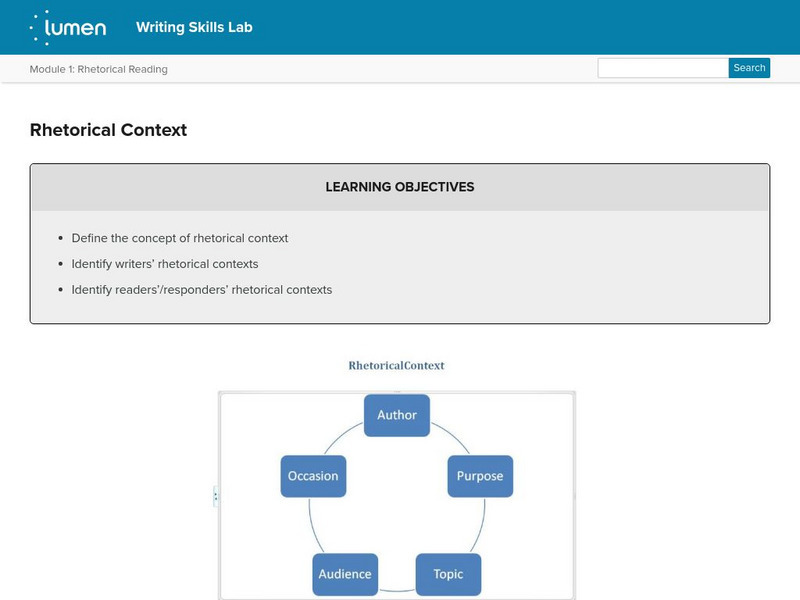
Lumen Learning
Lumen: Rhetorical Reading: Rhetorical Context
This lesson focuses on rhetorical context including defining it, questions to ask to understand it, and how it can be useful to the reader and responder.
Other popular searches
- Authors Purpose Powerpoint
- Authors Purpose Mini Lesson
- Authors Purpose Passage
- Teaching Author's Purpose
- Main Idea Authors Purpose
- Teaching Authors Purpose
- Authors Purpose Persuade
- Authors Purpose for Writing
- Identify Authors Purpose
- Author's Purpose to Inform
- Authors Purpose to Entertain
- Identifying Author's Purpose