Hi, what do you want to do?






Curated OER
What I Did On My Summer Vacation
Students use the internet to research the location of their summer vacation trip. Given the demographics, they plot the location on a world map. They create a brochure using the information they collected. Using PowerPoint, they develop...

Curated OER
Poetry Cubes
Reading aloud can be scary, but it's an important way to build oral fluency. Break the class into groups of four or five learners. Each learner will roll a cube to determine which poem they read aloud to their small group. Feel free to...

Curated OER
Creating a Science Fiction Story
As the culminating activity in a unit study of science fiction, young writers demonstrate their understanding of the genre by producing their own graphic novel. After deciding on the main elements of their story, individuals use a comic...

Curated OER
Living History- An Intergenerational Philanthropy
Students gather information from a senior friend to write a biography. In this living history books lesson, students organize information to complete a book about their senior friend. Detailed teacher instructions for completing the book...

Curated OER
Cartoons: How Have Society's Views of Women Changed Over Time?
Learners explore women's rights by viewing cartoon images. In this women's history lesson, students view several images depicting women in a certain way while discussing the meaning of the imagery among their classmates. Learners write a...

Curated OER
Exploring Roosevelt's New Deal Using Oral Histories from the Great Depression
Students examine the process of collecting life stories. They also look at the lives effected by The Great Depression to gain understanding of the controversial economic plan of Roosevelt.

Curated OER
Creating a Children's Book
Learners create a studenT book following an introduction to the publication process. Through exposure to several sources, students learn the steps involved in publishing a book.

Curated OER
Phaedo
In this online interactive history activity, students respond to 10 short answer and essay questions about Phaedo by Plato. Students may check some of their answers on the interactive activity.

Curated OER
Persuade Me
Students develop their writing skills. In this writing strategies lesson, students examine persuasive writing techniques on order to write persuasive mailers.

Curated OER
Holocaust Memorial Service
Young scholars research victims of the Holocaust, then create pieces of art to depict the suffering of the Holocaust victims.

Curated OER
Worksheet for Analysis of a Written Document
In this primary source analysis worksheet, learners respond to 16 short answer questions that require them to analyze the provided historical document.

Curated OER
Reading Log
Fourth graders, after reading books in Language Arts, complete a database to assist them with book reports.

Curated OER
Scavenger Hunt
Students summarize the "Tri-County Project" section of the nebraskastudies.org web site using a scavenger hunt.

Curated OER
Tasmanian Time Travel
Sixth graders perform research using the Internet about the Tasmanian Devil. The project can be presented in a variety of ways. The use of computer software is important for students to know, specifically Hyperstudio.

Curated OER
pOETRY cUBS
Young scholars develop an appreciation for different styles of poetry. It is also an excellent way to introduce a holiday, season, or theme. They also learn different techniques for memorization.

Curated OER
"Tri-County" Project--Well in a Cup
Students construct a model of a well to identify how water is brought to the surface. Signs of pollution are investigated.

Curated OER
Mock Standing Committee
Young scholars participate in standing committees to explore controversial issues. They research the issue in order to develop a perspective on the topic.
Texas Education Agency
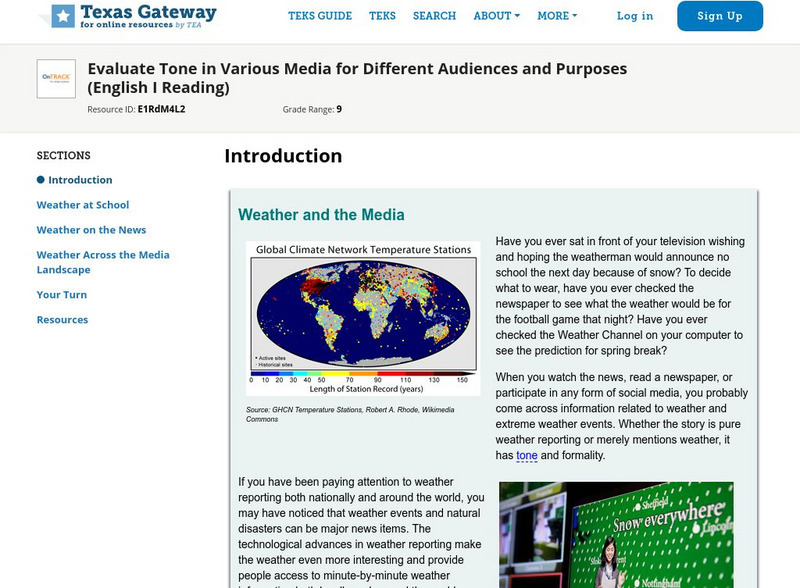
Texas Gateway: Evaluate Tone in Various Media for Audiences and Purposes
This lesson features several weather videos, both real and created, to help students understand how information and the tone changes based on the audiences and the purposes for the presentation.
Texas Education Agency
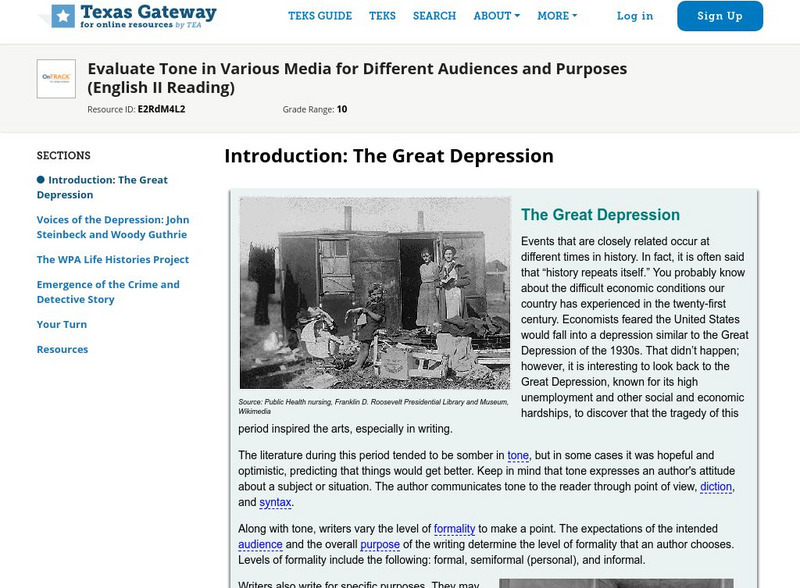
Texas Gateway: Evaluate Tone in Various Media for Different Audiences & Purposes
This lesson will help you evaluate changes in formality and tone within printed texts written for specific audiences and purposes. It focuses on writing produced during the Great Depression.

Louisiana Department of Education
Louisiana Doe: Curriculum Hub: Ela Guidebooks: Teenage Brain: Analyze and Annotate a Model Response
Analyze and annotate a model response focusing on support for a claim. Then revise and edit your work based on the model. This will help you develop work that is clear and coherent and appropriate to the task, purpose, and audience.
Louisiana Department of Education
Louisiana Doe: Curriculum Hub: Ela Guidebooks: Teenage Brain: Analyze and Annotate a Model Response
Analyze and annotate a model response focusing on the claims made in the model. We will then revise and edit our work based on the model. This will help us develop work that is clear and coherent and appropriate to the task, purpose, and...
TES Global
Tes: Analyzing & Comparing Non Fiction
[Free Registration/Login Required] Resource notes to aid students as they analyze different types of nonfiction. The GAP (genre, audience, and purpose) acronym is provided to use when comparing nonfiction texts.
British Library
British Library: 19th Century Non Fiction Texts: Crime & Punishment
This thematic collection will allow students to read and understand 19th-century non-fiction texts, and support them in identifying key features for a range of genres, audiences, and purposes. Each source is accompanied by original...
British Library
British Library: 19th Century Non Fiction Texts: Work & Welfare
This thematic collection will allow students to read and understand 19th-century non-fiction texts, and support them in identifying key features for a range of genres, audiences, and purposes. Each source is accompanied by original...