Hi, what do you want to do?





Science Education Resource Center at Carleton College
Serc: Tracking the Sun: Observing the Path of the Sun Throughout the Year
Over the course of the school year, students collect weekly data about the sun's position at a specific time of day, resulting in creating a figure "8" that shows the path of the sun called an analemma.

TED Talks
Ted: Ted Ed: What on Earth Is Spin?
Why is the spinning motion so special? Brian Jones details the dizzyingly wide array of ways that spinning affects our lives. [3:57]

Science Buddies
Science Buddies: Kinesthetic Astronomy: Earth's Rotation
This kinesthetic activity will demonstrate concepts like rotation and orbit, clarify movement and direction, and help young scholars understand why earthlings see different things in the sky.
NASA
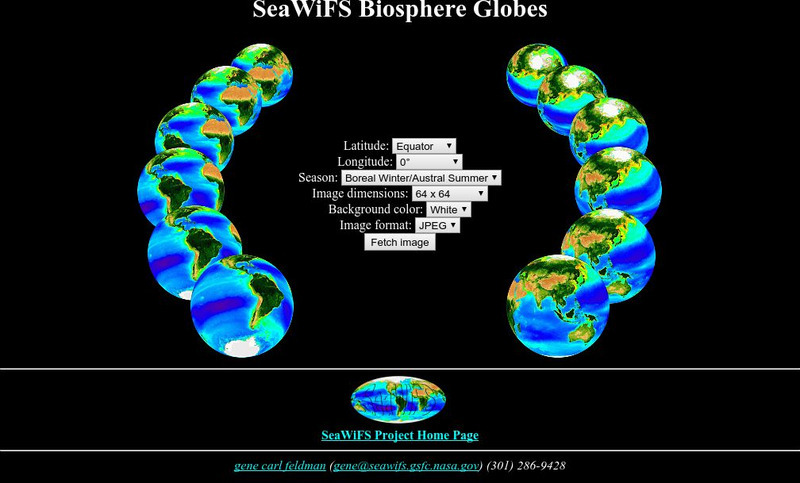
Nasa: Sea Wi Fs Biosphere Globes
This interactive globe allows you to get any view of the earth by entering latitude, longitude and season criteria.
Utah Education Network
Uen: A Moon With a View
Understand the rotation of the earth and the appearance of movement of other bodies in the sky.
Better Lesson
Better Lesson: Our Sky
What objects are in the day sky and the night sky? How do they seem to move? Come and explore with us as we discover the sun, moon, planets and stars! This detailed lesson plan includes pictures and videos of the lesson in action,...
NASA
Nasa: Eclipse Predictions and Earth's Rotations
An insightful website from NASA that presents a series of different questions about the rotation of the Earth.

ClassFlow
Class Flow: Earth and Space Day and Night
[Free Registration/Login Required] This flipchart illustrates a view of the earth from space and how day and night happens.

Other
Center for Science Education: Eye on the Sky: What Makes Day and Night?
This activity will allow you to model day and night cycles. A rotating student holding a map (provided) models the earth. A lamp is used to model the sun. Numerous worksheets (pdf) and additional website resources are also provided.

Geography 4 kids
Geography4 kids.com: Earth Around the Sun
Find out what all results from Earth revolving around the sun every 365 days as well as the rotation of the Earth every 24 hours.

ClassFlow
Class Flow: Day and Night
[Free Registration/Login Required] In this flipchart students will understand how the Earth rotates during a 24 hour period giving us day and night.
Other
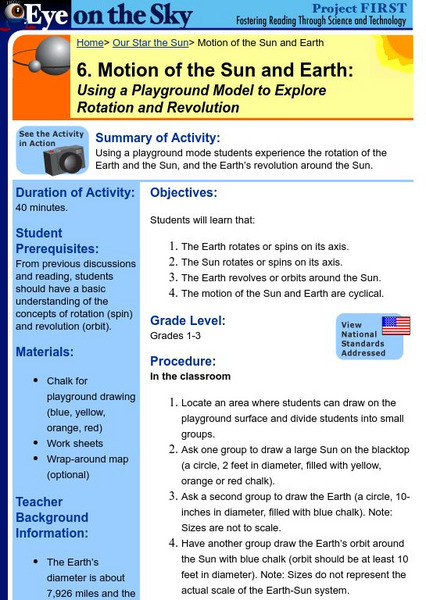
Center for Science Education: Eye on the Sky: Motion of the Sun and Earth
Students model the interaction of the earth and the sun. The activity is designed for the playground. You will need chalk, but all the other worksheets are provided.
National Museums Liverpool
Liverpool Museums: The Sun Tracker
This simulation allows the user to see the sun's arc in the sky anywhere in the world at any time. By changing the season settings the user can see how seasons affect the height of the sun's arc.
Read Works
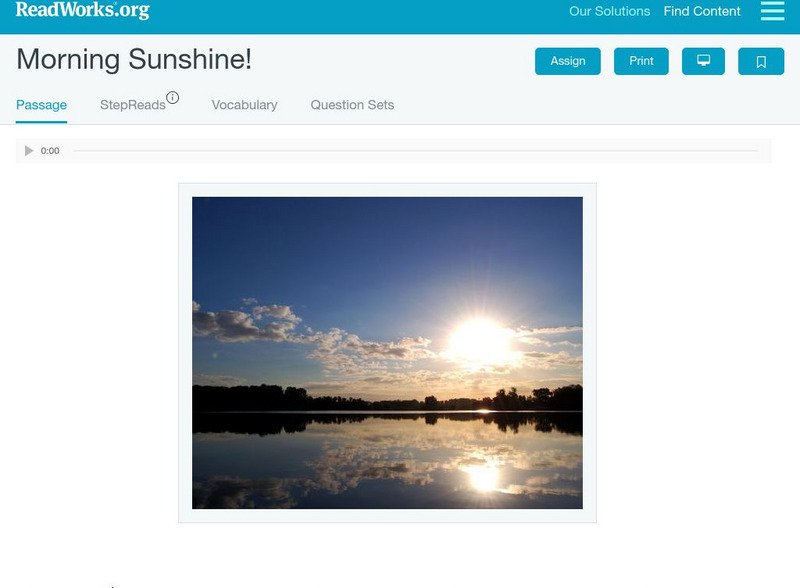
Read Works: Morning Sunshine
[Free Registration/Login Required] Students read about how the tilt of the Earth on its axis affects sunrises and sunstes. A question sheet is available to help students build skills in reading comprehension.
Sophia Learning
Sophia: Earth and Sun
A slideshow exploring Earth's rotation and revolution around the sun. Learn that because of Earth's axis tilt we experience the seasons!
Ohio State University
Beyond Penguins and Polar Bears: Common Misconceptions About Day and Night
Misconceptions about the causes of seasons and day and night are common through all ages. Use the information on this site to help your students understand these concepts. Included are links to many resources and lesson plans for...
Cornell University
Cornell University: Astronomy: Eratosthenes
Learn how Greek mathematician Eratosthenes used geometry to estimate the circumference of the Earth.
Utah Education Network
Uen: Trb 3:1 Investigation 6 Celestial Model
Third graders will gain an understanding of why stars appear to move across the night sky.
Better Lesson
Better Lesson: Our Stars
In this lesson, students will observe and communicate how the stars are in the sky both day and night. The extremely detailed lesson includes photos and videos of the lesson in actions, examples of student's work, materials, parent...

Alabama Learning Exchange
Alex: Our Restless Planet
This unit will use demonstrations and student examples to help young scholars gain an understanding of rotation, revolution, and orbit. Through hands-on activities students will explore the concepts of day and night. Technology will be...
McREL International
Mcrel.org: Planet Rotation [Pdf]
A worksheet regarding the axis of rotation within each of the planets. PDF