Hi, what do you want to do?






Curated OER
The Code of Hammurabi
Students use the guiding questions to accomplish the lesson plan objectives. They will know the purposes for the establishing of The Codes and how they were distributed throughout the ancient empire of Babylonia.

Curated OER
Making Soap
Young scholars recognize and use chemical indicators in the lab, recognize the need for safety while doing chemical experiments and understand the need for following precise directions.

Curated OER
New Year's Resolutions -Lesson plan
Young scholars study the origins of New Year's Resolutions while practicing taking dictation and identifying interesting points in a piece that is read to them. They investigate the types of things that people resolve on the first day of...

Curated OER
Ancient Mesopotamian and Egyptian Writing
Students research cuneiform and hieroglyphics from the internet and use educational software to create their own cuneiform tablet in this excellent World History lesson. The use of the computer software program Inspiration 7.5 is...

Curated OER
Angle Land and Angle Aerobics
Sixth graders investigate different types of angles. In this geometry lesson plan, 6th graders use a protractor to identify acute, obtuse, and straight angles.

Curated OER
Proofreading Practice
In this proofreading practice online learning exercise, 6th graders retype three passages correcting errors in spelling, punctuation, capitalization, grammar and usage, with answers available.

Curated OER
The Cuneiform Writing System in Ancient Mesopotamia: Emergence and Evolution
Learners research the parallel development and complexity of writing and civilization in ancient Mesopotamia. In this ancient Mesopotamia lesson, students analyze the Cuneiform writing system in ancient Mesopotamia and how the...

Curated OER
The History of Religion
Students learn about the two main types of religions. For this religion lesson, students define religion and learn about early religion as well as religion in the west. Students define animism, polytheism, pantheism,...

Curated OER
Cultural Calendar
Students design their own cultural calendar. In this calendar making lesson, students decide on a culture for a calendar theme and discuss how calendars differ from the US calendar. Students create their own calendar using a...

Curated OER
Alexander the Great
In this Alexander the Great worksheet, students answer multiple choice questions about Alexander the Great and the time he lived. Students answer 12 questions total.

Curated OER
Celebrations
In this celebrations worksheet, students choose the correct word to complete the sentences about different celebrations. Students complete 10 multiple choice questions.

Curated OER
Holidays
In this holidays worksheet, students choose the correct word to complete the sentences about different holidays around the world. Students complete 10 multiple choice questions.

Curated OER
The Persian Empire
In this the Persian empire worksheet, students read a two page passage about Persia, then answer 5 multiple choice and 7 short answer questions requiring research about the topic.

Curated OER
My 2011 Resolution: Investigate Mathematics of Calendars and Fitness
Ring in the new year with interdisciplinary units related to the development of calendars and getting fit.

Curated OER
Warfare and Empire
Pupils discuss how changing the environment can cause conflict between two groups. In groups, they brainstorm other ways to deal with this issue without using warfare. They use the internet to research the differences in today's army...

Curated OER
In the Path of the Ancients: Unearthing Formulas for Area
Learners apply the formulas for the area of parallelograms and triangles. Through guided practice, students discover the correct way to apply the formulas. Working in pairs, they write their own problems featuring the formulas.

Curated OER
Dig Magazine Archeology Quiz #114
For this Dig Magazine archeology quiz, students answer 12 multiple choice questions complementing the October 2010 issue. Page contains answer and additional resources link.

The British Museum
British Museum: Explore World Cultures: Babylonians
Learn about the ancient Babylonians via and examination of the art of the civilization in this image gallery of Babylonian works from the British Museum collection; each image is accompanied by a detailed description.
PBS
Pbs: Base 60: Babylonian Decimals
Explore a brief history of mathematics in Mesopotamia through the Babylonian Base 60 number system. This video focuses on how a base 60 system does not use fractions or repeating decimals, some of the advantages of a base 60 system, and...
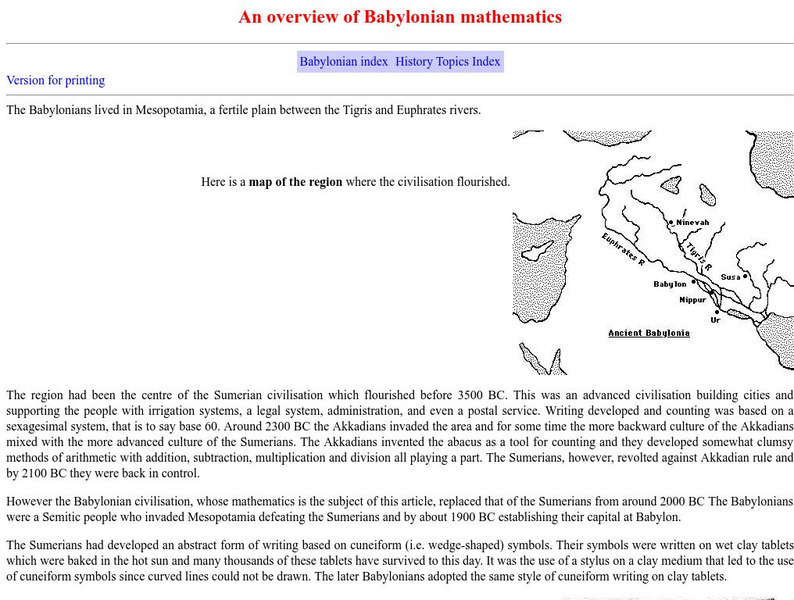
University of St. Andrews (UK)
University of St. Andrews: An Overview of Babylonian Mathematics
Information and examples of how the base 60 number system of the Babylonians worked in calculating problems similar to those we face today. Has a section comparing Pythagoras's theorem to Babylonian math.
National Council of Teachers of Mathematics
The Math Forum: Ask Dr. Math: Babylonian Number System
Dr. Math takes on a question about the Babylonian base-60 math system, explaining how a sexagesimal system looks and works in comparison with our decimal (base 10) system.
University of Calgary
University of Calgary: Reasons for Survival of Judaism Through Babylonian Exile
This resource provides explanations as to "Reasons for Survival of Judaism through Babylonian Exile."

University of Calgary
University of Calgary: A Page From the Babylonian Talmud
Describes in detail the various parts of a page from the Talmud.
Other
Enuma Elish: The Mesopotamian: Babylonian Creation Myth
An excellent translation of the Enuma Elish, with an introduction to the work and a short summary before each tablet. This is part of a Christian resource website.
Other popular searches
- Babylonian Number System
- Babylonian Mathematics
- Babylonian Empire
- Babylonian Math
- Babylonian Numeration System
- Babylonian Exile
- Babylonian Captivity
- Babylonian System
- Babylonian Division
- Babylonian Subtraction
- Babylonian Numerals
- Babylonian Counting Base 60