Hi, what do you want to do?






Harry S. Truman Library and Museum
Harry S. Truman Library & Museum: Three Branches of Government
Interactive teaching unit for Grades 5-8 that helps to explain the three branches of government and the the balance of power. Topics covered include balance of government, how a bill becomes a law, the amendment process, the Legislative...
Other
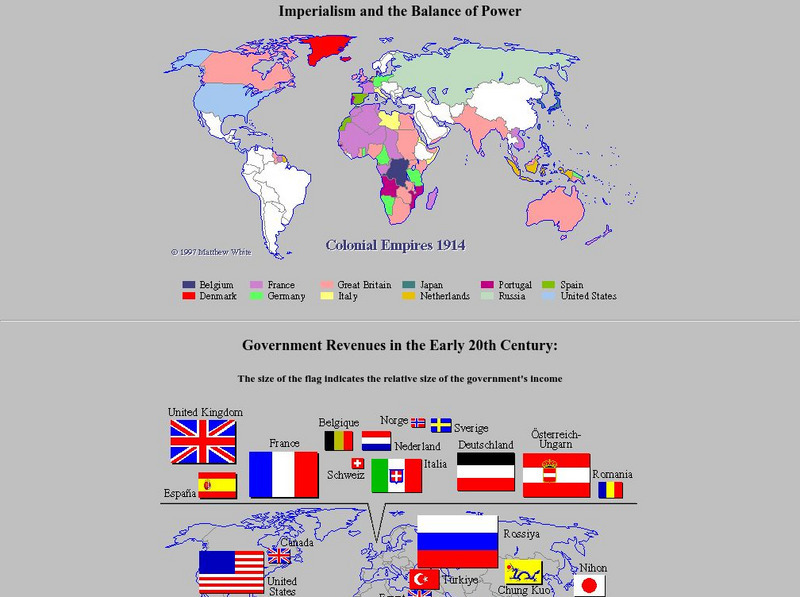
Map: Imperialism and the Balance of Power
World maps of the Colonial Empires of 1914 as well as their revenues during that time period. There are also maps depicting urban growth, type of government, wars and atrocities, and living conditions of the world in 1900.
BBC
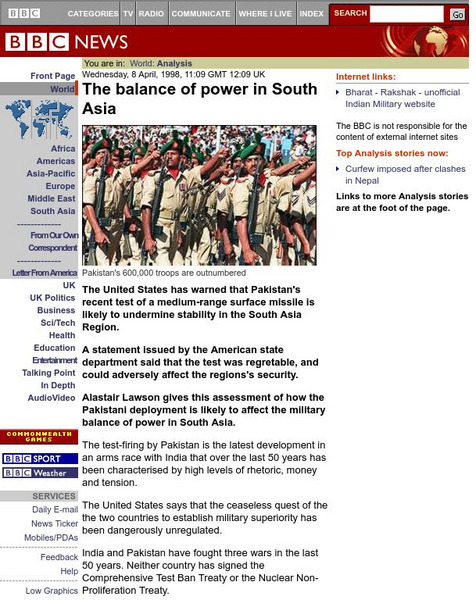
Bbc News: The Balance of Power in South Asia
A short report on how the use of a short range missile by Pakistan may have upset the balance of power between India and Pakistan.
US Mint
United States Mint: Branches of Power
Save the federal government from Oppressor Sam, and learn about the US Constitution to restore the three branches of government.

ClassFlow
Class Flow: Constitution
[Free Registration/Login Required] This flipchart is an in depth Activote questionnaire relating to our Constitution. Students should understand the basic concepts of the Constitution, checks and balances, separation of powers, and...
Indiana University
Center on Congress: Learn About Congress
Learn about the role of the US Congress, how it works, its history, and the principles behind its creation and operation. Wonderful set of resources including FAQs, short articles and video clips, "interactive learning modules" (i.e., a...
National Endowment for the Humanities
Neh: Edsit Ement: James Madison: From Father of the Constitution to President
In this Curriculum Unit, students will consider "James Madison: From Father of the Constitution to President" in 4 Lessons. The unit also includes worksheets and other student materials that can be found under the resource tab.

Scholastic
Scholastic: Role of the Supreme Court
This essay describes the power of the Supreme Court to 'check' the actions of both the President and Congress, with some historic documentation.
University of Groningen
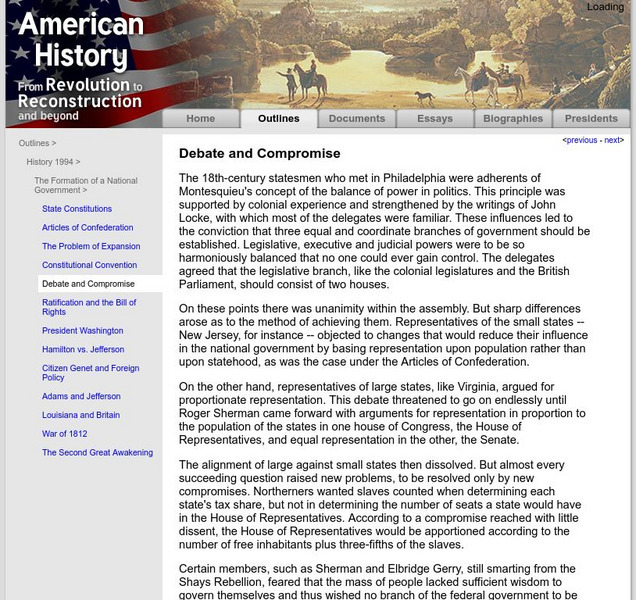
American History: Outlines: Debate and Compromise
The 18th-century statesmen who met in Philadelphia were adherents of Montesquieu's concept of the balance of power in politics. This principle was supported by colonial experience and strengthened by the writings of John Locke, with...
Bill of Rights Institute
Bill of Rights Institute: Constitutional Principles
James Madison knew that a key challenge of maintaining just government was framing it in such a way that the government would be forced to control itself. How does a system of separated powers-and the checks and balances built into those...
Annenberg Foundation
Annenberg Learner: Democracy in America: The Constitution: Fixed or Flexible?
This unit explores the timeless qualities of The U.S. Constitution, the opportunities to amend it, and how it is a pillar of the American identity, through these activities, videos, and outside resources.

University of Chicago
The Founders' Constitution: Federal v. Consolidated Government: Virginia Plan
The original text of The Virginia Plan presented at the Constitutional Convention. Discusses federal versus consolidated government.

The Dirksen Congressional Center
Congress for Kids: Checks and Balances
The system of checks and balances in place for maintaining the power relationships within the United States government is explained in kid-friendly terms. Suggestions for research projects, resource links and some activities are...
Digital History
Digital History: The Crisis of 1850
A preview of will prompt the passage of the Compromise of 1850. Read about California's bid for statehood as a free state.
Center For Civic Education
Center for Civic Education: Relationship of State and National Legal Systems
This lengthy essay describes the balance between state and federal judiciary courts and touches on independence, integration, power limits and immunities.
Annenberg Foundation
Annenberg Classroom: Tenth Amendment
Annenberg Classroom resource on the 10th Amendment which attempts to create a balance of power between federal and state government. With links to related news articles and resources.
Boise State University
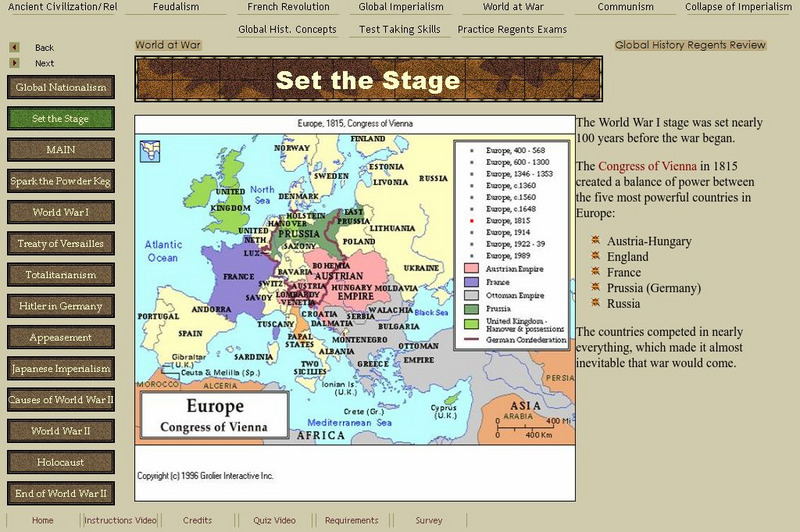
Boise State: World at War: Set the Stage
This 1815 map of Europe is a result of the Congress of Vienna creating a balance of power between the five most powerful countries in Europe. The countries competed in nearly everything, which made it almost inevitable that war would come.
Digital History
Digital History: America Goes to War [Pdf]
President Woodrow Wilson tried to maintain American neutrality in World War I. Find out why he decided that the U.S. needed to join the war and read a portion of his message to Congress asking for a declaration of war against Germany....
Independence Hall Association
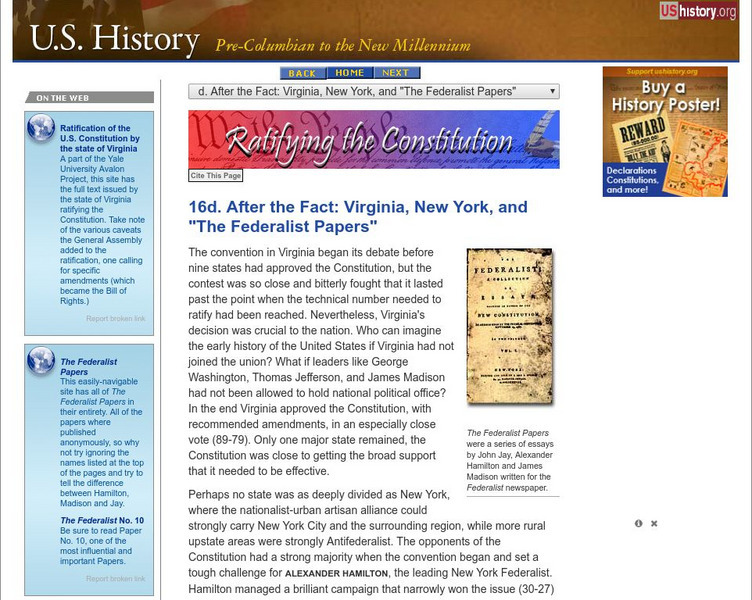
U.s. History: After the Fact: Virginia, New Yok, and "The Federalist Papers"
Read about the necessity for Virginia and New York to support the ratification of the Constitution. See what influenced the vote in Virginia and how the legislature of New York was finally convinced.
Curated OER
Map: Imperialism and the Balance of Power
World maps of the Colonial Empires of 1914 as well as their revenues during that time period. There are also maps depicting urban growth, type of government, wars and atrocities, and living conditions of the world in 1900.
Curated OER
Map: Imperialism and the Balance of Power
World maps of the Colonial Empires of 1914 as well as their revenues during that time period. There are also maps depicting urban growth, type of government, wars and atrocities, and living conditions of the world in 1900.

The Dirksen Congressional Center
Dirksen Congressional Center:congress for Kids: Introduction to the Constitution
Explore the history of the United States Constitution: information about the writing the Constitution, the Great Compromise, the Constitution's signers, the Bill of Rights, the Amendments to the Constitution, federal powers, checks and...
Other
The Federalist Papers:convention, Constitution,& Debates
A clickable index of the 85 Federalist Papers. The text of each letter (paper) sent to New York newspapers in 1787 and 1788 is easily accessed.
Illinois Institute of Technology
Oyez Project
The OYEZ Project is a vast multimedia relational database on the U.S. Supreme Court that contains abstracts for all leading constitutional decisions of the Court, authoritative oral arguments in streamed media format, and a 360-degree...