Hi, what do you want to do?






Curated OER
Charles Darwin
In this online interactive history worksheet, learners respond to 9 short answer and essay questions about Charles Darwin. Students may check some of their answers on the interactive worksheet.

ARKive
Biodiversity and Evolution
Why is diversity in biology so important for an ecosystem? Explore biodiversity, evolution, and natural selection with a presentation for your biology class. It features clear information, activities for further understanding, and...

Curated OER
How Evolution Works
Students work in groups to investigate and present genetic variation, adaptation, and sexual selection as it relates to evolution. In this evolution activity, students watch a video discuss how the human eye could evolve due to natural...

Curated OER
The Key To Classifying Animals
Explorers of the environment construct a dichotomous key for a variety of organisms and design a key to classify Galapagos animals based on descriptions and images. The lesson includes a link to an animal gallery and the worksheet for...

Curated OER
Explorations Through Time
In this earth history worksheet, students visit a website and complete 15 fill in the blank and 8 short answer questions based on what they read. Topics include biodiversity, animal kingdoms, evolution, fossils, and extinction.

Curated OER
Adaptation Worksheet
Adaptation or acclimation? Young ecologists determine which is being exemplified in twenty questions. When teaching about adaptations, make sure to talk about acclimation, a short-term learned response to a change in the surroundings....
Howard Hughes Medical Institute
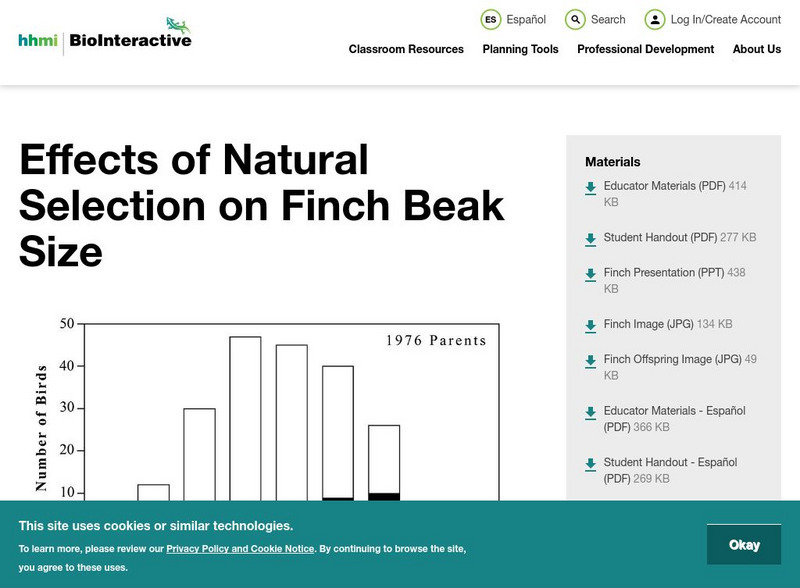
Hhmi: Bio Interactive: Effects of Natural Selection on Finch Beak Size
In this activity, students examine research on finches on the island of Daphne Major in the Galapagos Islands. The depth of the finches' beaks was measured before and after a drought. This data is displayed in graphs and students are...

Vision Learning
Visionlearning: Biology: Galapagos Finches
Interactive animation illustrates how Charles Darwin used his study of finch beaks to explain evolution. A phylogenetic tree diagram shows how the birds' color and beak shape changed over generations.

PBS
Pbs Learning Media: Adaptive Radiation: Darwin's Finches
Finches on the Galapagos Islands have evolved to exploit almost every possible niche. This diagram shows the range of food sources available on the island and the different beak shapes adapted to exploit each of them. Includes background...
Science Education Resource Center at Carleton College
Serc: Being Darwin's Finches
In this biology activity, students will be investigating evolution by "competing" for food like Darwin's finches might have competed. Each student group is given a different type of "beak" to work with and there are also different kinds...
![Pbs Learning Media: Finch Beak Data Sheet [Pdf] Website](https://content.lessonplanet.com/knovation/original/38853-54307de55e3ff0df41d67fbc6e061b4b.jpg?1661365772 "Pbs Learning Media: Finch Beak Data Sheet [Pdf] Website")
PBS
Pbs Learning Media: Finch Beak Data Sheet [Pdf]
This graphic from Ecology and Evolution of Darwin's Finches by Peter Grant presents data from the Galapagos Islands, showing that a severe drought put selective pressure on the population of Darwin's finches and resulted in a change in...

Other
Explore Learning: Rainfall and Bird Beaks
Explore how environmental conditions affect the adaptation of birds in this simulation. The amount of annual precipitation on an island is controlled by you while you track changes in the thickness of bird beaks over a five-year period....
Vision Learning
Visionlearning: Biology: Charles Darwin Iii: Descent With Modification
Instructional module focusing on Charles Darwin's theory of Descent with Modification. Discusses how slight changes from parent to offspring create variation and potentially create new species over time. Site also includes an interactive...