Hi, what do you want to do?






Star Date
Modeling the Night Sky
Dramatize the stars and planets as they become a visual representation of the solar system in this activity. Young astronomers track and simulate various constellations as they orbit the Earth to learn the position and motion of...

University of Texas
Observing the Moon
Why does it look like there is a man on the moon? Why does the moon look different every night? These are the focus questions of a lesson that prompts class members to observe and record the nightly changes of Earth's natural...

Teach Engineering
Ice, Ice, PV!
Knowing the temperature coefficient allows for the calculation of voltage output at any temperature. Groups conduct an experiment to determine the effects of temperature on the power output of a solar panel. The teams alter the...

Big Kid Science
Eclipse Classroom Activities: Cultural Significance Project
What better way to celebrate eclipses than across cultures? Explore myths of solar and lunar eclipses from ancient cultures like the Chinese, Ancient Greek, Mesoamerican, Incan, Egyptian, Ancient Babylonian, and Middle Eastern. Learners...

Wilderness Classroom
Ocean Life
Our oceans are composed of many complex relationships. Young oceanographers explore relationships between organisms, understand the world ocean's currents, and discover the effects of water pollution and how it behaves. There are...

Mr. Jones's Science Class
Planet Presentation
Upper-elementary astronomers take on the role of interplanetary real estate salesmen. They research an assigned planet and create a PowerPoint to persuade the rest of the class to purchase property and move there. This fun project would...
TeachEngineering
Teach Engineering: Renewable Energy Living Lab
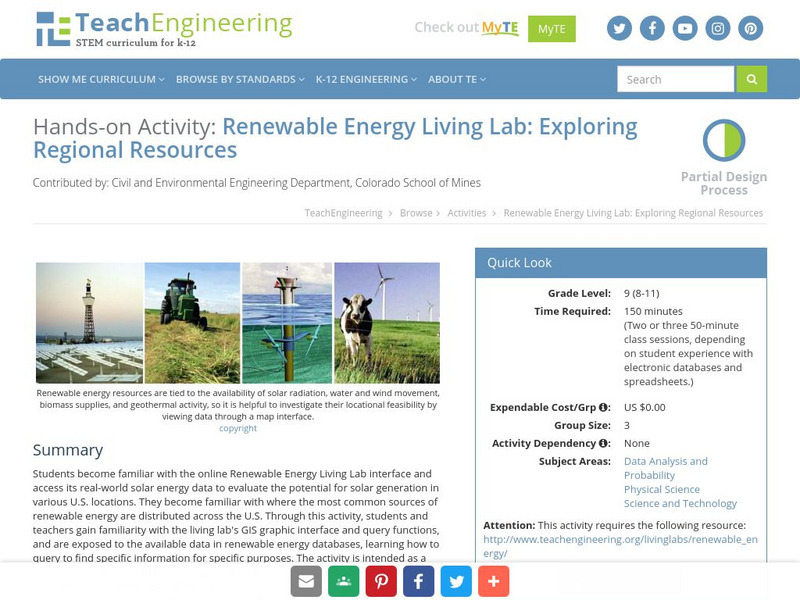
Students become familiar with the online Renewable Energy Living Lab interface and access its real-world solar energy data to evaluate the potential for solar generation in various U.S. locations. They become familiar with where the most...