Hi, what do you want to do?






Curated OER
Light as Waves and Particles
Eleventh graders explore the wave and particle properties of light.

Discovery Education
Sonar & Echolocation
A well-designed, comprehensive, and attractive slide show supports direct instruction on how sonar and echolocation work. Contained within the slides are links to interactive websites and instructions for using apps on a mobile device to...

Curated OER
Differential Thermal Calorimetry
Young scholars access prior knowledge of infrared rays, ultraviolet rays, gamma rays, x-rays and cosmic waves. In this electromagnetic waves lesson, students hold a mock trial electromagnetic spectrum. Young scholars present...

Curated OER
The Physics of Hummingbirds: Magic in the Air
Students study hummingbirds and how they use Newton's law. In this motion lesson students complete several activities and view videos of hummingbirds.

Curated OER
What You See Is What You Get
Students explore light and colors. They see how white light is made up of various colors. They need to have some background knowledge about prisms, light wave lengths, and behavior of light, primary and secondary colors, and ratios.

Curated OER
Sound Energy
Sixth graders understand properties and behavior of heat, light, and sound. They describe the production of sound in terms of vibration of objects that create vibrations in other materials. Students describe how sound is made from...

Curated OER
Enlightening Explorations, Part III
Sixth graders continue their examination of light. In groups, they make rainbows and examine the spectrum of visible light. They travel between various stations recording their observations about the behaviors of light. To end the...

Curated OER
Playground Games
Students compete in playground games in order to review velocity and wave behavior in real life situations. They demonstrate understanding by calculating velocity in their "Playground Games" packet.

Curated OER
Chemistry 301
In this chemistry 301 instructional activity, students answer questions as it relates to the electron configuration of given elements. Students use the periodic table to assist in their interpretation of the questions provided.

Curated OER
Jell-O Optics
Students observe an activity with Jell-O to learn about optics. In this investigative lesson students fill out a handout on the activity that helps them to investigate the index of refraction and the speed of light.

Curated OER
Sound
Fifth graders explore and examine the basic properties of sound. In pairs, they speak through a balloon and listen to the sound vibrations, and listen to a ticking clock or watch through a variety of materials and identify the...

Curated OER
Modeling Drug Assimilation in the Human Body
Students investigate the accumulation of drugs in the body. In this algebra lesson, students collect data on drug retention and assimilation. They use their data to predict the behavior and effects of drugs.

Curated OER
Niels Bohr
In this online interactive history worksheet, students respond to 9 short answer and essay questions about the achievements of Niels Bohr. Students may check some of their answers on the interactive worksheet.

Physics Classroom
The Physics Classroom: Light Waves and Color
The behavior of light waves is introduced and discussed. Also, polarization, color, diffraction, and interference are introduced and discussed thoroughly as supporting evidence of the wave nature of light.
Physics Classroom
The Physics Classroom: Wavelike Behaviors of Light
How light waves demonstrate their wave nature by reflection, refraction, and diffraction.
Physics Classroom
The Physics Classroom: Light Waves and Color: Wavelike Behaviors of Light
In this series of interactive physics tutorials, students will focus on the wavelike nature of light.
Ducksters
Ducksters: Physics for Kids: Behavior of Light as a Wave
Kids learn about the behavior of light as a wave in the science of physics including reflection, refraction, and diffraction.
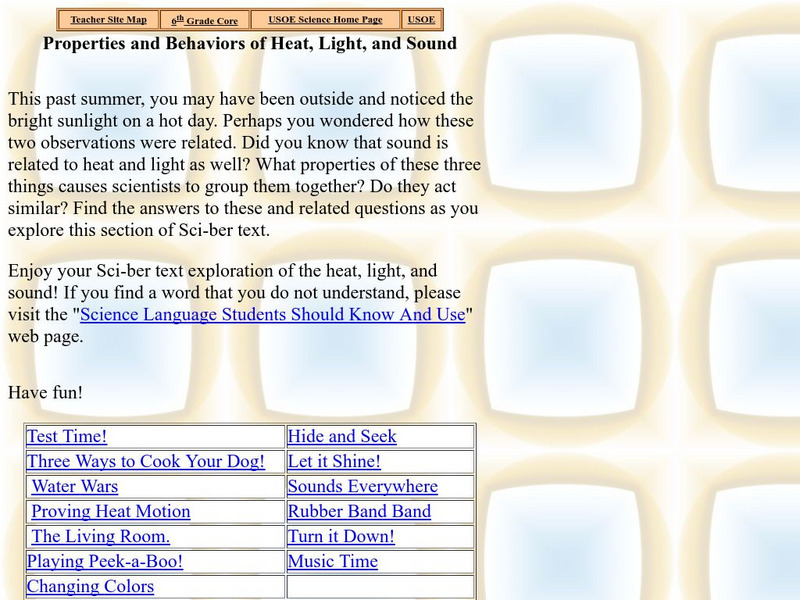
Utah State Office of Education
Utah Science: Properties and Behaviors of Heat, Light and Sound
How can scientists lump heat, light and sound together when investigating properties and behaviors? This learning module will address that question through a series of activities.
Physics Classroom
The Physics Classroom: Refraction and the Ray Model of Light: Boundary Behavior
In this physics tutorial, focus on the refraction of light in great detail. Explore the conceptual and mathematical principles governing the bending of waves as they cross the boundary between two media.
Physics Classroom
The Physics Classroom: Light Waves and Color: Thin Film Interference
Students investigate an example of interference that provides further evidence in support of the wavelike behavior of light.
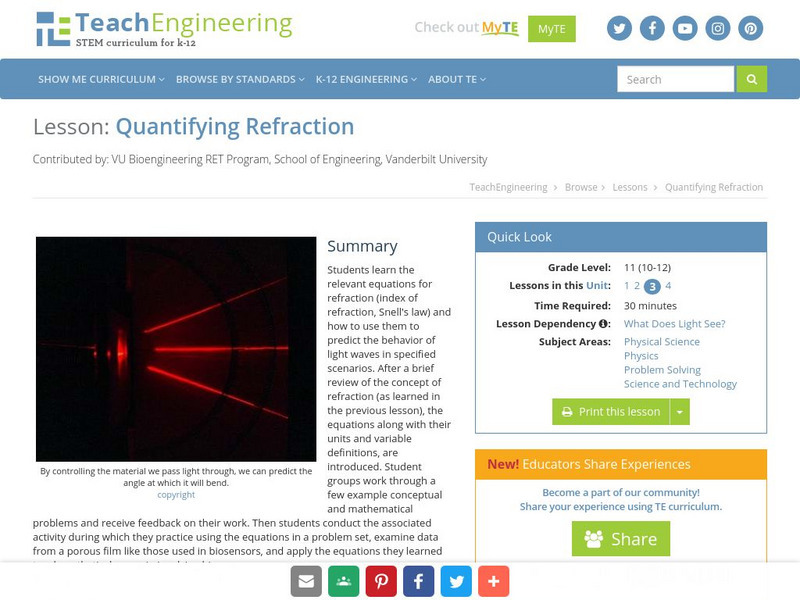
TeachEngineering
Teach Engineering: Quantifying Refraction
Students learn the relevant equations for refraction (index of refraction and Snell's law) and how to use them to predict the behavior of light waves in specified scenarios.
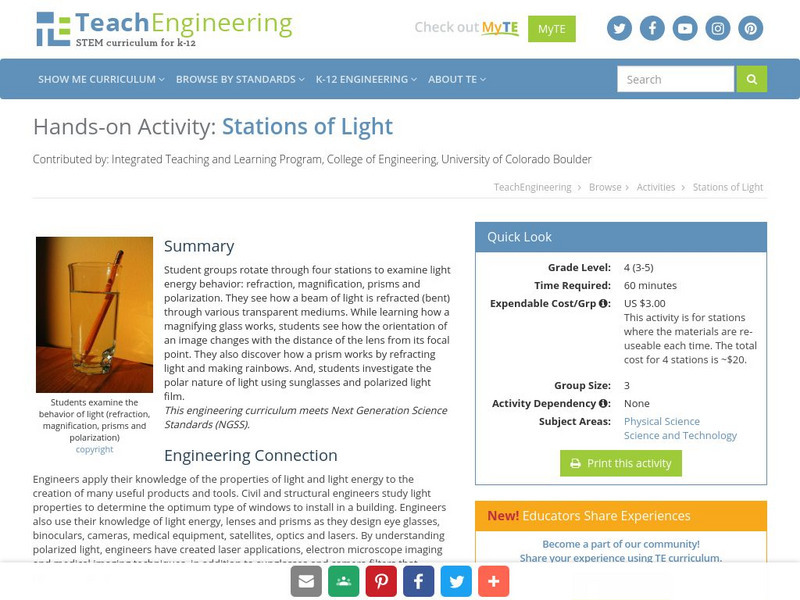
TeachEngineering
Teach Engineering: Stations of Light
Student groups rotate through four stations to examine light energy behavior: refraction, magnification, prisms and polarization. They see how a beam of light is refracted (bent) through various transparent mediums. While learning how a...
TeachEngineering
Teach Engineering: Learning Light's Properties
Students learn the basic properties of light--the concepts of light absorption, transmission, reflection and refraction, as well as the behavior of light during interference. Lecture information briefly addresses the electromagnetic...
Other
University of Tennessee Knoxville: Diffraction and Interference
Explains what diffraction and interference are, and what kinds of patterns are produced when light waves pass through a single slit, a double slit, or a diffraction grating. Includes three problems for students to try, with solutions...