Hi, what do you want to do?





Globe
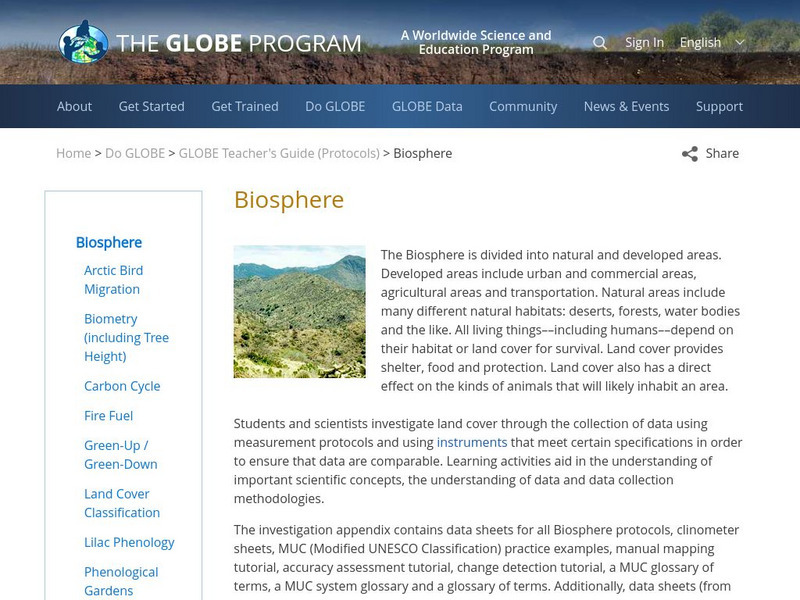
The Globe Program: Biosphere
Website from Global Learning and Observations to Benefit the Environment (GLOBE) Program with comprehensive learning and field study resources on the biosphere in which students use materials and data to make observations and learn about...

Morning Earth
Biosphere as Place: Ocean Benthic Biomes One
Students investigate the Biology topic of ecosystems. The marine ecosystem tutorial consists of definitions, pictures, and examples of different ocean-benthic biomes.
Morning Earth
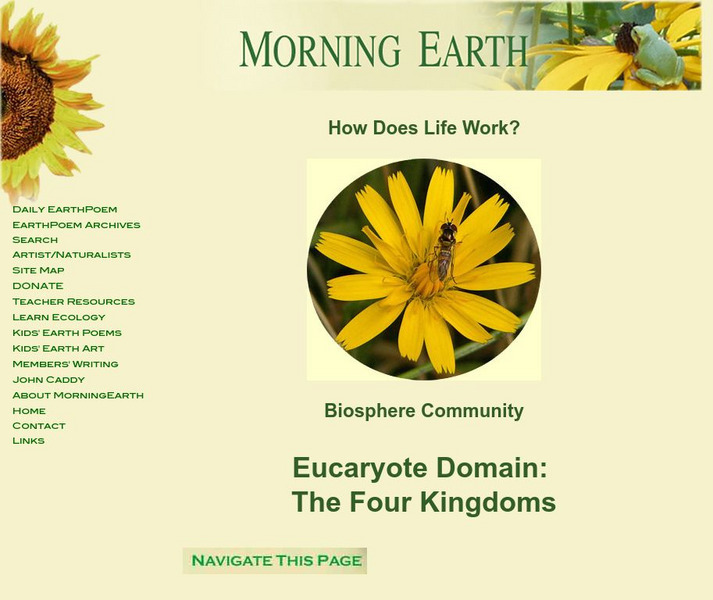
Biosphere Community: Eucaryote Domain: The Four Kingdoms
Scholars explore concepts in Biology. The tutorial consists of definitions, examples, and pictures about the four kingdoms of Eucaryotes.
Morning Earth
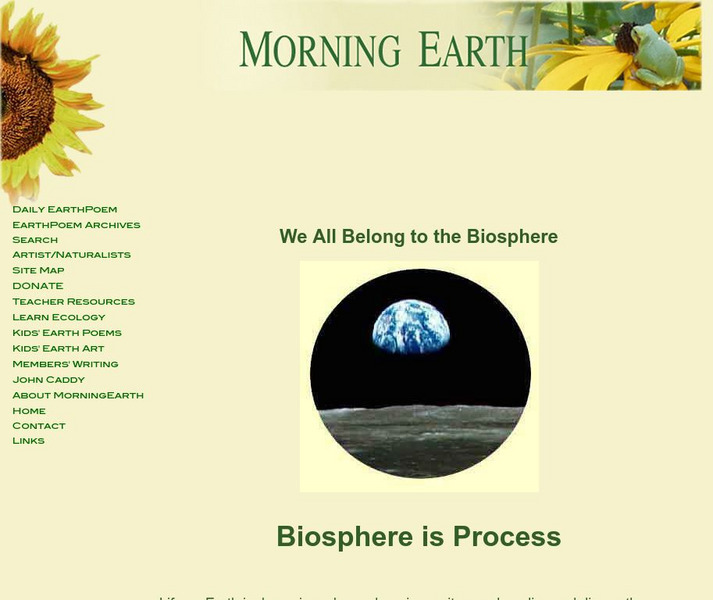
How Life Works: Biosphere Is Process: Life Helps Make Earth's Crust
Scholars explore the Earth science topic of the Earth's basic structure. The tutorial consists of definitions and pictures about the Earth's crust.
PBS
Pbs Learning Media: Linking Vegetation Growth to Rainfall
The earth has four integrated subsystems that depend on one another. Study how the biosphere and hydrosphere interact by viewing videos based on data collected by NASA. This data shows the correlation between rainfall amounts...
Science Buddies
Science Buddies: Growing a Soil Menagerie
Everything on our planet is linked by a giant recycling system called the biogeochemical cycle. How our planet recycles and reuses everything we need to support life is explained by making a miniature biosphere in this lab. You will also...
Mocomi & Anibrain Digital Technologies
Mocomi: Carbon Cycle
The carbon cycle is one of the most important cycles. It is the biogeochemical cycle by which carbon is exchanged among the biosphere, pedosphere, geosphere, hydrosphere, and atmosphere of the Earth. This cycle is important because it...
Other
My Science Box: Ecosystem Organization
In this instructional activity, students will learn about the different levels in the hierarchy of ecology and explain the relationships: organism, population, community, ecosystem, biome, and biosphere. They will also discover why...
Famous Scientists
Famous Scientists: Vladimir Vernadsky
Find out about Vladimir Vernadsky, considered one of the founders of geochemistry, biogeochemistry, and of radiogeology, and most noted for his 1926 book The Biosphere in which he inadvertently worked to popularize that term.
TeachEngineering
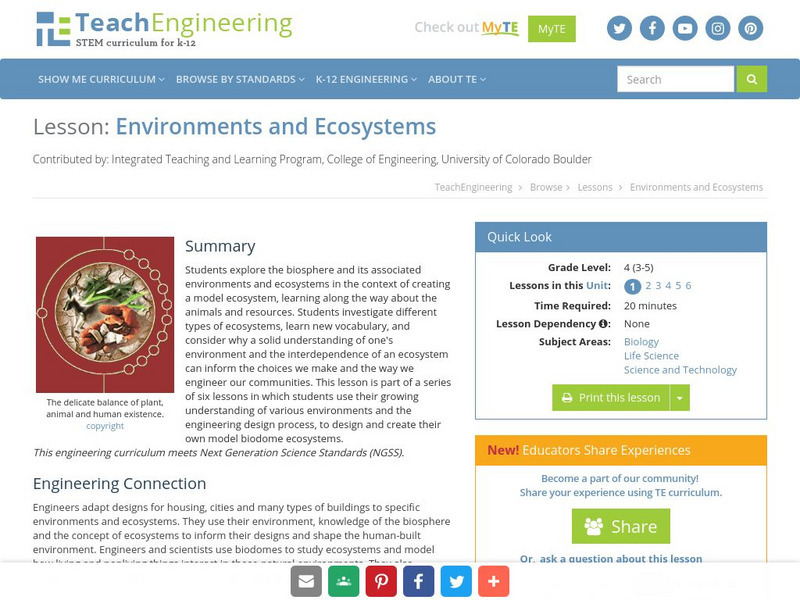
Teach Engineering: Environments and Ecosystems
Young scholars explore the biosphere and its associated environments and ecosystems in the context of creating a model ecosystem, learning along the way about the animals and resources. Students investigate different types of ecosystems,...
TeachEngineering
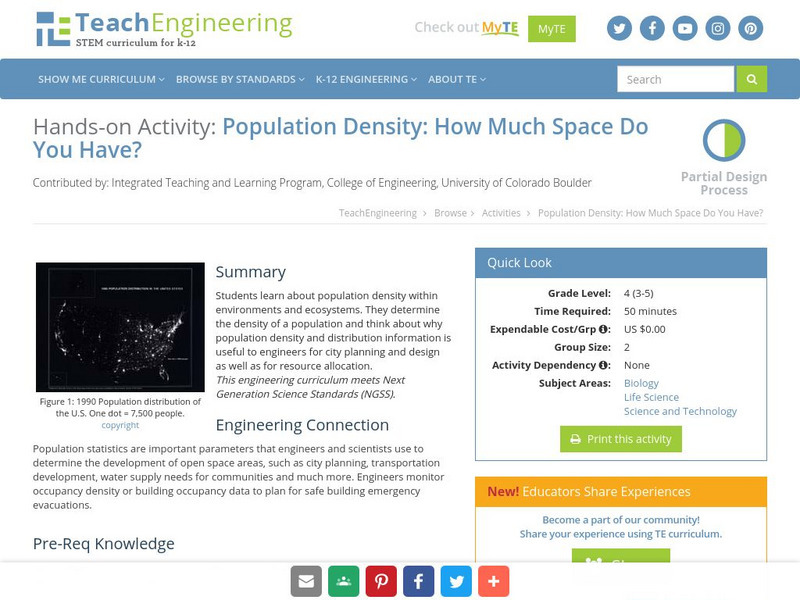
Teach Engineering: Population Density: How Much Space Do You Have?
Students learn about population density within environments and ecosystems. They determine the density of a population and think about why population density and distribution information is useful to engineers for city planning and...
University Corporation for Atmospheric Research
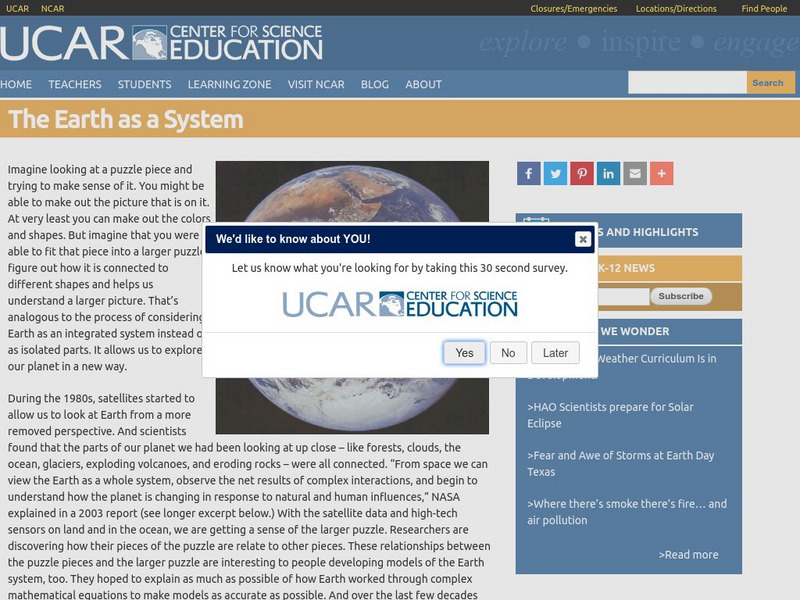
Ucar: The Earth as a System
An overview of content about Earth and its atmosphere. The module was developed for middle school science teachers to provide background information for teaching the curriculum.
Other
Abiotic Factors
Abiotic components are the nonliving components of the biosphere. Chemical and geological factors, such as rocks and minerals, and physical factors, such as temperature and weather, are referred to as abiotic components.
American Geosciences Institute
American Geosciences Institute: Earth Science Week: Surficial Features
Using a surficial features map, students see the connections between those features and other Earth systems. They will consider the interactions of the geosphere, hydrosphere, biosphere, and atmosphere.
BiologyWise
Biology Wise: The Levels of Organization of Living Things
Explains the importance of systems of organization in biology and describes the thirteen levels of organization, from the atom up to the biosphere.
BiologyWise
Biology Wise: Levels of Biological Organization
Describes the levels of organization in biology, from the subatomic particle up to the biosphere.
University of Wisconsin
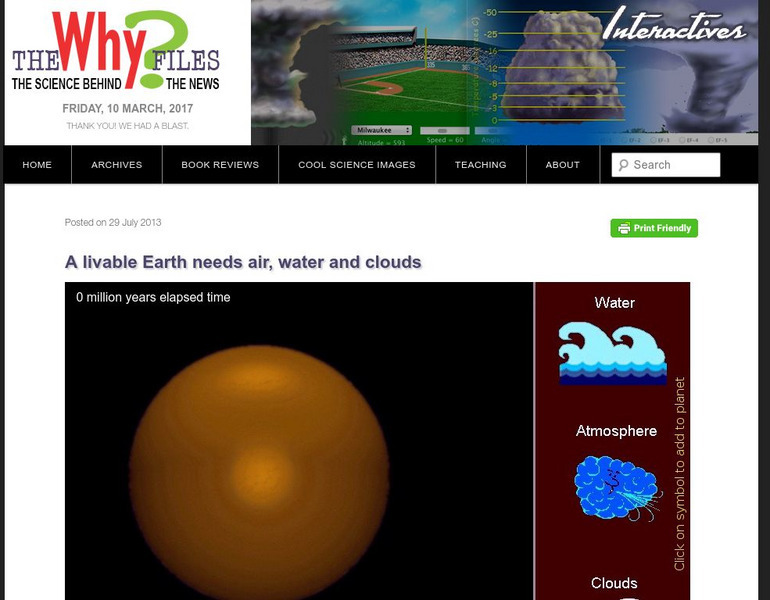
The Why Files: A Livable Earth Needs Air, Water, and Clouds
Make Earth's climate livable by adding the right amount of air, water, and clouds to its surface and atmosphere.
Morning Earth
Morning Earth: Ansel Adams
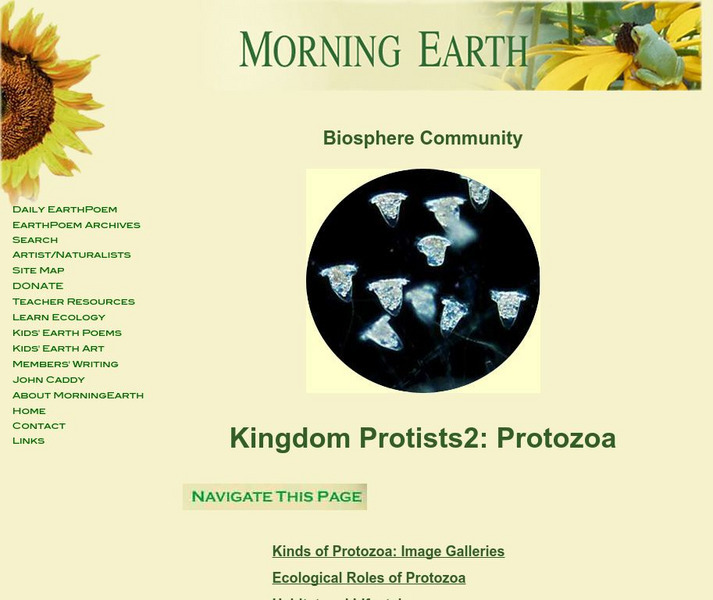
Scholars explore the Biology concept of microorganisms. The tutorial consists of definitions, examples, and pictures about protozoa.
Other popular searches
- Biosphere and Hydrosphere
- Biosphere Ecology
- Biosphere Experiment
- Diagram of Biosphere
- Biosphere Lab Activity
- Biosphere and Lithosphere
- Geography Biosphere
- Discrepant Events Biosphere
- Biosphere Bottle Biology
- Biology: The Biosphere
- "Climate" Biosphere
- "Biomes" Biosphere