Hi, what do you want to do?






Khan Academy
Khan Academy: Squash and Stretch Animation With Bezier Curves
In this practice exercise students use the program below to create an animation of a bouncing ball. See if you can get the ball to squash as it hits the ground and stretch as it bounces back.
Other
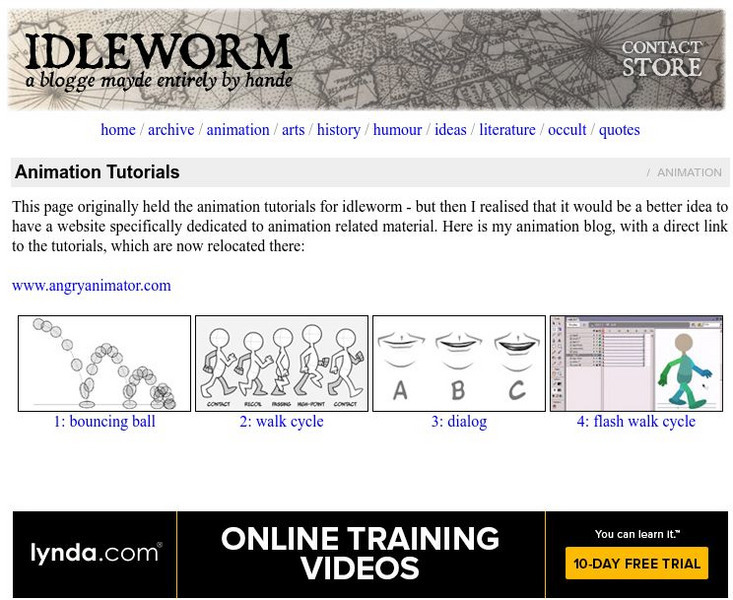
Idleworm: Animation Drawing Lessons
Animation drawing lessons for the beginner. There are two lessons: "The Bouncing Ball" and "The Walk Cycle." Both lessons are simplified for the beginner. A great resource!

The Tech Interactive
Tech Museum of Innovation: Common Light Sources
While reviewing various light sources, the source of colors (white, red, yellow, blue) are also discussed. The bouncing of light, the matching of colors, and seeing colors are all highlighted.
Physics Aviary
Physics Aviary: Energy Loss Lab
This lab is designed to have students investigate the amount of energy lost by a ball when it bounces. Students will change the starting height of the ball and see how this affects the amount of energy lost and the percent of the...

Khan Academy
Khan Academy: Straight Ahead Animation (Practice)
Try to make an animation of a bouncing ball by positioning the ball in each frame.

Australian Broadcasting Corporation
Australian Broadcasting Corporation: News in Science: Big Bang May Have Been a Big Bounce
From ABC News in Science, Larry O'Hanlon's article suggests the possibility of the Big Bang having been created out of the remains of a previous universe which collapsed upon itself.
The Federal Reserve System
Federal Reserve Board: Will Business Investment Bounce Back?
Federal Reserve Board Governor Ben S. Bernanke discusses business investment trends to the Forecasters Club in New York City. (April 24, 2003)

PBS
Pbs Teachers: Daredevil Ball Jump Ii Experiment
Make alterations in the variables of the original ZOOM Daredevil Ball Jump activity by heating or cooling the balls in the experiment. Predict how the balls' bounces will be affected by hot and cold, test the predictions and record the...
TeachEngineering
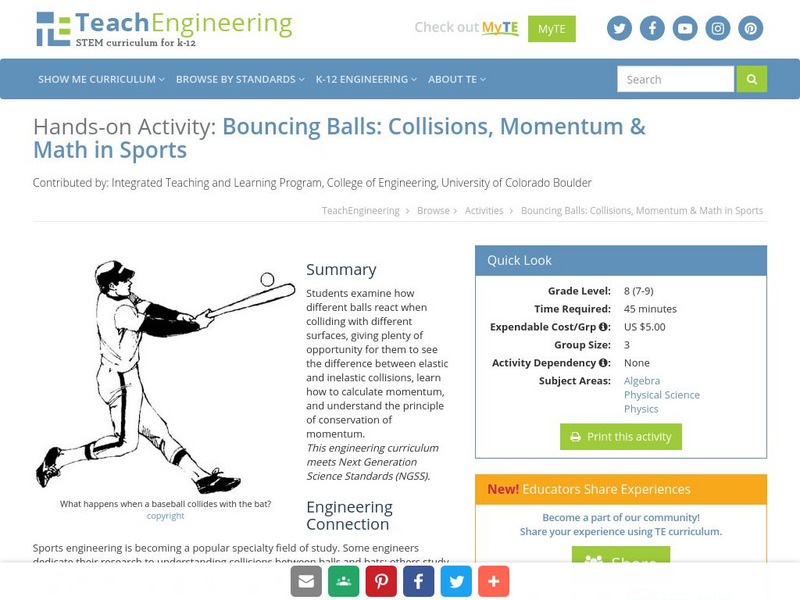
Teach Engineering: Bouncing Balls
Students examine how different balls react when colliding with different surfaces, giving plenty of opportunity for them to see the difference between elastic and inelastic collisions, learn how to calculate momentum, and understand the...
TeachEngineering
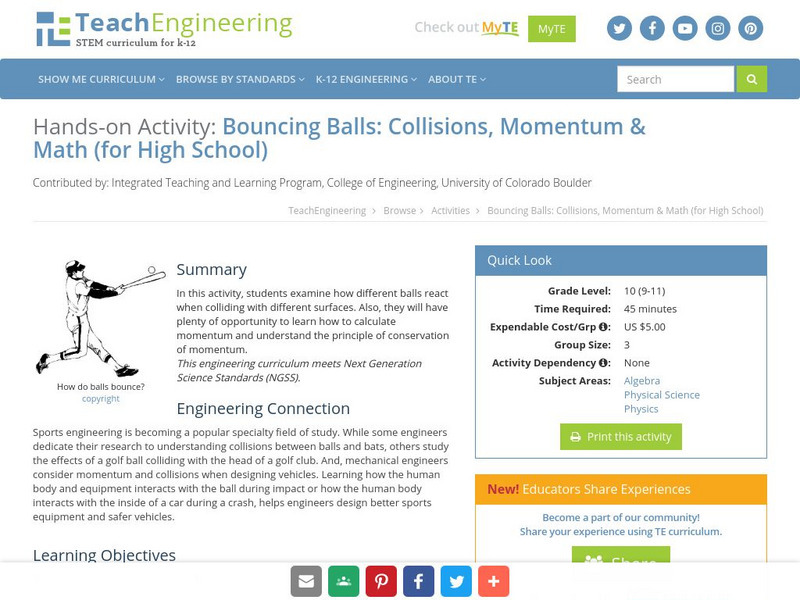
Teach Engineering: Bouncing Balls (For High School)
In this activity, students examine how different balls react when colliding with different surfaces. Also, they will have plenty of opportunity to learn how to calculate momentum and understand the principle of conservation of momentum.

PBS
Pbs Teachers: Daredevil Ball Jump Experiment
Construct a device to measure the height of a bounced ball, then compare the bouncing heights of various types of balls. Record the results on a chart.
University of Colorado
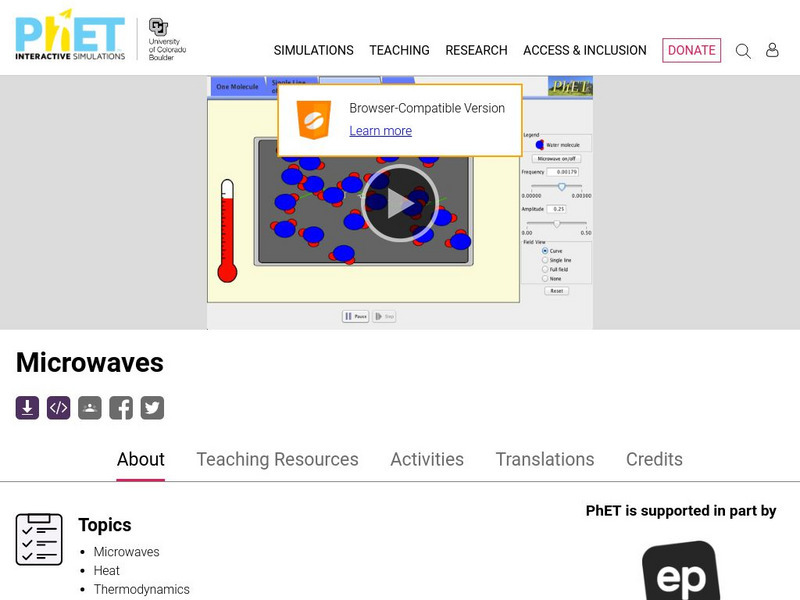
University of Colorado: Ph Et Interactive Simulations: Microwaves
How do microwaves heat up your coffee? Adjust the frequency and amplitude of microwaves. Watch water molecules rotating and bouncing around. View the microwave field as a wave, a single line of vectors, or the entire field.
TeachEngineering
Teach Engineering: The Optimization of Slime
Using their knowledge of the phases of matter, the scientific method, and polymers, student teams work as if they are chemical engineers to optimize the formula for slime. Hired by the fictional company, Slime Productions, students are...

Other
Embrace the Future: Resilient Kids
Advice about strengthening your ability to bounce back from adversity. Learn key skills, such as problem solving, making friends, and positive thinking, that will help you stay happy, healthy, and productive.
Sophia Learning
Sophia: Bill Nye Demonstration: Happy and Unhappy Ball
What happens when a ball bounces? Learn about liquid nitrogen as Bill Nye the Science Guy demonstrates what happens to everyday materials when placed in it. [0:22]
TeachEngineering
Teach Engineering: Energy of Motion
By taking a look at the energy of motion all around us, students learn about the types of energy and their characteristics. They first learn about the two simplest forms of mechanical energy: kinetic and potential energy, as illustrated...

Other
Vic Firth: Snare Drum Rudiments
All 40 of The Percussive Arts Society's Essential Snare Drum Rudiments are found on this site. Each rudiment includes audio and video so you can see and hear how the rudiments should be practiced. There are also many helpful tips on how...

PBS
Pbs: Bombing Nazi Dams
It was 1943, and the British were retaliating. Here is the story of the famous Lancaster bomber and the brave British pilots that tried to stop Nazi Germany.
Texas Instruments
Texas Instruments: On the Rebound
In this activity, students collect motion data for a bouncing ball using a motion detector. They analyze the data and attempt to find the exponential relationship between the bounce number and maximum height that the bounce reaches.
Illustrative Mathematics
Illustrative Mathematics: F Le Basketball Rebounds
The purpose of this task is to introduce students to an exponential decay function in the form f(x) = abx, with a concrete interpretation of the decay factor b. A table shows the rebound height of a basketball for each successive bounce....
Other
Port Discovery Children's Museum: Stem at Home: Bouncy Egg Experiment
Would you believe us if we told you we could make an egg bounce without breaking? Check out this experiment. It requires just three ingredients and five easy steps to learn how to bounce an egg.
Scholastic
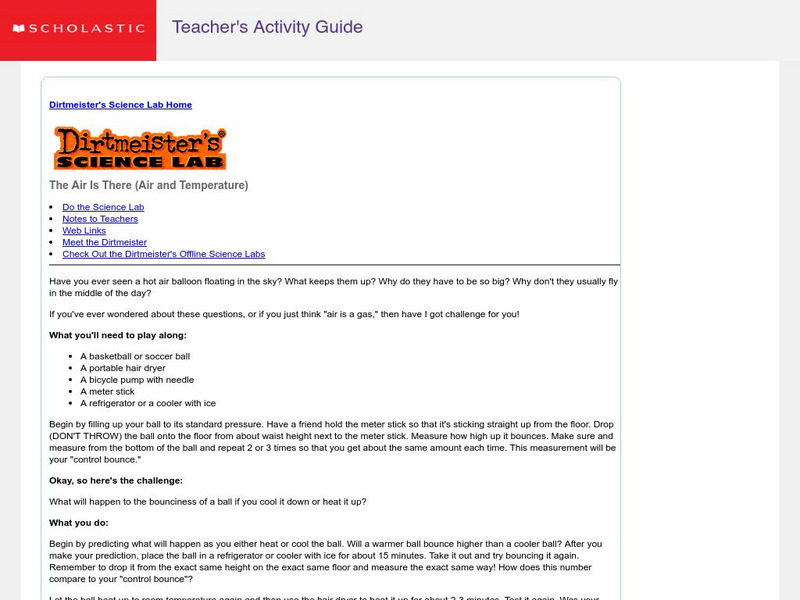
Scholastic: Dirtmeister's Science Lab: The Air Is There
An experiment to see how the temperature of an object affects how high it bounces. This site contains web links and notes for the teacher.
American Museum of Natural History
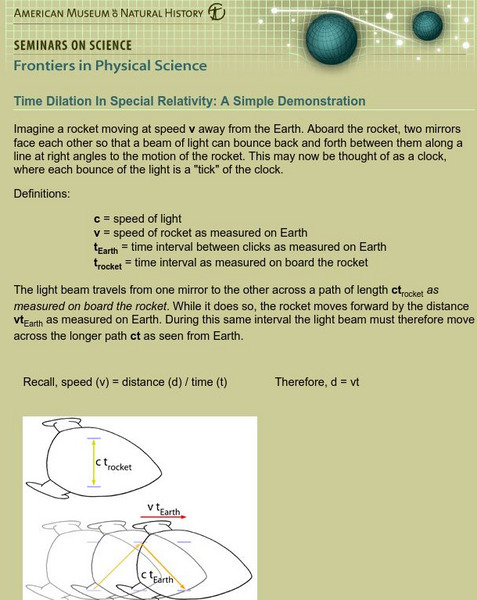
American Museum of Natural History: Resources: Time Dilation Equation
Using an example of light bouncing back and forth between two mirrors in a rocket, time dilation is explained in this resource. Step-by-step calculations using Einstein's time dilation equation are shown.
Texas Instruments
Texas Instruments: Curve Ball Adventure 12
In this adventure , students will make a Height-Time plot of a bouncing ball using the CBR 2. They graph height as a function of time. They identify and understand the vertex form of a quadratic equation that is generated to describe the...
Other popular searches
- Ball Bounce Experiment
- Bounce Pass
- Bounce a Ball
- Basketball Bounce Pass
- Tennis Ball Bounce
- Bounce Height
- Bounce Angles
- Bounce the Balls
- Basketball Bounce
- Bounce Pass Lesson
- Bounce Lab
- Bounce of Ball