Hi, what do you want to do?





TeachEngineering
Teach Engineering: Collisions and Momentum: Bouncing Balls
As a continuation of the theme of potential and kinetic energy, this lesson introduces the concepts of momentum, elastic and inelastic collisions. Many sports and games, such as baseball and ping-pong, illustrate the ideas of momentum...
Texas Instruments
Texas Instruments: Bouncing Ball
In this activity, students' will create a Height-Time plot for a bouncing ball. They will examine how the ball's height changes mathematically from one bounce to the next.
Texas Instruments
Texas Instruments: The Golf Ball Challenge
In this activity, students will measure the bounce heights of golf balls dropped from a height. They examine the geometric sequence in the successive bounce heights and determine the constant or common ratio and the rate of decay of the...
Texas Instruments
Texas Instruments: Bouncing Ball
In this experiment, students collect the height versus time data of a bouncing ball using the CBR 2. This activity investigates the values of height, time, and the coefficient A in the quadratic equation, which describes the behavior of...
Texas Instruments
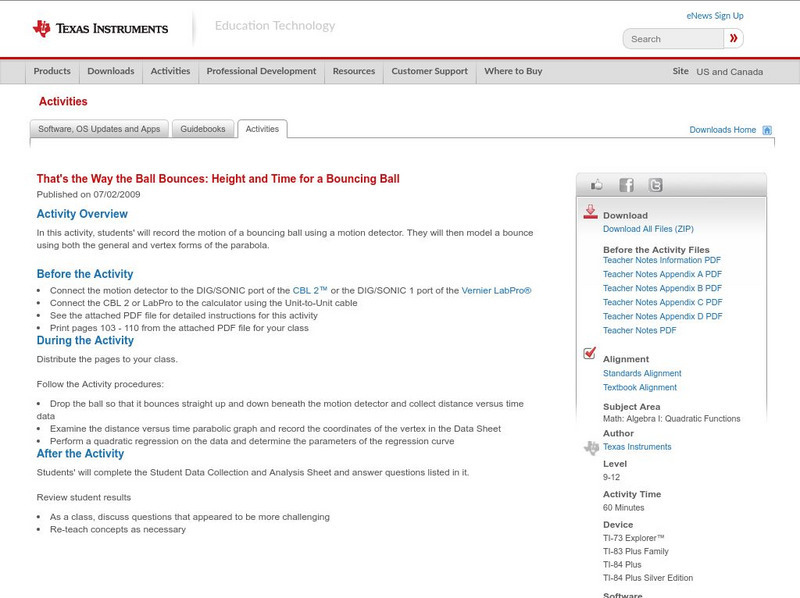
Texas Instruments: Height and Time for a Bouncing Ball
In this activity, students' will record the motion of a bouncing ball using a motion detector. They will then model a bounce using both the general and vertex forms of the parabola.
Texas Instruments
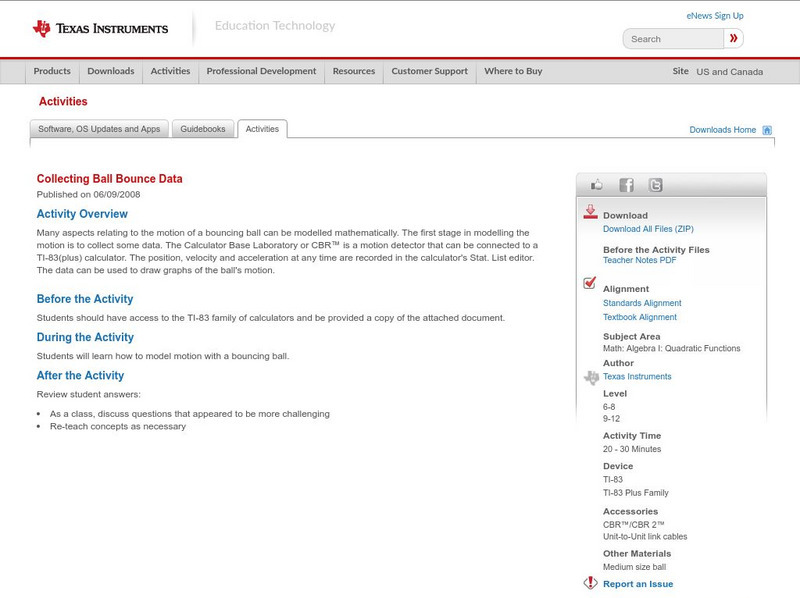
Texas Instruments: Collecting Ball Bounce Data
Many aspects relating to the motion of a bouncing ball can be modelled mathematically. The first stage in modelling the motion is to collect some data. The Calculator Base Laboratory or CBR is a motion detector that can be connected to a...

Texas Instruments
Texas Instruments: How High Will It Bounce?
In this activity, students collect the height versus time data of a bouncing ball using the CBR 2. They find the relationship between the bounce number and the bounce height. They learn to graph scatter plots, calculate the maximum value...

Texas Instruments
Texas Instruments: Ball Bounce
This activity allows students to use real data obtained by them to model quadratic equations. students can use the TI-83 and/or TI-84 and a motion detector to collect their data. The students will then manually fit both quadratic and...
Texas Instruments
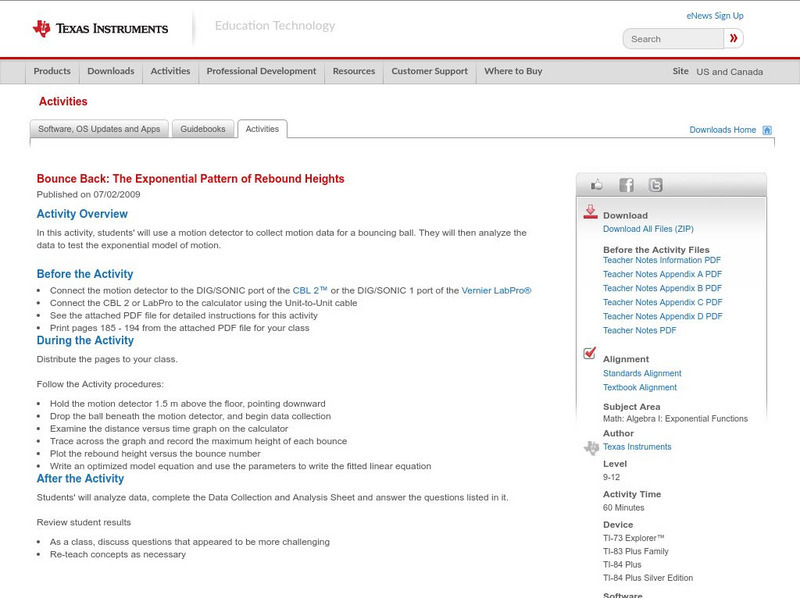
Texas Instruments: Bounce Back: The Exponential Pattern of Rebound Heights
In this activity, students' will use a motion detector to collect motion data for a bouncing ball. They will then analyze the data to test the exponential model of motion.

Texas Instruments
Texas Instruments: Curve Ball Adventure 12
In this adventure , students will make a Height-Time plot of a bouncing ball using the CBR 2. They graph height as a function of time. They identify and understand the vertex form of a quadratic equation that is generated to describe the...
Texas Instruments
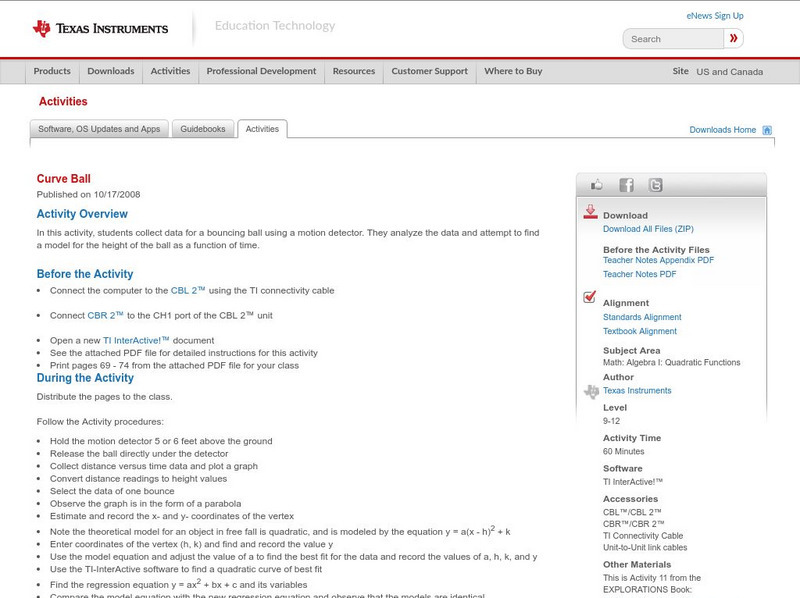
Texas Instruments: Curve Ball
In this activity, students collect data for a bouncing ball using a motion detector. They analyze the data and attempt to find a model for the height of the ball as a function of time.
Texas Instruments
Texas Instruments: Curve Ball
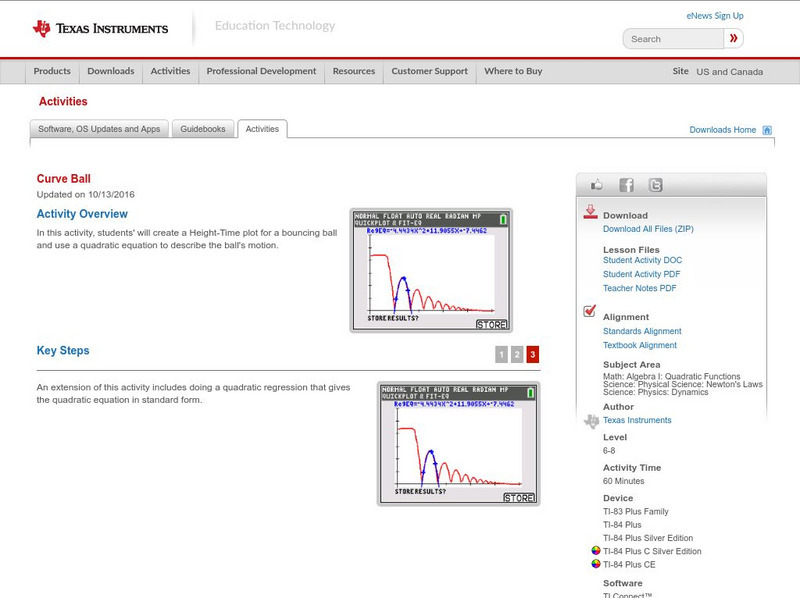
In this activity, students will create a Height-Time plot for a bouncing ball and use a quadratic equation to describe the ball's motion.

Khan Academy
Khan Academy: Animation 101 (Practice)
This is a 7-problem quiz/practice bouncing a ball using the squash and stretch with Bezier curves.

Science Buddies
Science Buddies: Follow the Bouncing Ball: A Web Animation Project
This project is a fun way to try your hand at programming. You'll learn how to create some simple animations, and you'll perform tests and make measurements to help you create more realistic-looking animations. All you need to get...

Science Buddies
Science Buddies: Follow the Bouncing Ball: A Web Animation Project
This project is a fun way to try your hand at programming and expand your knowledge of web design. You will learn how to create some simple animations, and perform tests and make measurements to help you create more realistic-looking...

PBS
Pbs Teachers: Daredevil Ball Jump Experiment
Construct a device to measure the height of a bounced ball, then compare the bouncing heights of various types of balls. Record the results on a chart.
MadSci Network
The Mad Scientist Network: Bouncing Rubber Ball
A question and answer format is used to relate elastic potential energy to the bounce of a rubber ball. Explanation of this simple phenomenon is thorough, complete, and free of trite statements.
TeachEngineering
Teach Engineering: How High Can a Super Ball Bounce?
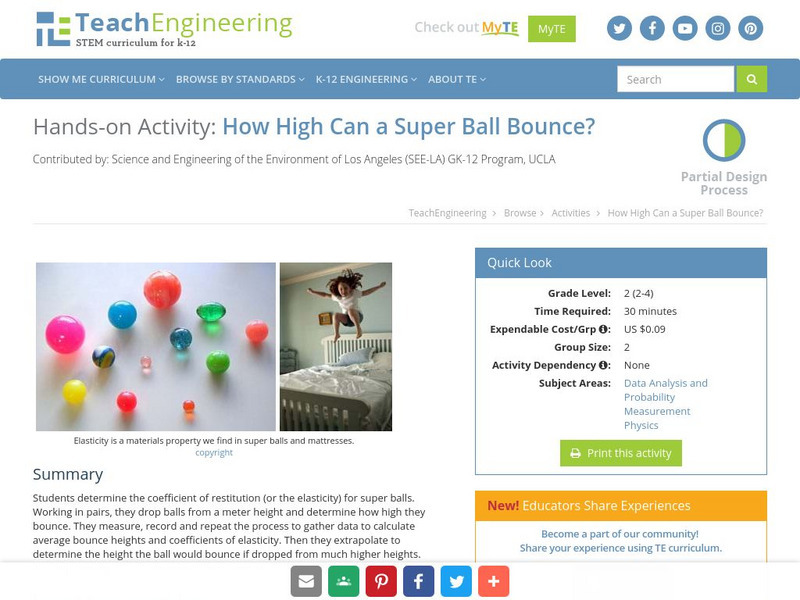
Students determine the coefficient of restitution (or the elasticity) for super balls. Working in pairs, they drop balls from a meter height and determine how high they bounce. They measure, record and repeat the process to gather data...

Physics Aviary
Physics Aviary: Energy Loss Lab
This lab is designed to have students investigate the amount of energy lost by a ball when it bounces. Students will change the starting height of the ball and see how this affects the amount of energy lost and the percent of the...
ABCya
Ab Cya: Sparkanoid
Each level presents a new challenge in this outer space Brakeout game! Bounce the ball off your pad to destroy the blocks. Gather powerful boosts and destroy your enemies. Can you clear the field without losing the ball or being hit by...

Khan Academy
Khan Academy: Squash and Stretch Animation With Bezier Curves
In this practice exercise students use the program below to create an animation of a bouncing ball. See if you can get the ball to squash as it hits the ground and stretch as it bounces back.

Khan Academy
Khan Academy: Straight Ahead Animation (Practice)
Try to make an animation of a bouncing ball by positioning the ball in each frame.

Khan Academy
Khan Academy: Save Your Animation
Make and save your own animation! Use the program below to build your animation. Now you can move the ball anywhere as well as rotate it. Use the x and y avars to position the ball. Use the s avar to control the stretch and squash, and...

Khan Academy
Khan Academy: Hands on Activity: Animating Luxo Jr.
Begin your career as an animator now! This lesson is a series of hand-drawn challenges which will introduce some basic animation principles and get you thinking about the physics of motion.