Hi, what do you want to do?





Library of Congress
Loc: Journals of the Continental Congress, 1774 1789
Link directly to hypertext versions of the minutes recorded at the First and Second Continental Congresses. Included are the words of the various factions within the Congresses and the final resolutions that were passed, and then sent to...
University of Groningen
American History: Outlines: Louisiana and Britain
One of Jefferson's acts doubled the area of the country. At the end of the Seven Years' War, France had ceded to Spain the territory west of the Mississippi River, with the port of New Orleans near its mouth -- a port indispensable for...
Digital History
Digital History: The Revolution Begins
Perhaps if King George III had been attentive to the colonists' pleas, things would have turned out differently. Read about the siege of Boston by the British troops, and the "shot heard around the world."
History of American Wars
History of American Wars: Revolutionary War Timeline
A timeline showing the events leading up to the Revolutionary War, beginning with unpopular legislation implemented under British rule. It follows with the reaction of the American colonists and continues in a cause and effect manner...

Other
Worchester Polytechnic Institute: The Intolerable or Coercive Acts
A brief listing and description of the Acts of the British Parliament that were to be known as the Coercive Acts by Parliament and the Intolerable Acts by the Colonists.
Independence Hall Association
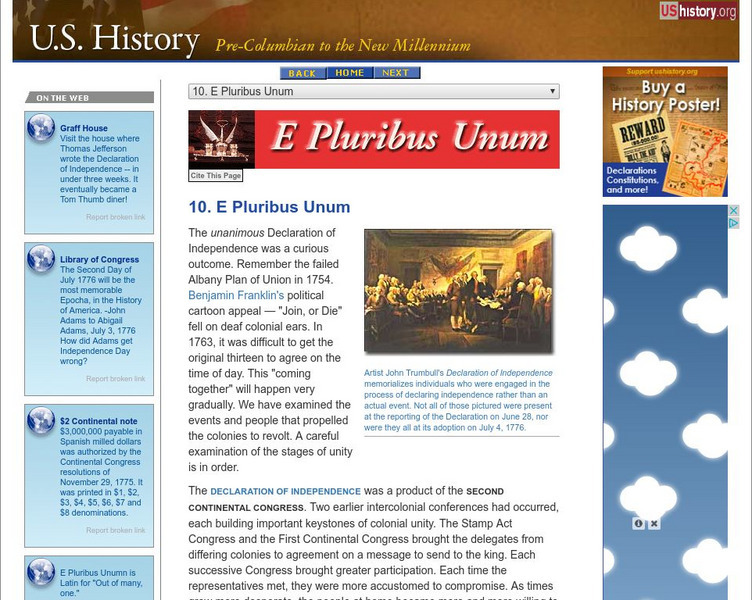
U.s. History: E Pluribus Unum
The fact that the Second Continental Congress convened was evidence that the colonists had had enough from the British Parliament. Read about the ways the colonies finally began to work together and focus on a common plan, resulting in...
Independence Hall Association
U.s. History: The Intolerable Acts
Find the response by the British Parliament to the dumping of tea into Boston Harbor. So many laws were enacted that the colonists lumped them together and called them the Intolerable Acts.
CommonLit
Common Lit: Benedict Arnold: Two Sides of a Bitter Coin by David White
Benedict Arnold (1741-1801) was an American general during the American Revolutionary War. He originally fought for the colonists' Continental Army but later defected to the British Army. Today, the name "Benedict Arnold" has become...
A&E Television
History.com: What Did the Three Continental Congresses Do?
During the Revolutionary War, the Continental Congress became America's de facto government. Over a period of 15 years, from 1774 to 1789, the Continental Congress underwent a profound evolution. Starting out as a temporary group that...

Library of Congress
Loc: Nathanael Greene Was Born
A note on Nathanael Greene, a friend of George Washington's and a Revolutionary War hero.
Ibis Communications
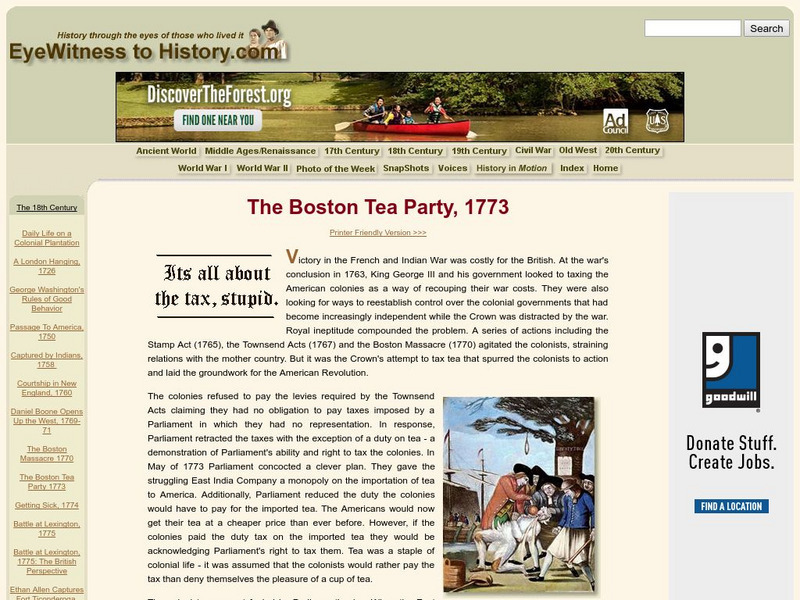
Eye Witness to History: The Boston Tea Party, 1773
This article details information surrounding the Boston Tea Party in 1773.
PBS
Pbs: Commanding Heights: Nigeria, an Overview
Brief timeline of Nigerian history in the twentieth century, from the PBS series "Commanding Heights: The Battle for the World Economy." Includes timeline entries related to independence, which was achieved in 1960.
University of Groningen
American History: Outlines: Taxing and Representation
Describes why the colonies objected to being taxed directly by Parliament for revenue. Contains quotes by James Otis and Samuel Adams. Explains the significance of the Stamp Act.
CommonLit
Common Lit: Text Sets: The American Colonies
Collection of 14 Grade-Leveled texts (4-11) on the topic "The American Colonies." What was life like for European settlers in the New World? How did American colonies function before the Revolutionary War? Explore life in the...

University of Groningen
American History: Outlines: Townshend Acts
Overview of the tax on goods imported to the colonies known as the Townshend Acts sparking protest in the colonies.
Other
Transcript of the Balfour Declaration, 1926 [Pdf]
The full text of the Balfour Declaration of 1926 that pronounced that all the dominions of Britain, including Britain itself, were all of equal status. A precursor to the Statute of Westminster.
Independence Hall Association
U.s. History: Lexington and Concord
Find a good overview of the "shot heard around the world," the battle at Lexington, and the continuance at Concord. Read Paul Revere's account of his famous ride, and follow his route on the map. Then find a brief account of the capture...
This Nation
This natiton.com: "Boston Massacre Oration" Hancock
The text of John Hancock's speech delivered on March 5, 1774, the fourth anniversary of the Boston Massacre of Colonists by British soldiers.
Digital History
Digital History: The Fate of Native Americans
A brief look at the inability of Native Americans to halt the settlement of their lands by American colonists after the French and Indian War. There is a short description of Chief Pontiac and his alliance of several tribes which fought...
Other
Boston History and Architecture: Boston Tea Party
Citing the Boston Tea Party has been a rallying cry. Find out what the real reasons were behind the actions of the Sons of Liberty on that night of December 16, 1773. What made the colonists so angry and the reactions of the British lay...

Ducksters
Ducksters: American Revolution for Kids: Boston Massacre
Kids learn about the Boston Massacre when British soldiers in Boston opened fire on a group of American colonists killing five men. Take a quiz at the end to see what you learned!
Curated OER
Image of Thomas Paine
Professor John Belchem, of the University of Liverpool, writes this scholarly profile of Thomas Paine for BBC History. In it he describes the tenor and impact of Paine's writings and explains the significance of Paine's thinking on the...

Other
All the News? American Revolution & Maryland's Press
Explore this collection of digitized historical newspapers and broadsides from the 1760s about pre-Revolutionary topics. Requires Adobe Reader.

Other
The History of Tobacco Part Ii
Extensive timeline (1492-1997) of tobacco cultivation--in three parts. Click links at bottom of pages to view Parts I, III, and IV.