Hi, what do you want to do?





University of Groningen
American History: Outlines: Debate and Compromise
The 18th-century statesmen who met in Philadelphia were adherents of Montesquieu's concept of the balance of power in politics. This principle was supported by colonial experience and strengthened by the writings of John Locke, with...
University of Groningen
American History: Outlines: Taxation Without Representation
Overview of the contentious struggle about taxation without representation between colonists and the British leading King George III and Parliament to overthrow the Stamp Act, but impose the Declaratory Act, asserting Parliament...
University of Groningen
American History: Outlines: Taxation Without Representation
The issue thus drawn centered on the question of representation. From the colonies' point of view, it was impossible to consider themselves represented in Parliament unless they actually elected members to the House of Commons. But this...
University of Groningen
American History: Outlines: Stamp Act
This site has the brief history and background of the Stamp Act of 1765 provided for by the University of Groningen.
University of Groningen
American History: Outlines: Boston "Tea Party"
Overview of the conflict between Britain and American colonists over policies imposed favoring the British East India Company leading to rebellion and what is known as the Boston Tea Party.
University of Groningen
American History: Outlines: A New Colonial System
Although some believe that the history of the American Revolution began long before the first shots were fired in 1775, England and America did not begin an overt parting of the ways until 1763, more than a century and a half after the...
BBC
Bbc: History: The Welfare State Never Ending Reform
An article by a British Member of Parliament that traces the history of the welfare state in Britain. It examines its beginning in the early 1900s through its overreaching problems at the end of the twentieth century. Archived.
Independence Hall Association
U.s. History: The Tea Act and Tea Parties
Read the text of the Tea Act, passed by the British Parliament primarily as a way to rescue the failing British East India Company. Find out about the colonists' reactions to this tax, and read a first-hand account of the Boston Tea Party.
BBC
Bbc: Bitesize History: The Chartists
Explains who the Chartists were and their first efforts to try to persuade the British Parliament to enact reforms for the working class. Their three petitions failed to move Parliament but increased the resolve of others to push for...

Independence Hall Association
U.s. History: The Intolerable Acts
Find the response by the British Parliament to the dumping of tea into Boston Harbor. So many laws were enacted that the colonists lumped them together and called them the Intolerable Acts.
Independence Hall Association
U.s. History: The Intolerable Acts
Details explaining what the Intolerable Acts were, as well as providing the full text of each act passed by the British Parliament in 1774.
Independence Hall Association
U.s. History: Administration of Justice Act of 1774
The complete original text of the British Parliament's Administration of Justice Act of 1774 to encourage enforcement of Royal Authority.
University of Groningen
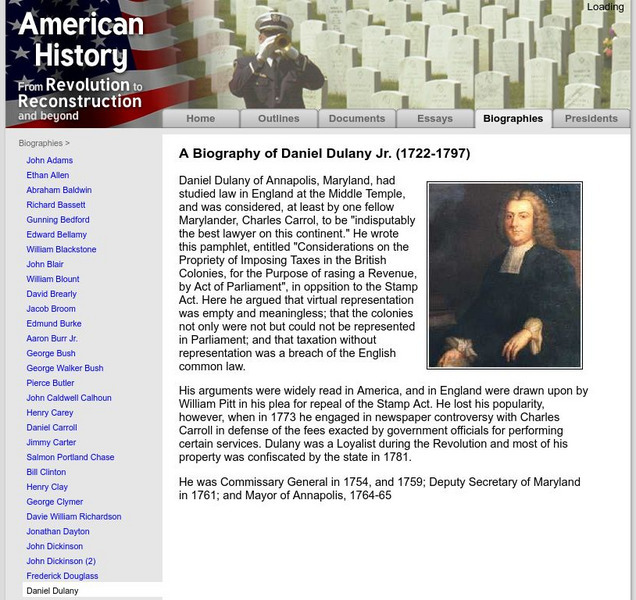
American History: Biographies: Daniel Dulany Jr. (1722 1797)
Daniel Dulany of Annapolis, Maryland, had studied law in England at the Middle Temple, and was considered, at least by one fellow Marylander, Charles Carrol, to be "indisputably the best lawyer on this continent." He wrote this pamphlet,...
The History Cat
The History Cat: Countdown to Revolution
Begins with a description of the British system of mercantilism that was imposed on the American colonies along with the taxes levied through the Stamp Act and the Sugar Act. The Americans complained that it was taxation without...
University of Groningen
American History: Essays: The Sugar and Stamp Acts
Reasons for the Sugar Act and the Stamp Act are briefly described. The article also describes the colonial assemblies' reasons for fearing and speaking out against these taxes. The biggest question, Parliament's right to tax the...
Digital History
Digital History: The Stamp Act and Virtual Representation [Pdf]
This lesson plan is from a unit on events leading to the American revolution. It highlights the Stamp Act, and the British concept of 'virtual representation' where a member of government was believed to represent every citizen, not just...
Stanford University
Sheg: Document Based History: Reading Like a Historian: Stamp Act
[Free Registration/Login Required] Students solve a problem surrounding a historical question by reading primary source documents. This historical inquiry instructional activity allows students to engage in key aspects of historical...

The History Place
The History Place: American Revolution: Prelude to Revolution
This site from The History Place offers a timeline of events of the Revolution. It offers information about England's involvement with the United States. Pictures are provided throughout along with links to additional information.

University of Groningen
American History: Outlines: Townshend Acts
Overview of the tax on goods imported to the colonies known as the Townshend Acts sparking protest in the colonies.
Independence Hall Association
U.s. History: E Pluribus Unum
The fact that the Second Continental Congress convened was evidence that the colonists had had enough from the British Parliament. Read about the ways the colonies finally began to work together and focus on a common plan, resulting in...
Independence Hall Association
U.s. History: The Quartering Act of 1774
This site provides the full text of the Quartering Act passed by British Parliament in 1774.
Other
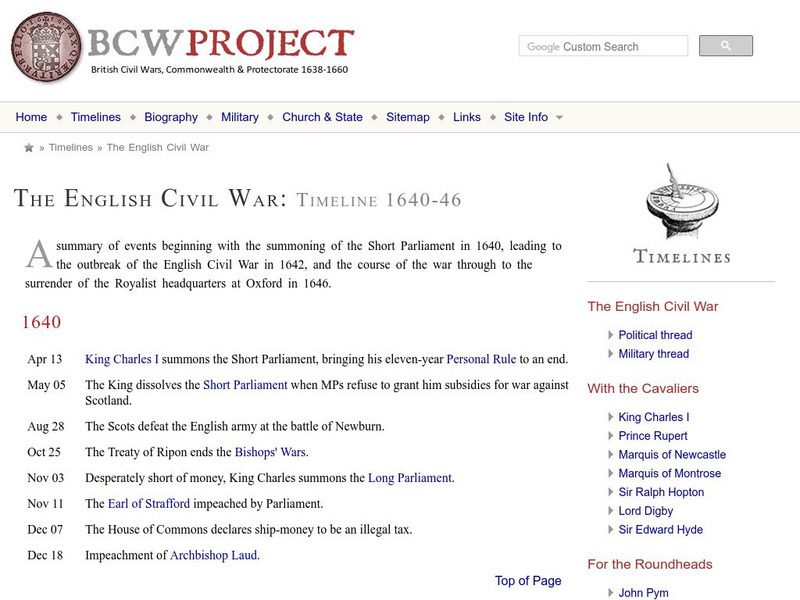
British Civil Wars: Timeline: The First Civil War 1640 46
A time line listing the main events that occurred during the first British Civil War between 1640-46. Provides links to more detailed descriptions of particular events.
BBC
Bbc: History: The Masquerading Monarch
A article about the checkered reign of Charles II of England. Archived.
British Library
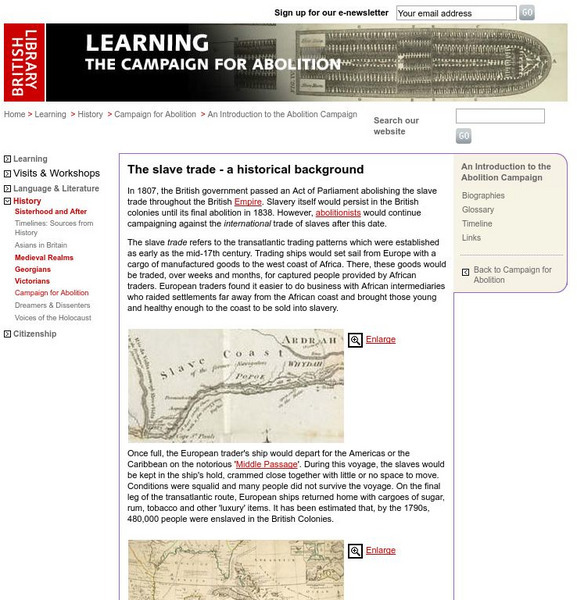
British Library: The Slave Trade
An article describing the historical background to the Abolitionist movement in England, giving details on the slave trade and more.