Hi, what do you want to do?





Australian Museum
Australian Museum: Bug Wise: Cicada
Museum site features the Cicada. Provides a comprehensive physical description as well as information as to where they are found and what they do.
Other
The Bug Club: Bug Pets
The Bug Club for young entomologists offers answers to insect questions, a colorful newspaper, and invertebrate caresheets if you're interested in keeping bugs as pets.
Other
Alphabet soup.com: Insects and Spiders
An extensive list of activities, songs, poems, and fingerplays are listed by alphabet-soup.com. Additional recipes, art projects, and literature connections are also included.
US Department of Agriculture
Us Dept. Of Agriculture: Agricultural Research Service: Not All Bugs Are Bad
Find out who an entomologist is and how they are using good bugs to control the population of bad bugs. Resource by Agricultural Research Service.

TED Talks
Ted: Ted Ed: Should We Eat Bugs?
What's tasty, abundant and high in protein? Bugs! Although less common outside the tropics, entomophagy, the practice of eating bugs, was once extremely widespread throughout cultures. Insects hold promise for food security and the...
Earth Life
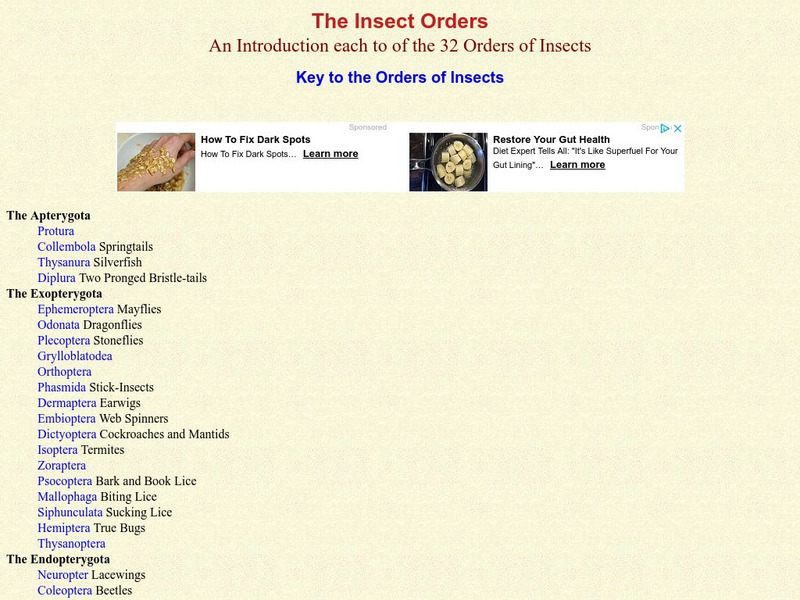
Wonderful World of Insects: An Introduction to the 32 Orders of Insects
A very thorough look at the world of insects. This site examines the 32 orders of insects and gives a complete explanation of the characteristics of each order. Text is supplemented with pictures.
Scholastic
Scholastic: Monster Bugs
Here are a couple of fun games where you can mix and match bug bodies, legs, wings, and heads to make your own "monster bug." There is also some fun trivia as you play!
Soft Schools
Soft Schools: Insects Quiz
Take an interactive quiz over insects. After completing the quiz, check your score, and then revisit any incorrect question for further review

CK-12 Foundation
Ck 12: Life Science: 9.15 Insects
Understand the behaviors, characteristics, and classification of insects.
Natural History Museum
Natural History Museum: Insects and Spiders
As an online exhibit from the Natural History Museum, this site examines many different subtopics stemming from a study on both insects and spiders. Several of the subtopics include spider bites, bumblebees, moths, edible insects,...
PBS
Pbs Learning Media: Backyard Bugs
This video segment from Wild TV takes a closer look at backyard bugs, their habitat and characteristics. [2:48]
Other
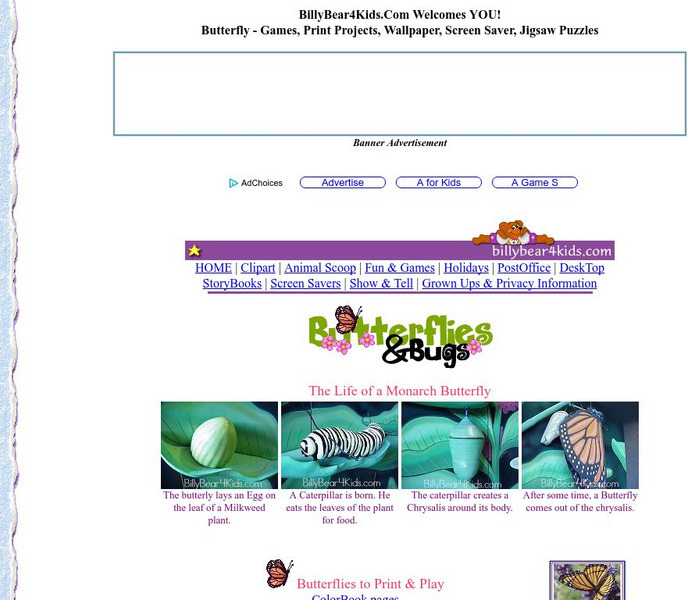
Billy Bear4 Kids: Butterflies and Bugs
BillyBear4Kids.com is a great butterfly resource with links to butterfly cut-outs, flashcards, bookmarks, crafts, online games, and more. Scroll down for reproducibles.
National Pest Managment Association
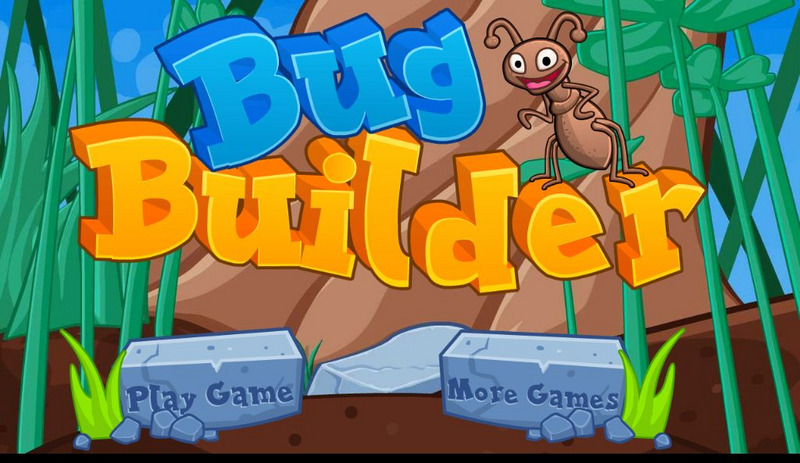
Pest World for Kids: Bug Builder
Create an ant, a bee, a spider, a cockroach, or a bug of your own design. Use the camera feature to save it to a gallery, and even email it to yourself.
Ed Koday
Web Archive: Harelequin Bug
This black, shield-shaped bug is brightly colored with orange, red, and yellow markings. It varies from 7 to 10 mm in length. At rest, the front pair of wings overlap and the insect's back appears to be marked with a distinct "X."
Ed Koday
Web Archive: Spittle Bug
There are 23,000 species of spittle bugs, but you may not have ever seen one because of the unusual way that they protect themselves. They actually produce a liquid that they whip up into a mass of bubbles, and then they hide in it! This...
Other
California Science Center: Build a Bug! [Pdf]
Build an edible bug with this activity from the California Science Center. Make good choices based on what you learn about the body, wings, and legs.
Ed Koday
Web Archive: Box Elder Bug
This bug is about 1/2 inch long and 1/3 as wide. It is black with three red lines on the thorax, a red line along each side, and a red line on each wing. The wings lie flat on the back when at rest. The young nymphs are red and gray. The...
Ed Koday
Web Archive: Milkweed Bugs
Adults are 9/16 to 10/16 inch long, black, and colorfully marked with reddish-orange on the head, sides of the pronotum (part of the thorax), and the wing covers. They have a Y-shaped head marking and two wide crossing orange bands...
McGraw Hill
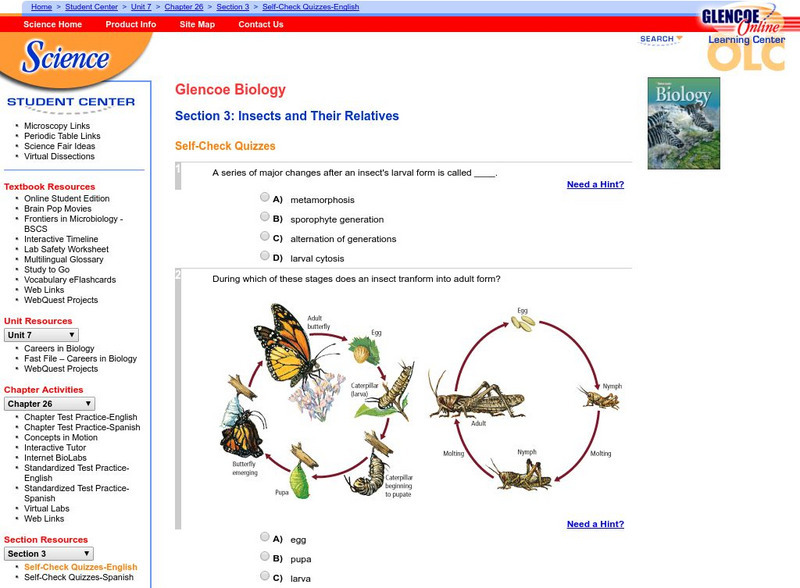
Glencoe Biology: Insects and Their Relatives: Self Check Quiz
Five multiple-choice quiz questions covering insects and their relatives. Students have the opportunity to check their answers after submitting their results.
Other
Insectclopedia: Lesson Plans
A very comprehensive site from pedagonet.com that includes lesson plans on insects for all ages and grade levels. Students will enjoy learning about insects as you employ these engaging lesson plans in your own classroom.
Australian Museum
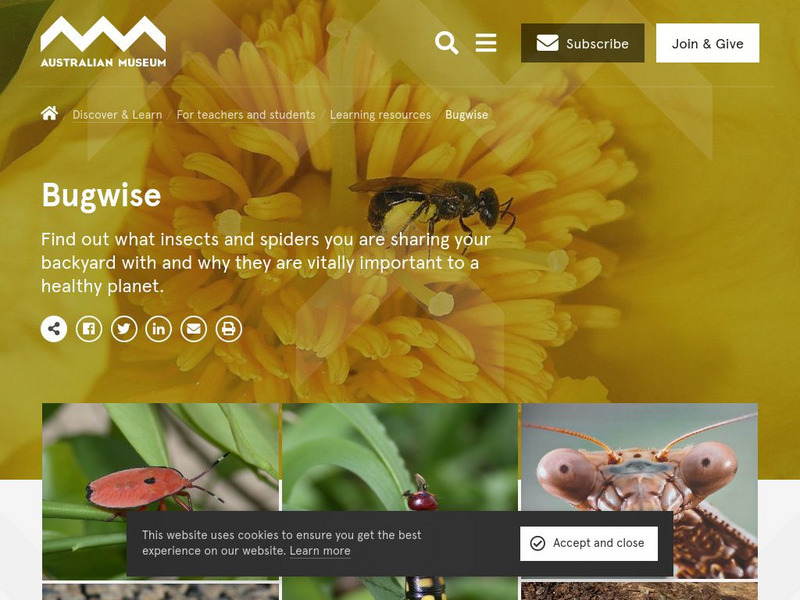
Australian Museum: Bug Wise
Explore the diverse world of invertebrates. Learn what they are, what they do, and how they contribute to our planet. This site offers "BugWise News", a forum, an invertebrate guide, and a wide range of great resources and activities.
Museums Victoria
Museum Victoria: Bugs: Glossary
Glossary of terms commonly used to describe bugs, their habitat, and their life cycle.
Read Works
Read Works: What's Bugging Everyone?
[Free Registration/Login Required] An informational text about bedbugs and how difficult they are to exterminate. A question sheet is available to help students build skills in reading comprehension.

TED Talks
Ted: Ted Ed: A Simple Way to Tell Insects Apart
Anika Hazra explains how the features of an insect's mouthparts can help identify which order it belongs to, while also providing clues about how it evolved and what it feeds on.
Other popular searches
- Insects and Bugs
- Bugs and Insects Crafts
- Bugs and Insects Art
- Insects and Bugs Stencils
- Theme Insects and Bugs
- Bugs and Insects Prue School
- Studying Bugs and Insects
- Bugs and Insects Pre School
- Bugs and Insects Worksheet