Hi, what do you want to do?






Curated OER
Make It All Better!
Young scholars brainstorm ideas to solve a problem. In this technology lesson, students share their ideas to class. They research innovations that could benefit the community.

Curated OER
Forces on the Human Molecule
Learners conduct several simple lab activities to explore the five fundamental load types that can act on structures: tension, compression, shear, bending, and torsion. In this activity, students play the role of molecules in a beam...

Curated OER
Functional Homes
Young scholars observe and reflect on habitats built and used by various life forms. They discover the benefits of the "homes" to the creature and its life and apply the natural designs to human uses.

Curated OER
Analyzing 3-D Shapes and 2-D Representations
Students can analyze 3-D objects better with actual physical models and by also drawing 2-D representations of them.

Curated OER
Introduction to Biometrics
Students use the internet to research how biometrics is being used in the real world today. They work together to research hand geometry applications. They share their findings with the class.

Curated OER
Making Kites
Students engage in the study of kites and focus upon the evaluation and designs invovled. They conduct research into the different types of designs and use the information in order to create unique project designs. The drawings are...

Curated OER
The Science Behind Phone Systems
Students, in groups, discuss the origin of voice communications. In small groups students research the science behind innovations related to voice communications up through today's satellite systems. They make models or demonstrations.

Curated OER
Simple Machines and Modern Day Engineering Analogies
Students apply the mechanical advantages and problem-solving capabilities of six types of simple machines (wedge, wheel and axle, lever, inclined plane, screw, pulley) as they discuss modern structures in the spirit of the engineers and...

Curated OER
Teaching Measurement Through Science
Use these lesson plans to give your students real world practice with measuring distance, mass, and volume.

Curated OER
Look at Those Leaves!
Students research tree leaves. In this tree leaves lesson, students observe, measure, and sort tree leaves. Students examine leaves individually, in groups, and in relationship to the entire tree.

Curated OER
Toy Inventors Workshop
Eleventh graders investigate the technology of designing toys by conducting interviews with preschool age children. Ideas are obtained for making new types of toys. They design the toys and then use computer technology to share the...

Curated OER
Make It All Better!
Students design an innovation that could help their community. In this technology lesson, students identify problems that could be solved by innovation. They present their ideas in class.

Curated OER
Ideal Living
Students examine two artists Vasily Kandinsky and Marcel Breuer. In this artist analysis lesson, students explore the principles of Bauhaus and consider the elements of chair design. Students identify the technique of lithography and may...

Curated OER
Inventors of New England
Students examine recent inventions and discuss the steps the inventor had to go through to develop this product. They share their ideas with the class.

Curated OER
Journey to the Afterlife
Students work together to design an Egyptian funerary barge. They discover the importance of the afterlife to Egyptians. They create their boat and share their design with the class. They compare and contrast the technology of Ancient...
TeachEngineering
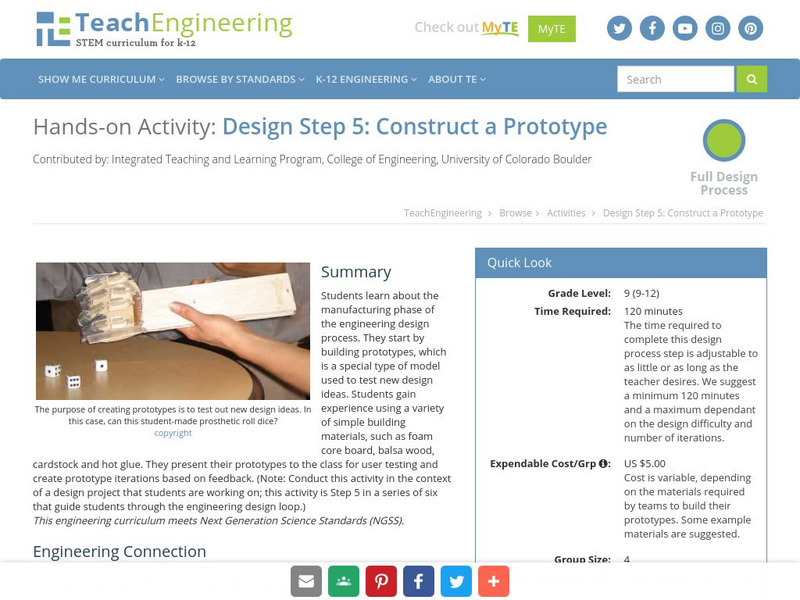
Teach Engineering: Design Steps 5 and 6: Create and Test a Prototype
Students learn about the importance of creating and testing prototypes during the engineering design process. They start by building prototypes, which is a special type of model used to test new design ideas. Students gain experience...
TeachEngineering
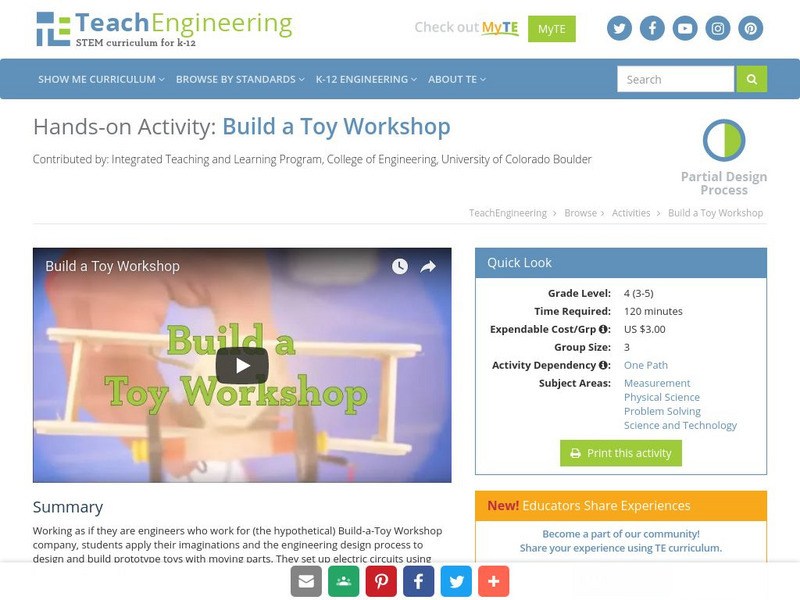
Teach Engineering: Build a Toy Workshop
Working as if they are engineers who work for (the hypothetical) Build-a-Toy Workshop company, students apply their imaginations and the engineering design process to design and build prototype toys with moving parts. They set up...

TryEngineering
Try Engineering: Engineer a Cane
This instructional activity focuses on how engineers improve assistive devices such as a cane to meet the needs of the elderly. Students work in teams to re-engineer a cane for a "client." They are assigned a client profile, develop a...
Other
Lincoln Public Schools: Applied Technology & Engineering: Mousetrap Car It's a Snap! [Pdf]
This is an engineering activity that requires students to build a mousetrap car based on certain constraints. Constraints include students having a virtual budget that they use to buy approved parts for their car, the car having...
Other
Massachusetts Department of Education: Sunlight Warms Earth's Surface
This unit contains a series of lessons that allow students to explore the effect of sunlight on Earth's natural surfaces of sand, soil, rock, and water. In addition, students explore how the color and material of a surface affects how...
TeachEngineering
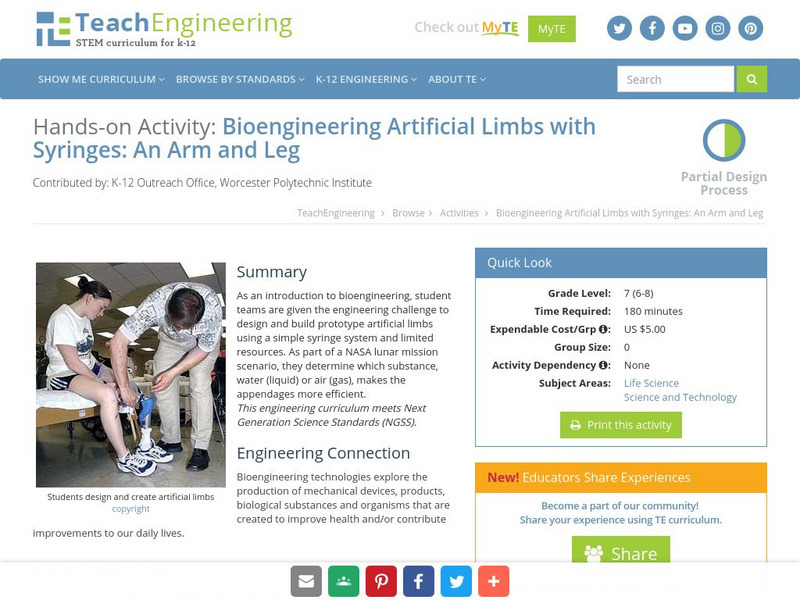
Teach Engineering: An Arm and a Leg
Students will design and build a prototype of an artificial limb using a simple syringe system as an introduction to bioengineering. Students will determine which substance water (liquid) or air (gas) will make the appendage more efficient.
TeachEngineering
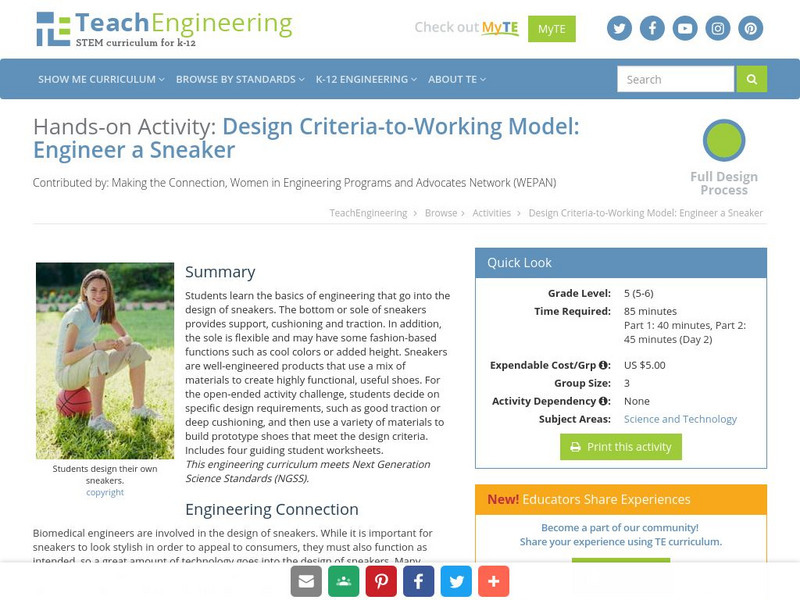
Teach Engineering: Engineer a Sneaker
The goal is for students to understand the basics of engineering that go into the design of a sneaker. The bottom or sole of a sneaker provides support, cushioning, and traction. In addition the sole is flexible and can have some fashion...
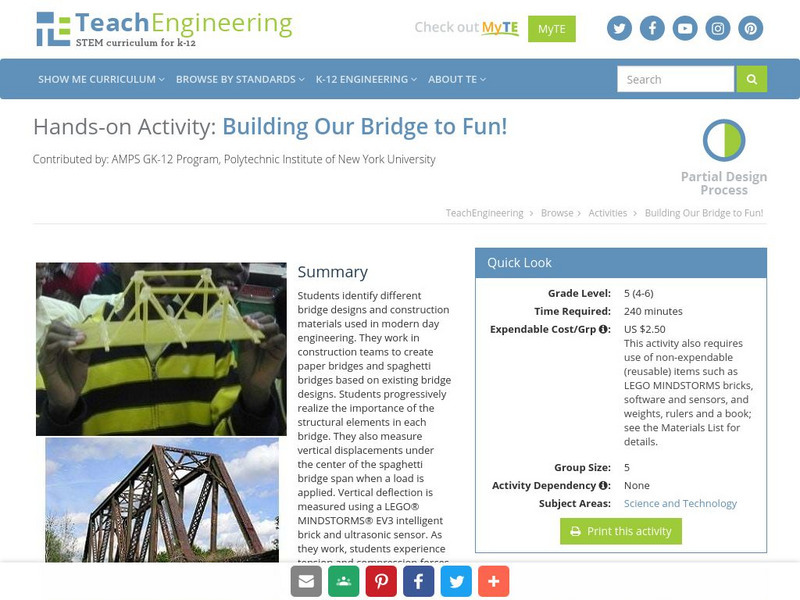
TeachEngineering
Teach Engineering: Building Our Bridge to Fun!
Students identify different bridge designs and construction materials used in modern day engineering. They work in construction teams to create paper bridges and spaghetti bridges based on existing bridge designs. Students progressively...

Science Museum of Minnesota
Thinking Fountain: Straws: Make a Glider
Design and construct a glider that files! Compare the flights with classmates' prototypes to test the success of your design.