Hi, what do you want to do?






Curated OER
Thinking Like An Engineer
High schoolers explore physics. They investigate the strategies used by an engineer to solve a problem. Students construct various models to solve the problem. They display their solutions and explain how they solved the problem.

Curated OER
Money Matters
Students explore the concept of money. In this money lesson, students role play an economy. Students are divided into three categories- the money factory, construction workers, and the grocery store. Students work cooperatively to make...
Science Buddies
Science Buddies: Go, Gadget, Go! Building Robots With Lego Mindstorms
In the mid-20th century, people thought of robots as futuristic tools. But in the 21st century, robots are not a figment of our imaginations, but are a part of our reality. Robots even perform tasks that humans can't do. In this...
Better Lesson
Better Lesson: Area and Perimeter Review Using Legos
Lesson plan in which students calculate area, build areas to a given amount, and calculate the perimeter with the use of Legos. Step by step instructions and videos are provided. CCSS.Math.Content.3.MD.C.7.c Use area models to represent...
Science Buddies
Science Buddies: Building Structures: It's a Slippery Slope
All structures require a foundation to keep them from falling down. This is especially important when a structure is built on a hill or on a slope. In this science project, you will build a tower of Lego Duplos on slopes with different...
TeachEngineering
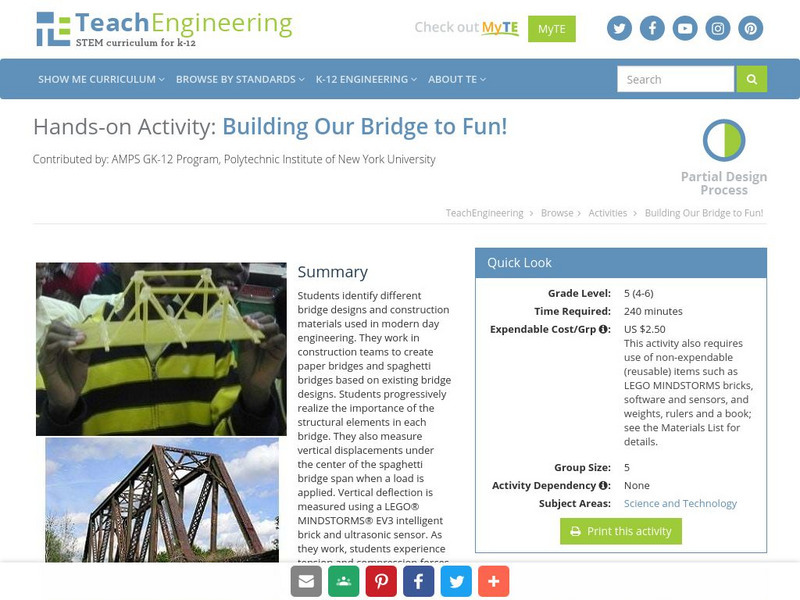
Teach Engineering: Building Our Bridge to Fun!
Students identify different bridge designs and construction materials used in modern day engineering. They work in construction teams to create paper bridges and spaghetti bridges based on existing bridge designs. Students progressively...
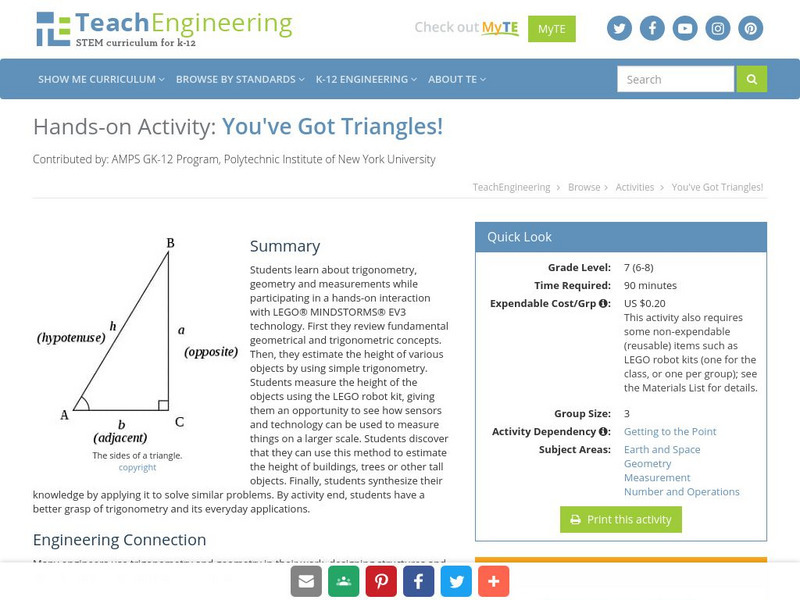
TeachEngineering
Teach Engineering: You've Got Triangles!
Students learn about trigonometry, geometry and measurements while participating in a hands-on interaction with LEGO MINDSTORMS NXT technology. First they review fundamental geometrical and trigonometric concepts. Then, they estimate the...
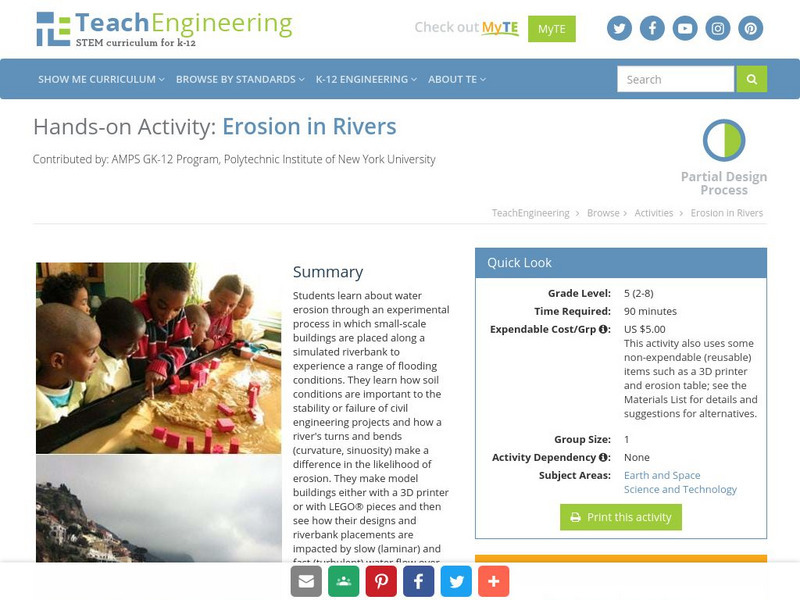
TeachEngineering
Teach Engineering: Erosion in Rivers
Learners learn about water erosion through an experimental process in which small-scale buildings are placed along a simulated riverbank to experience a range of flooding conditions. They make model buildings either with a 3D printer or...
TeachEngineering
Teach Engineering: How Does a Robot Work?
This lesson introduces electricity, batteries and motors using a LEGO MINDSTORMS NXT robot. The associated activity guides students to build a simple LEGO NXT set-up and see the practical implementation of the concepts discussed. Before...
TeachEngineering
Teach Engineering: All Fat Is Not Created Equally!
Students learn that fats found in the foods we eat are not all the same; they discover that physical properties of materials are related to their chemical structures. Provided with several samples of commonly used fats with different...
TeachEngineering
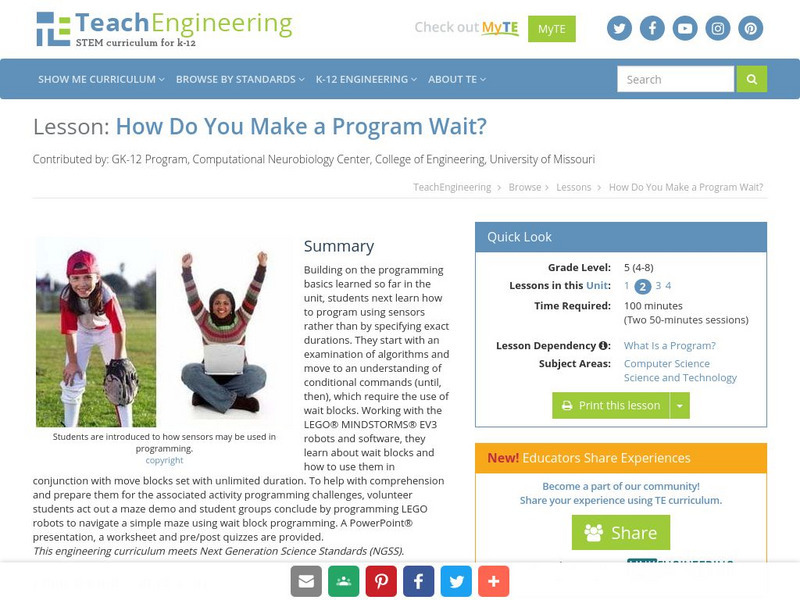
Teach Engineering: How Do You Make a Program Wait?
Building on the programming basics learned so far in a corresponding Robotics unit, students learn how to program using sensors rather than by specifying exact durations. Working with the LEGO MINDSTORMS NXT robots and software, they...
TeachEngineering
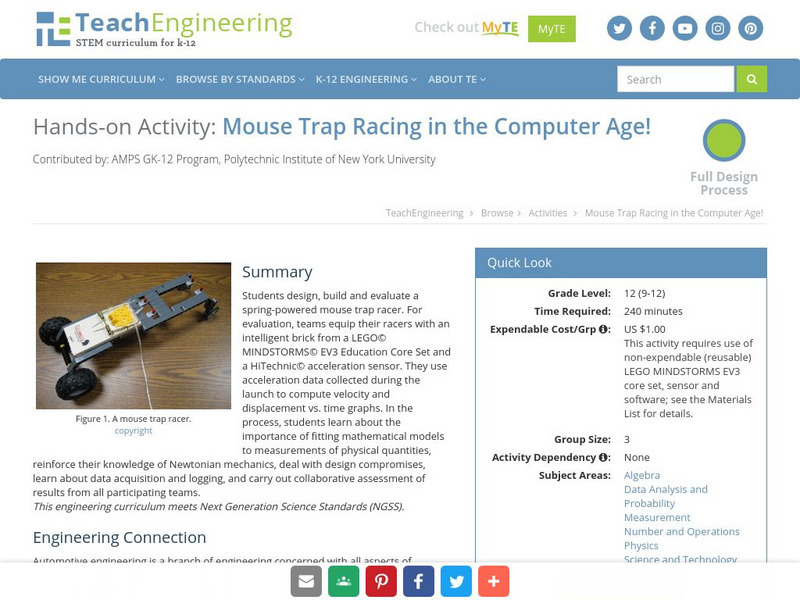
Teach Engineering: Mouse Trap Racing in the Computer Age!
Students design, build and evaluate a spring-powered mouse trap racer. For evaluation, teams equip their racers with an intelligent brick from a LEGO MINDSTORMS NXT Education Base Set and a HiTechnic acceleration sensor. They use...
TeachEngineering
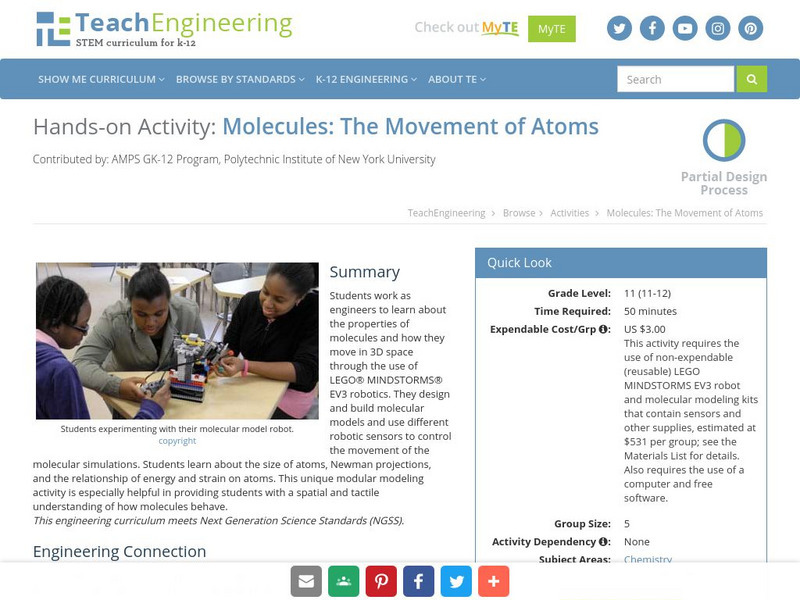
Teach Engineering: Molecules: The Movement of Atoms
Students work as engineers to learn about the properties of molecules and how they move in 3D space through the use of LEGO MINDSTORMS NXT robotics. They design and build molecular models and use different robotic sensors to control the...
TeachEngineering
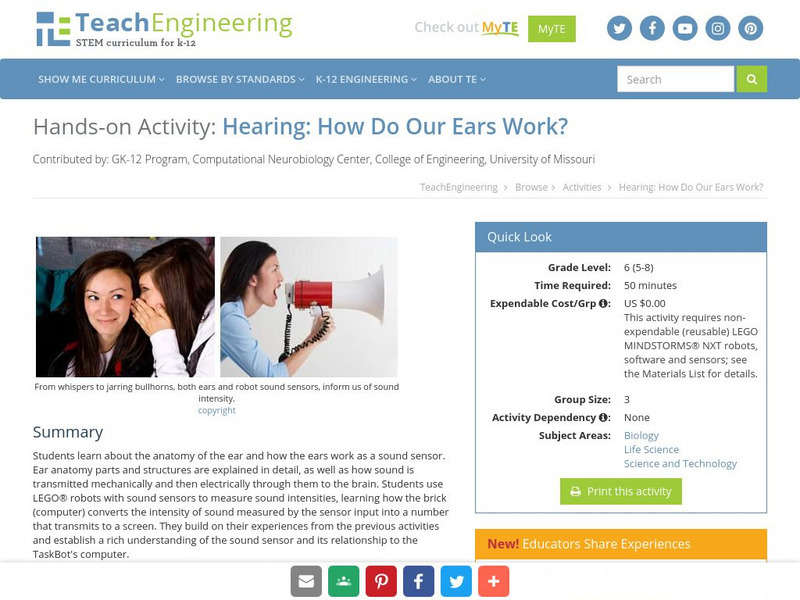
Teach Engineering: Hearing: How Do Our Ears Work?
Students learn about the anatomy of the ear and how the ears work as a sound sensor. Ear anatomy parts and structures are explained in detail, as well as how sound is transmitted mechanically and then electrically through them to the...
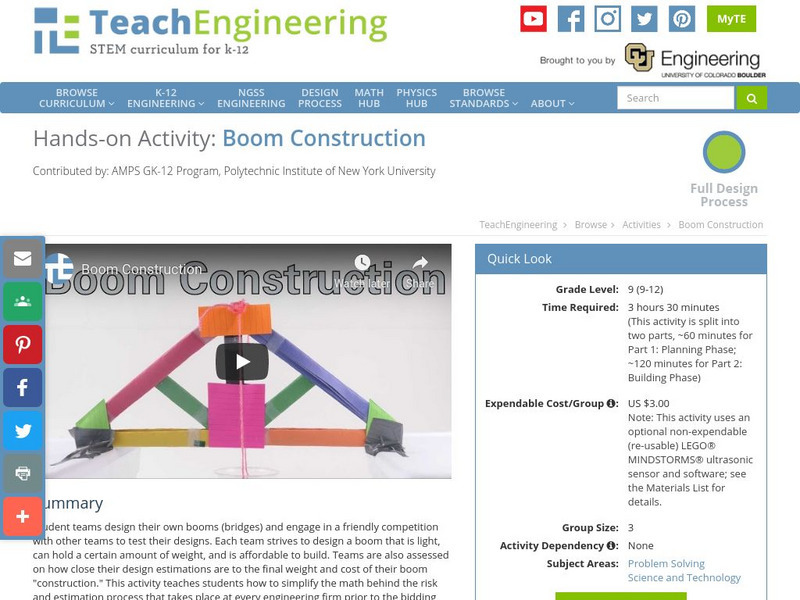
TeachEngineering
Teach Engineering: Boom Construction
Student teams design their own booms (bridges) and engage in a friendly competition with other teams to test their designs. Each team strives to design a boom that is light, can hold a certain amount of weight, and is affordable to...
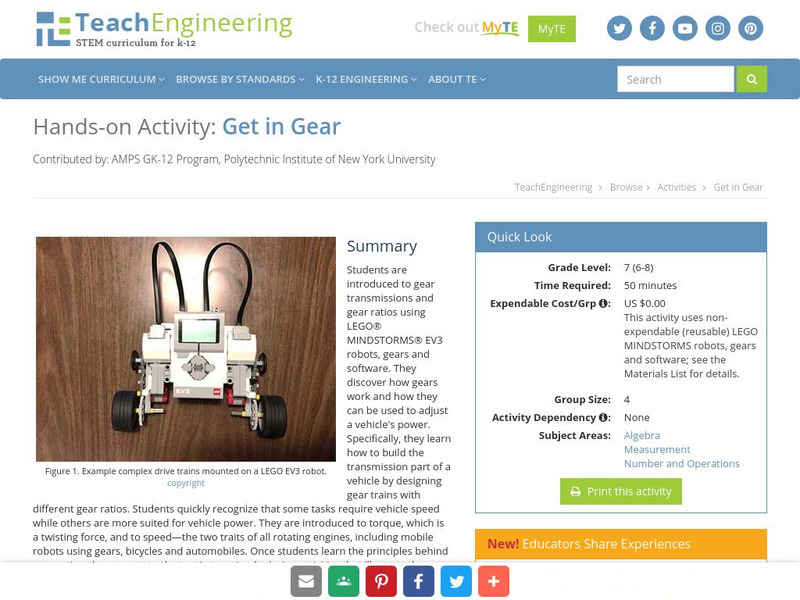
TeachEngineering
Teach Engineering: Get in Gear
Students discover how gears work and how they can be used to adjust a vehicle's power. Specifically, they learn how to build the transmission part of a vehicle by designing gear trains with different gear ratios.
Frontiers Media
Frontiers: Human Toolmaker
Do you enjoy building airplanes, cars, houses, or robots with Lego blocks? Humans are the only animal species that can create complicated constructions from simple Lego blocks - our Lego building ability is "human-specific," since it is...
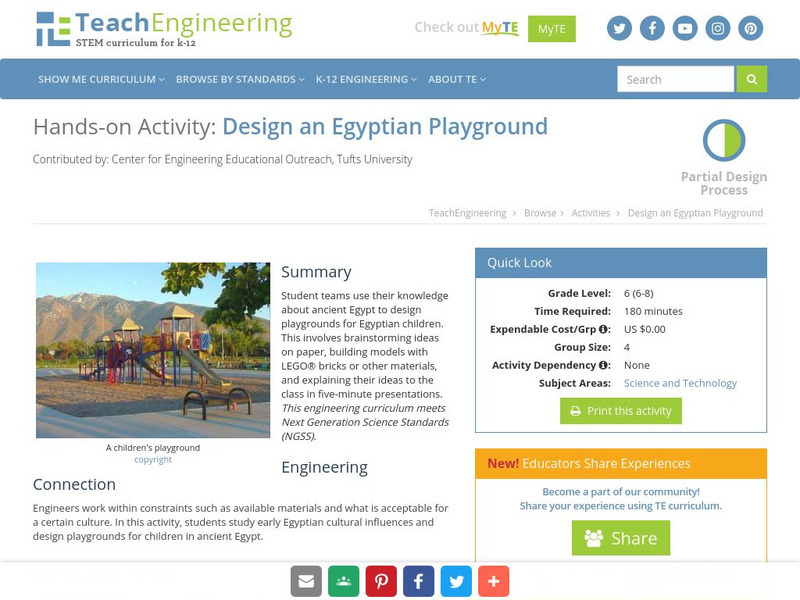
TeachEngineering
Teach Engineering: Design an Egyptian Playground
Students are broken up into four groups. Each group will use their knowledge about Egypt to originate a playground for Egyptian children. This will involve brainstorming ideas on paper, building a prototype with Legos or other material,...
Scientific American
Scientific American: Earthquake Proof Engineering for Skyscrapers
Young scholars construct a shake table, then build towers of different heights using Lego blocks, and test their stability on this platform. Next, they test towers with different sized bases, and towers made using different materials.