Hi, what do you want to do?





Science Education Resource Center at Carleton College
Serc: Investigating Density: Determined by Using Mass and Volume of a Substance
In this activity, students investigate the history of density, its uses, and applications. Students will generate and calculate data applying it to a graph. They will be looking at the relationship between mass and volume.
Simon Fraser University
Chem1 Virtual Textbook: Getting Started in Chemistry
With the subtitle, "stuff you should know before delving too far into Chemistry," this site examines a range of six topics to provide the user with a broader understanding of chemistry.
Michigan Reach Out
Austin University: Demonstrating Air Pressure With Eggs
This site will tell you how you can use an egg to identify air pressure and how it affects objects. Includes easy step by step instructions.

Exploratorium
Exploratorium: Science Snacks: Eyedropper Hydrometer
Deepen the students' understanding of density by constructing a simple hydrometer that can be used to compare the densities of different solutions.
Exploratorium
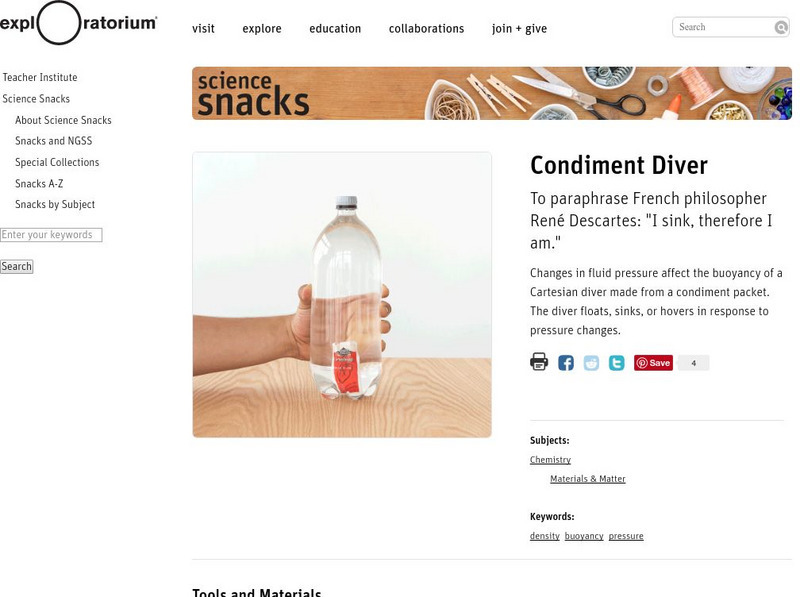
Exploratorium: Science Snacks: Condiment Diver
Use a condiment packet as a Cartesian diver to show how pressure changes cause the "diver" to float, sink or hover.
Museum of Science
Museum of Science and Industry: Online Science: Design a Submarine
Become an engineer, and design a submarine that moves in the water like a real submarine. Try making it sink, float, and hover in the water.

Read Works
Read Works: Take the Plunge
[Free Registration/Login Required] An informational text about the positive effects of swimming. A question sheet is available to help students build skills in reading comprehension.

Physics Aviary
Physics Aviary: Practice Problems: Cargo Challenge Problem
Students figure out how much mass can be put in a boat without having the boat go fully under the fluid.
Physics Aviary
Physics Aviary: Practice Problems: Percent Floating Challenge
Students must figure out how much of a ball will be under a fluid when it is in equilibrium with its environment.
Science Struck
Science Struck: How to Find Volume With Water Displacement Method
Tells the story of how Archimedes discovered the Archimedes Principle and his water displacement method for determining the volume and density of an object. Provides an explanation and several examples of how it is done.
Walter Fendt
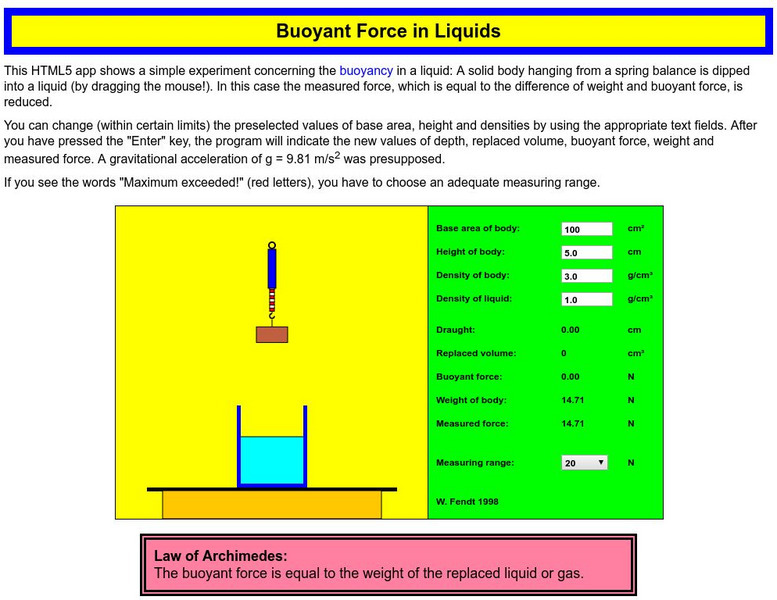
Walter Fendt: Buoyant Force in Liquids
An app that demonstrates the Law of Archimedes. This virtual experiment will show students that by changing the shape of the solid, the amount of liquid displaced will change.
Colorado State University
Little Shop of Physics: The Amazing Physics of Everyday Objects
Try out these experiments you can do with items you might already have around the house: "Two Ball Bounce," "Cartesian Diver," "Straw Flute," "Bernoulli Ball," and others. Two experiments, "Imploding Pop Can" and "Balloon in a Bottle,"...
CK-12 Foundation
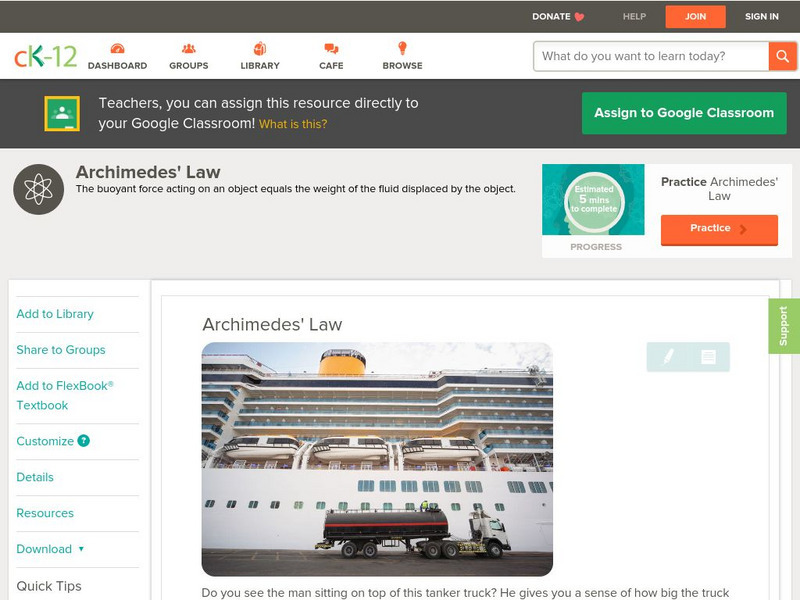
Ck 12: Physical Science: Archimedes' Law
[Free Registration/Login may be required to access all resource tools.] Archimedes Law: displacement and buoyant force and why some objects float.

Alabama Learning Exchange
Alex: What's the Matter: A Sinker or Floater?
Students will explore matter that sinks or floats when submerged in water and that matter is categorized as either a sinker or a floater. Students will work actively in small, cooperative learning groups as well as gather in a whole...
CK-12 Foundation
Ck 12: Physics: Pressure and Force: Fluids Study Guide
Review and study pressure and force in regards to fluids.
Science Buddies
Science Buddies: Build a Rubber Band Paddle Boat
Build your own bathtub or pool toy from simple craft materials in this fun activity. You will build a rubber-band-powered boat that can zip across the surface of the water after you wind up the rubber band.
Other popular searches
- Density and Buoyancy
- Sink Float Buoyancy
- Eggs and Buoyancy
- Buoyancy Force
- Relative Buoyancy
- Buoyancy Boat Design
- Density & Buoyancy
- Buoyancy and Boats
- Water Buoyancy
- Buoyancy Swimming
- Buoyancy Ideas
- Neutral Buoyancy