Hi, what do you want to do?






University Corporation for Atmospheric Research
Ucar: The Carbon Cycle
A comprehensive introduction to the carbon cycle. The cycle of atoms between living and non-living things is known as a biogeochemical cycle. The most common of these are the carbon and nitrogen cycles.
Biology Pages
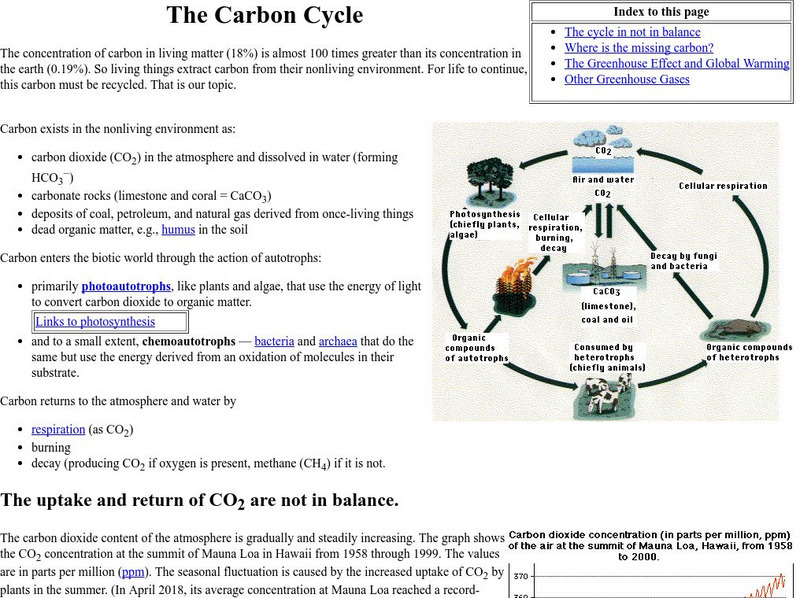
Kimball's Biology Pages: The Carbon Cycle
Useful introduction to the carbon cycle with a diagram and a discussion of the effects of carbon dioxide on the greenhouse effect and global warming.
Mocomi & Anibrain Digital Technologies
Mocomi: Carbon Cycle
The carbon cycle is one of the most important cycles. It is the biogeochemical cycle by which carbon is exchanged among the biosphere, pedosphere, geosphere, hydrosphere, and atmosphere of the Earth. This cycle is important because it...
NASA
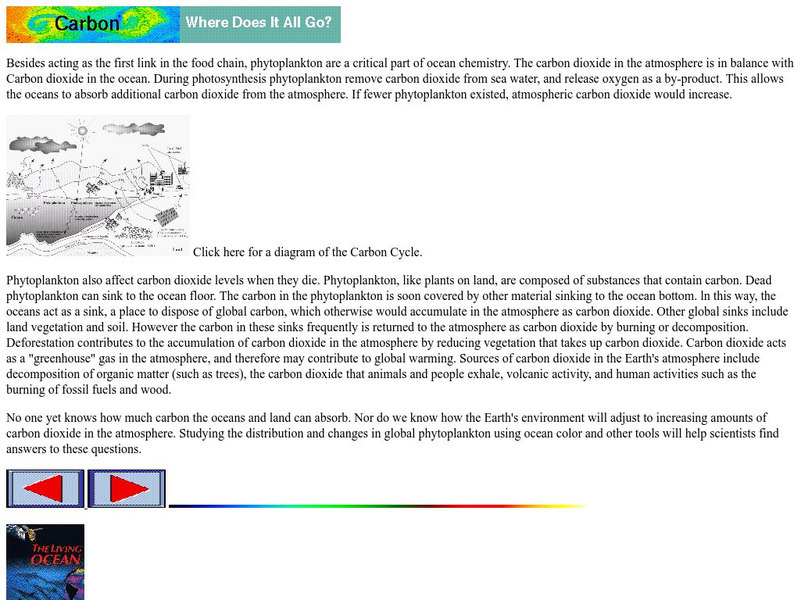
Nasa: Carbon: Where Does It All Go?
At this site from NASA you can understand how phytoplankton help the carbon dioxide levels between the oceans and the air stay in balance.
BiologyWise
Biology Wise: A Brief Guide to the Steps of the Carbon Cycle
Outlines the steps for the movement of carbon along the carbon cycle through photosynthesis, food chains, being dissolved into the ocean, the decomposition of organisms, fossil fuel formation, industrial use of fossil fuels, carbon...
TeachEngineering
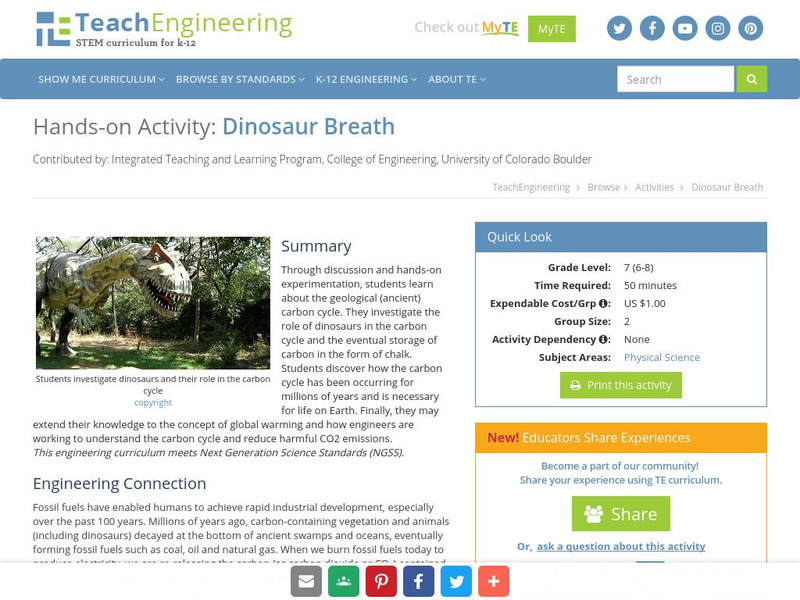
Teach Engineering: Dinosaur Breath
Through discussion and hands-on experimentation, students learn about the geological (ancient) carbon cycle. They investigate the role of dinosaurs in the carbon cycle and the eventual storage of carbon in the form of chalk. Students...
TeachEngineering
Teach Engineering: Moebius Strips
In this activity, students make Moebius strips and use them to demonstrate the interconnectedness of an environment. They will explore the natural cycles (water, oxygen/carbon dioxide, carbon, nitrogen) within the environment.
Other
Marietta College: Ecosystems
Complete illustrated discussion of energy flow within ecosystems, including discussions of trophic levels, ecological pyramids, food chains and webs, biological magnification, and cycles.