Hi, what do you want to do?





E-learning for Kids
E Learning for Kids: Science: Loch Ness: What Happens When Solids and Liquids Are Heated or Cooled?
Students will look at what happens to different types of matter when they have a change of state.

Center of Science and Industry
Cosi Columbus: Can You Stand the Pressure
Science experiment that demonstrates the four states or phases of matter: solid, liquid, gas, and plasma. Includes full list of materials, procedures, and scientific explanation of how you change water from a liquid state to a gaseous...
Read Works
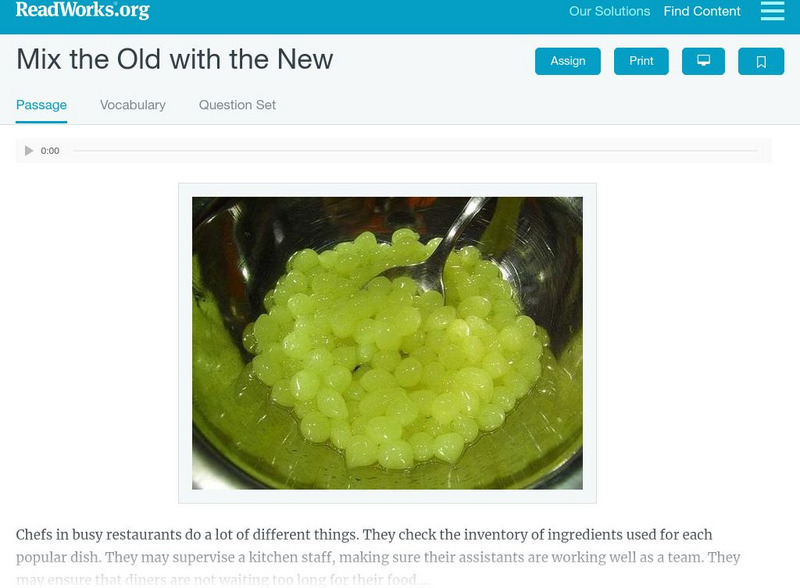
Read Works: Mix the Old With the New
[Free Registration/Login Required] An informational text about how cooking causes changes in matter. A question sheet is available to help students build skills in reading comprehension.
University Corporation for Atmospheric Research
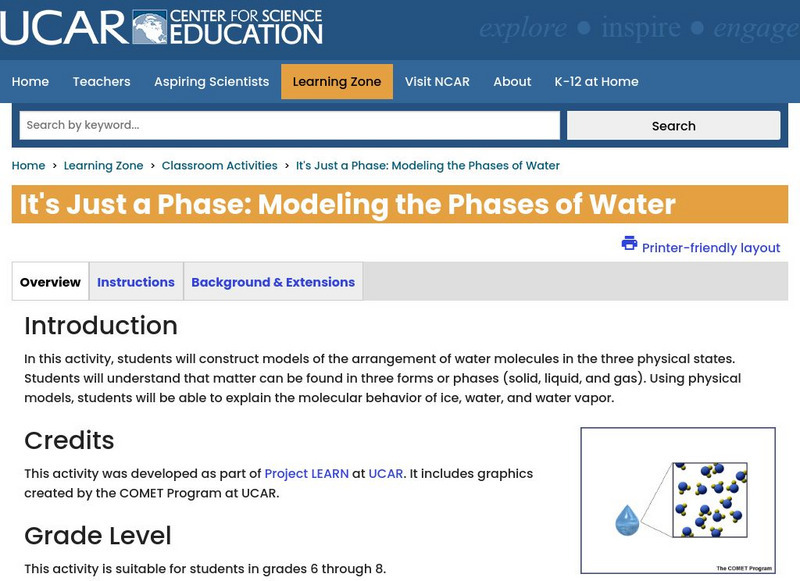
Ucar: Just a Phase: Water as a Solid, Liquid, and Gas
This site helps students construct a model of the arrangement of water molecules when present as solid, liquid or gas. Includes background information, lesson plans, links to standards and assessment ideas.
Frostburg State University
General Chemistry Online: Physical and Chemical Changes
Resource provides information about the difference between physical and chemical changes. Includes a definition and examples of each.
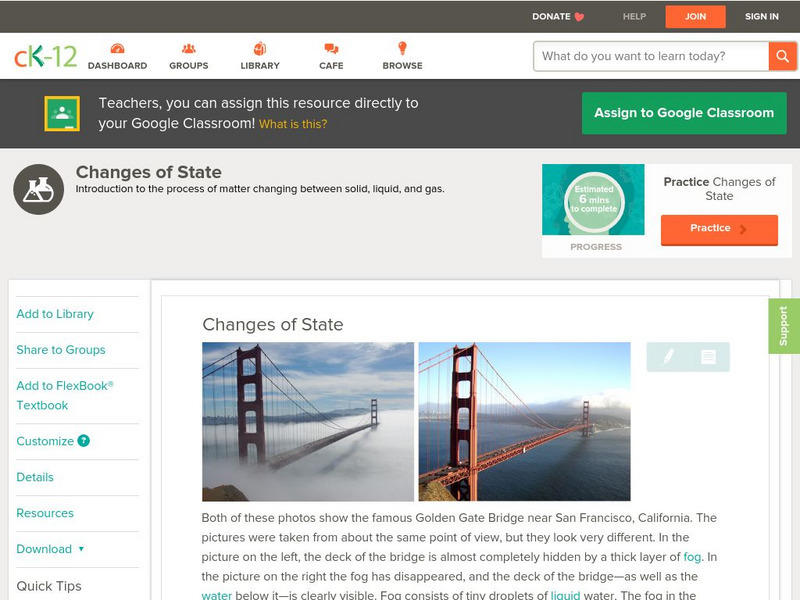
CK-12 Foundation
Ck 12: Physical Science: Changes of State
[Free Registration/Login may be required to access all resource tools.] Definition of a change of state and the physical processes that cause it.
University of Florida
Chem. 2041 Lecture Notes: The Forces Between Molecules
A discussion of the variety of forces which hold molecules together. The relative strengths of these forces for the various states of matter is discussed. The effect of such forces on the boiling points and other phase change...
American Chemical Society
Inquiry in Action: From Liquid to Gas to Solid
What causes frost to form on the outside of a cold container? In this activity, students will see that the liquid water can change state again and freeze to become ice.
New York University
New York University: What Is Matter?
At this resource discover the difference between solids, liquids, and gases. Practice what you just learned with included review questions.
Science Education Resource Center at Carleton College
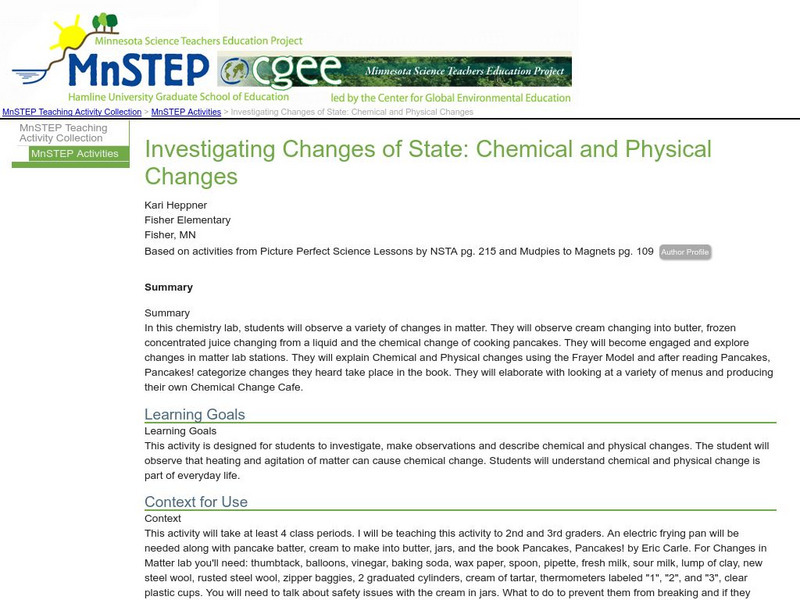
Serc: Investigating Changes of State: Chemical and Physical Changes
In this chemistry lab, students will investigate, observe, and describe a variety of chemical and physical changes in matter. They will understand that this is part of everyday life.
CPALMS
Florida State University Cpalms: Florida Students: Physical and Chemical Changes
Explore the differences between chemical and physical changes, including some examples at the atomic level.

Chem4kids
Chem4 Kids: Chemical vs. Physical Changes
Identify chemical and physical changes and the differences between the two.
Science Education Resource Center at Carleton College
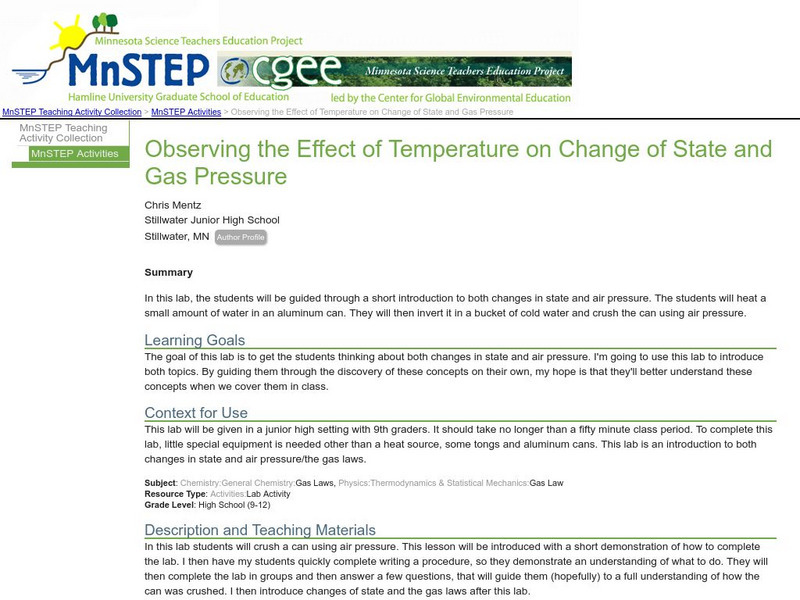
Serc: Observing the Effect of Temperature on Change of State and Gas Pressure
This lab serves as a short introduction to both changes in state and air pressure/the gas laws. The learners will heat a small amount of water in an aluminum can. They will then invert it in a bucket of cold water and crush the can using...
PBS
Pbs Learning Media: Discovering Air
Our understanding about the air we breathe has changed dramatically through time. This illustrated timeline from the NOVA Web site tracks the changing thought on air and the creation of the Periodic Table of the Elements.

Florida State University
Florida State University: Intermolecular Forces: Changes of State
Discusses the changes of state that can occur for the three different types of matter (solids, liquids, and gases) and different types of heat energy that have been defined by scientists.
Utah Education Network
Uen: Adding Heat
Observe the changes in the states of matter and volume when a balloon-covered flask with water in it is heated.
ArtsNow
Arts Now Learning: Be One With the Water [Pdf]
Fourth graders will explore states of matter and the water cycle by bringing water to life with their bodies. By enacting the changes that water molecules experience, 4th graders will learn scientific information kinesthetically.
Other
Howto smile.org: From Gas to Liquid to Solid
Allow your students to explore states of matter as they learn what causes frost to form on the outside of a cold container. Students will observe how liquid water can change to ice or water vapor in this lab. Lesson includes background...
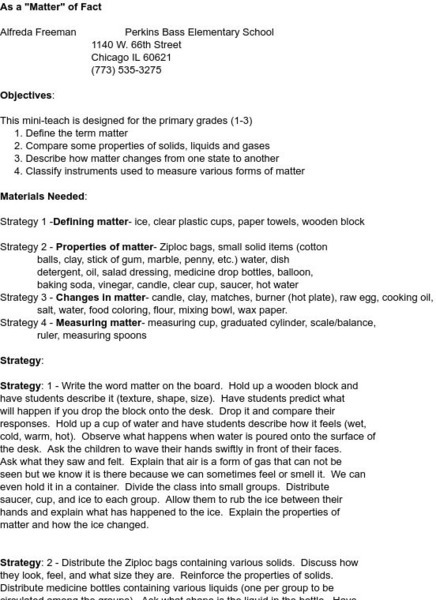
Science and Mathematics Initiative for Learning Enhancement (SMILE)
Smile: As a "Matter" of Fact
In this lesson plan site, learners will define matter and compare properties of solids, liquids and gases.
CPALMS
Florida State University Cpalms: Florida Students: Conservation of Mass Tutorial
Learn how mass is conserved in physical and chemical changes.
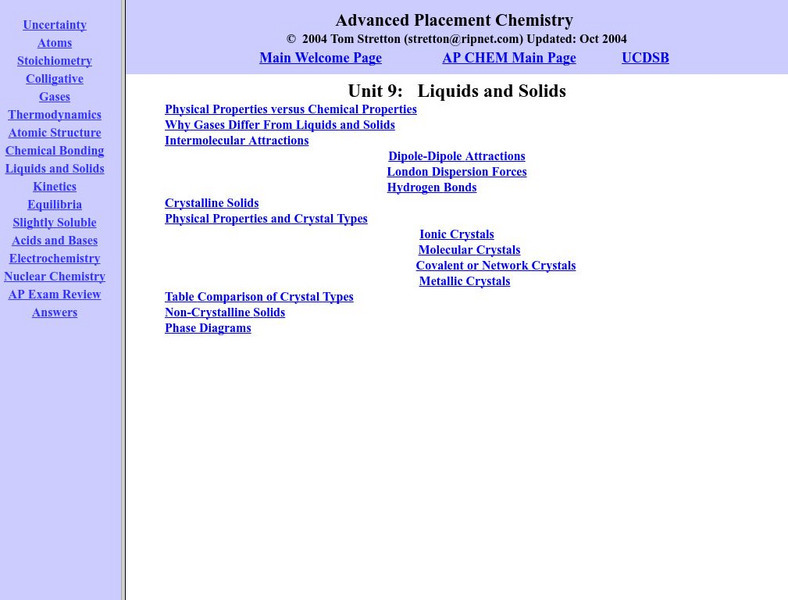
Upper Canada District School Board
Tom Stretton's Advanced Placement Chemistry: Liquids and Solids
Take on this self-guided advanced level e-text, and learn about the chemical and physical structure of liquids and solids.
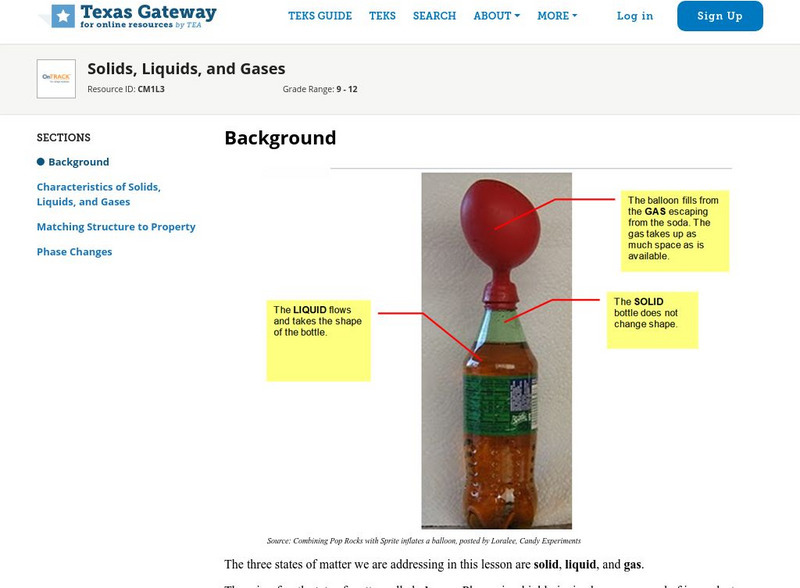
Texas Education Agency
Texas Gateway: Solids, Liquids, and Gases
Given descriptions, scenarios, or illustrations, students will distinguish between the compressibility, structure, shape, and volume of solids, liquids, and gases.
CK-12 Foundation
Ck 12: Physical Science: Changes of State
[Free Registration/Login may be required to access all resource tools.] Definition of a change of state and the physical processes that cause it.
Other
Rooted and Growing: Kindergarten Science Unit: Objects and Materials [Pdf]
A collection of science lessons where students explore the characteristics of different materials and everyday objects and create their own objects and art. They study the properties of the materials that make them strong, absorptive,...