Hi, what do you want to do?





Science Education Resource Center at Carleton College
Serc: Does Salt & Vinegar Have an Effect on Pennies?
During this lab students will experiment to see whether a salt and vinegar solution can clean a tarnished penny. Included on site is lesson plan and student worksheet.
Concord Consortium
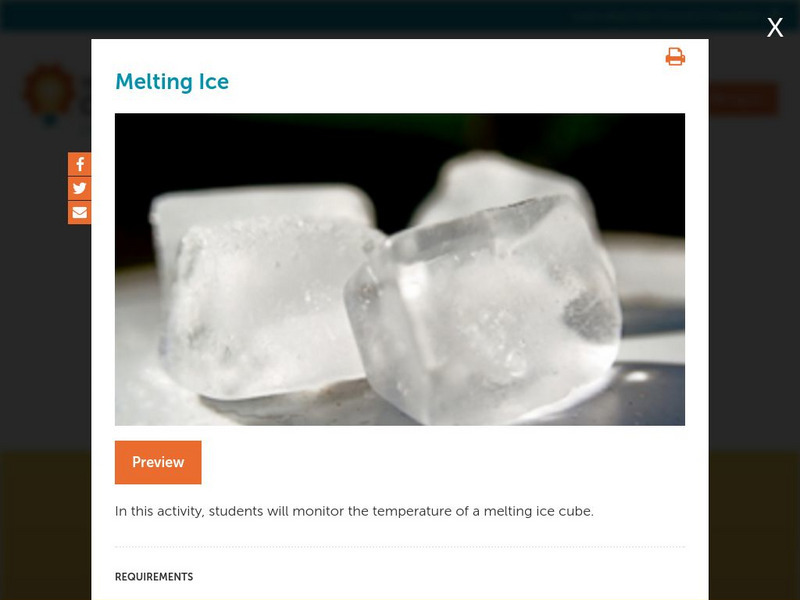
Concord Consortium: Stem Resources: Melting Ice
Using temperature probes, students will monitor the temperature of melting ice cubes in different situations. This lab activity, allows students to view the procedure and answer questions online that can be saved and evaluated by the...

Other
The Science House: Ziptop Bag Chemistry
In this experiment, three reactions are performed in a sealed Ziploc bag so that they can be observed. Students identify whether physical or chemical change has taken place.
Other
The Science House: Dancing Spaghetti
The chemical change of matter is illustrated in this lab experiment when spaghetti is placed in a solution of baking soda and vinegar. Watch the spaghetti rise to the surface and sink again once the gas is released.

ClassFlow
Class Flow: Changes of Matter
[Free Registration/Login Required] This lesson is the third of three lessons. It covers the physical changes of matter and explains how chemical changes can be detected.
CK-12 Foundation
Ck 12: Fourth Grade Science: Physical Science: Forms and Changes of Energy
[Free Registration/Login may be required to access all resource tools.] Discusses different forms of energy and how energy changes form.
Science and Mathematics Initiative for Learning Enhancement (SMILE)
Smile: Physical and Chemical Changes
This lesson plan focuses on the difference between physical and chemical changes of matter.
Maryland Science Center
Maryland Science Center: Create a Kitchen Chemistry Kit [Pdf]
Instructions for how to safely create a chemistry set using basic ingredients found around the home. Provides two experiments to try, one involving a physical change and the other a chemical change.
Other
King's Centre for Visualization in Science: Scientific Models
A series of interactive applets use scientific models to teach some basic concepts of matter, including states of matter and physical and chemical changes.

Scholastic
Scholastic: Dirtmeister's Science Lab: Matter
Step into Dirtmeister's Science Lab as he explores the challenge question: "How can you force a physical change in matter?" Learn about matter, make your predictions and then do the experiment.
Science Education Resource Center at Carleton College
Serc: Mn Step: Shrinky Dink Chemistry
In this lesson, young scholars first learn about thermoplastics, and about polystyrene in particular, which is a #6 plastic. They will then heat different #6 plastics to create shrinky dinks. As they are heated, they shrink, which is a...

Khan Academy
Khan Academy: What Conditions Influence Lyophilisation?
The resource from Khan Academy and the Association of American Medical Colleges provides study content for the MCAT. This resource provides practice uestions related to phase changes during lyophilisation, or the process of freeze drying.
CK-12 Foundation
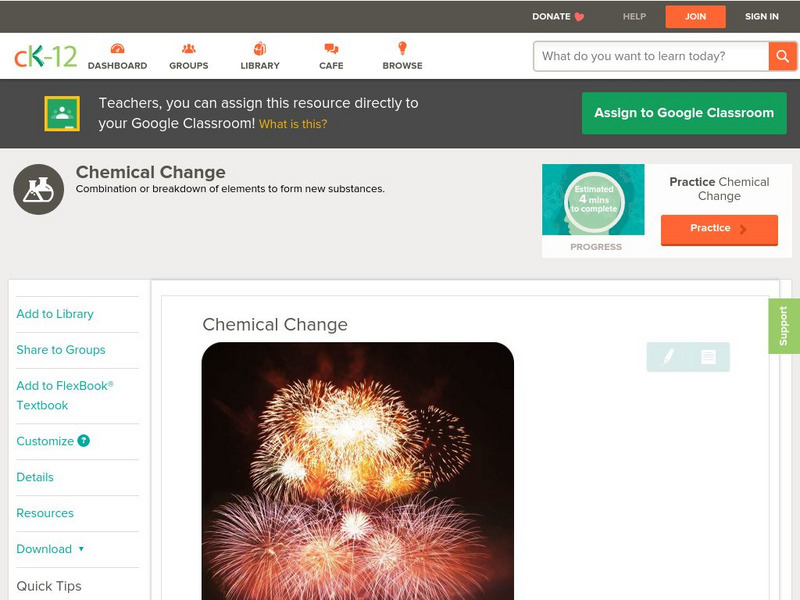
Ck 12: Physical Science: Chemical Change
[Free Registration/Login may be required to access all resource tools.] Definition of chemical change and examples, signs of chemical change and how it can be reversed.
Science Struck
Science Struck: Examples of Chemical Changes in Everyday Life
This resource lists the different types of chemical reactions and gives examples of chemical changes that are seen in everyday life.
CK-12 Foundation
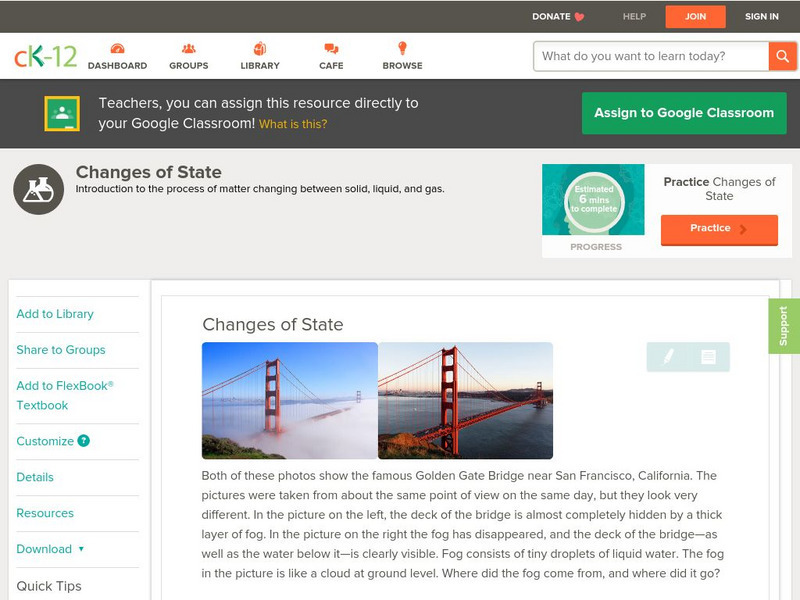
Ck 12: Physical Science: Changes of State
[Free Registration/Login may be required to access all resource tools.] Definition of a change of state and the physical processes that cause it.
Science Struck
Science Struck: Can Diamonds Be Melted or Dissolved?
While diamonds are extremely hard and strong, they are not indestructible. Learn how diamonds can be burned, melted, or dissolved.
CK-12 Foundation
Ck 12: Entropy
[Free Registration/Login may be required to access all resource tools.] After identifying the two driving forces behind all chemical reactions and physical processes, students investigate entropy, and predict whether the entropy change...
Read Works
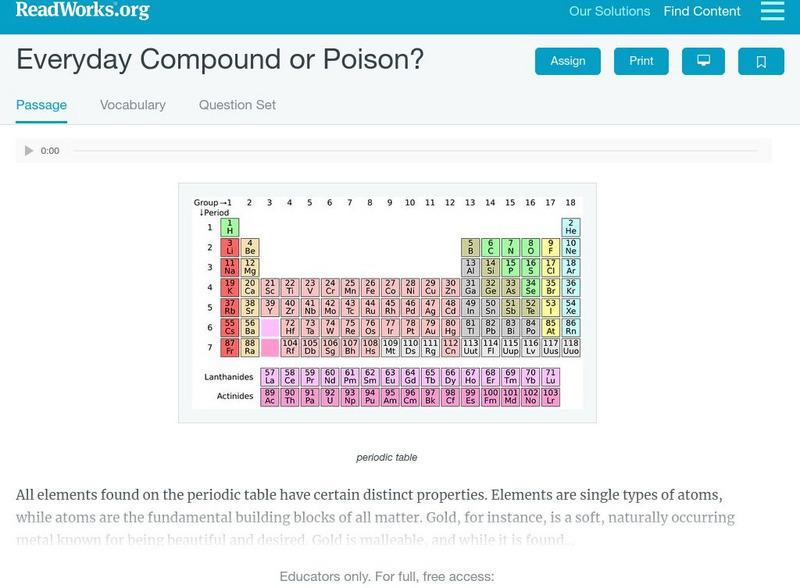
Read Works: Everyday Compound or Poison?
[Free Registration/Login Required] An informational text about how chemicals can be combined to form safe or unsafe compounds. A question sheet is available to help students build skills in reading comprehension.
Other
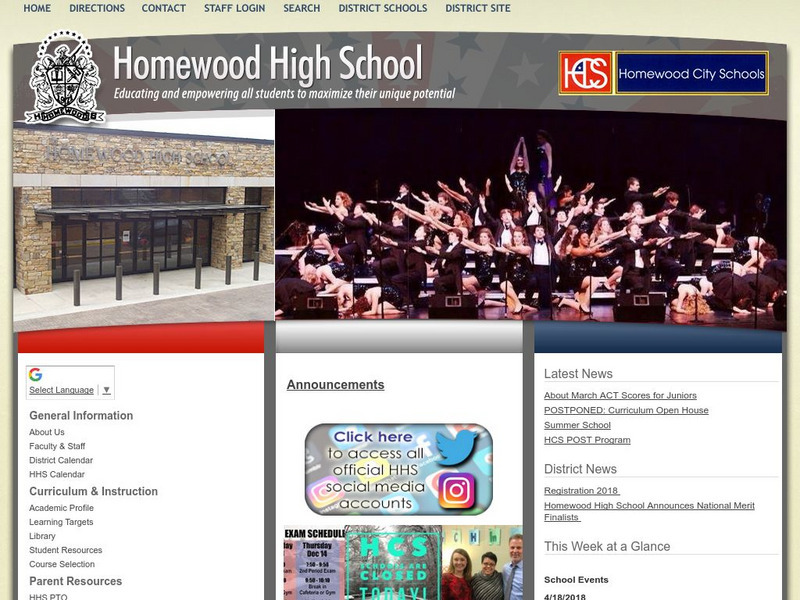
Homewood City Schools: Classification of Matter
This Homewood City Schools site has an outline form and contains lots of information about the classification and composition of matter. Some of the topics covered are matter and temperature, changes in state, composition of matter, and...
Quia
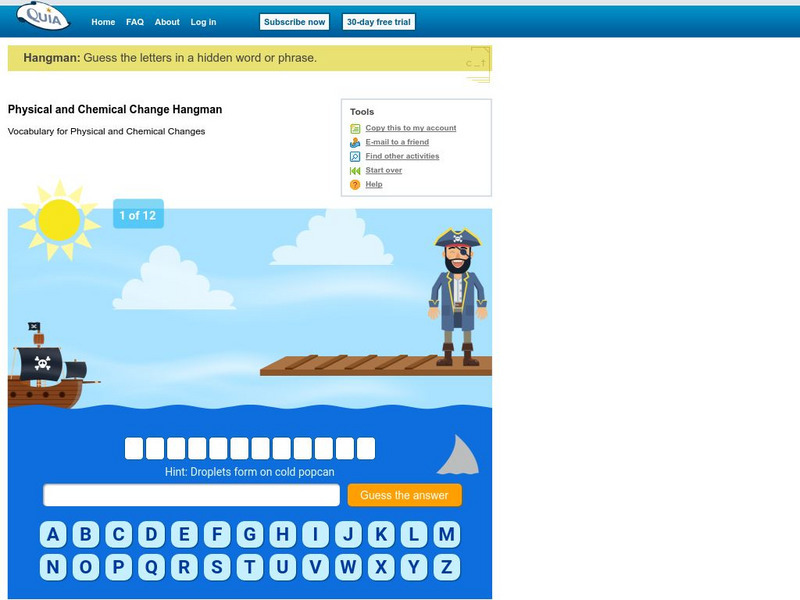
Quia: Physical and Chemical Change Hangman
Quia Corporation provides a hangman game about physical and chemical changes.
Other
The Science House: Combustion
In this experiment, students will observe that the weight of the product of combustion is greater than that of the starting material. Teacher's notes address the key concepts of this experiment.

ClassFlow
Class Flow: Physical and Chemical Changes
[Free Registration/Login Required] This flipchart introduces fifth graders to physical and chemical changes in matter. The Law of Conservation of Matter is also covered.
Annenberg Foundation
Annenberg Learner: 5 Question Survey: Chemical Change
Find out your or your students' basic knowledge of concepts like matter, molecules and open and closed systems. Afterwards you can see how others answered the questions.

ClassFlow
Class Flow: Changing States
[Free Registration/Login Required] Through this unit children consolidate their ideas about changes of state which can be reversed. They use their understanding to explain a range of familiar phenomena.