Hi, what do you want to do?






Concord Consortium
What Is a Chemical Reaction?
Take your class inside a beaker for an up-close view of a chemical reaction! Junior chemists examine how chemical reactions occur using an interactive resource. The activity allows users to change the temperature and observe how it...

Royal Society of Chemistry
Everyday Chemicals (14-16)
Two men want drinks and the first orders H2O. The second man orders H2O too, but he dies. Scholars apply their knowledge of H2O2 and other everyday chemicals during the activity. They match chemical formulas to common chemical names in a...

Royal Society of Chemistry
State Symbols
When water is a solvent in a chemical equation, we consider it an aqueous solution. Scholars match the name of four states of matter to their proper symbol in a chemical equation. Four puzzles provide repetition to help pupils remember...
Concord Consortium
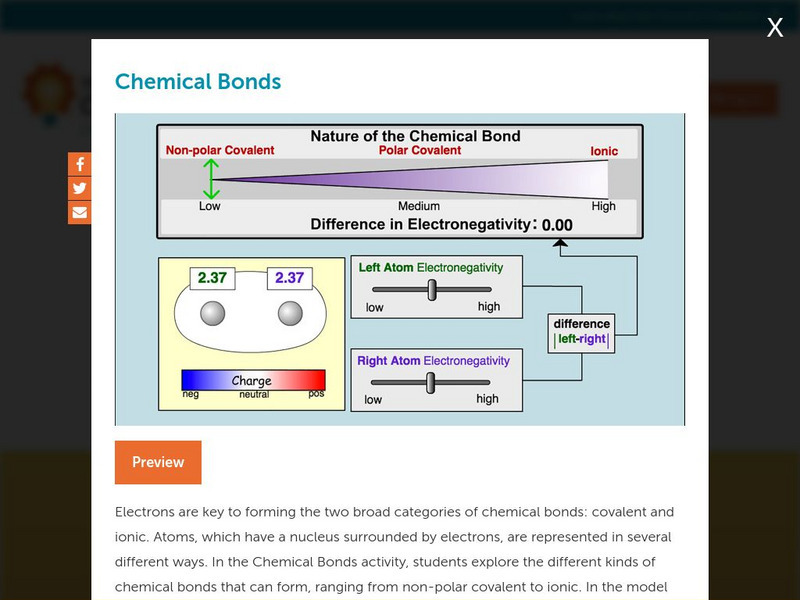
Concord Consortium: Stem Resources: Chemical Bonds
By working through this web-based activity, students differentiate between ionic, non-polar covalent, and polar covalent bonds. Specifically, distinctions are made between bonding types based on orbital shapes and electronegativity...
Concord Consortium
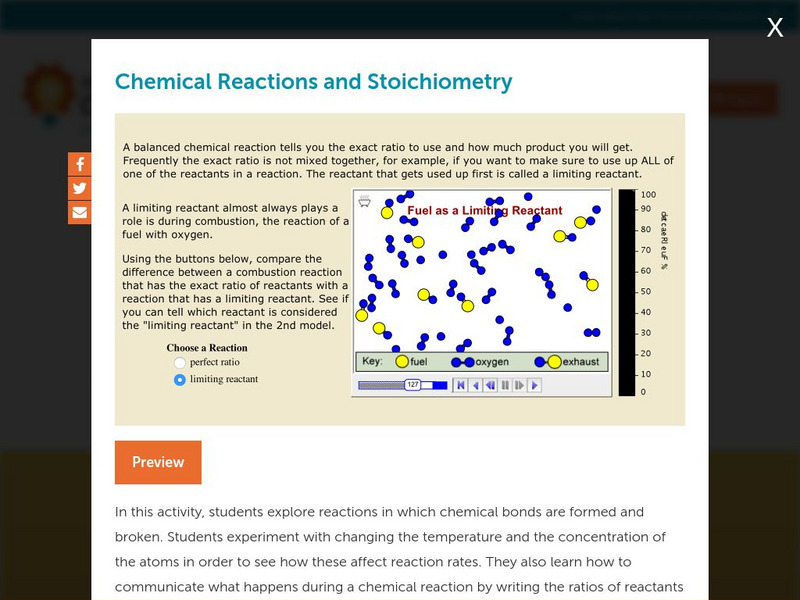
Concord Consortium: Chemical Reactions and Stoichiometry
In this activity, students explore reactions in which chemical bonds are formed and broken. Students experiment with changing the temperature and the concentration of the atoms in order to see how these affect reaction rates. They also...

Concord Consortium
Concord Consortium: Stem Resources: Making and Breaking Bonds
A look at the processes of association and dissociation in chemical bonding. Observe simulations that show the influence of temperature on making and breaking of bonds, how diatomic molecules form, and what determines the speed of...
Concord Consortium
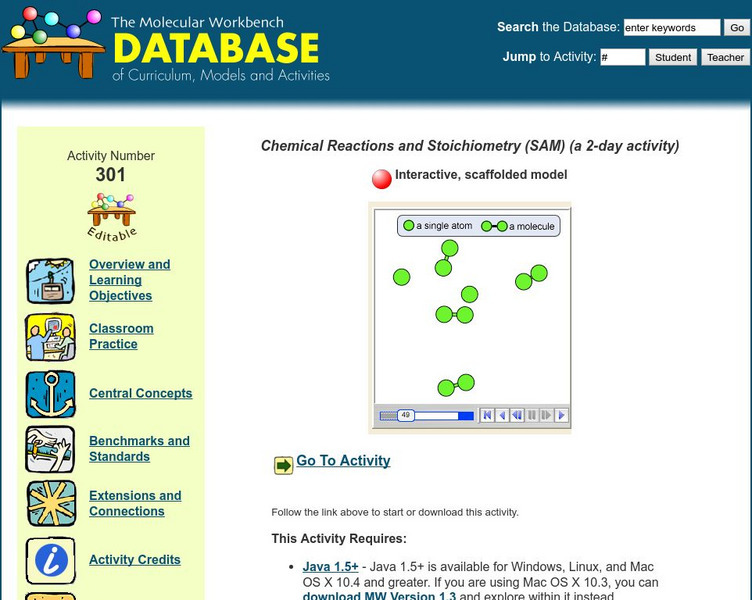
The Molecular Workbench Database: Chemical Reactions and Stoichiometry
This simulation helps students investigate the basics of chemical equations. Students will review stoichiometry and what effects their reaction rates.
Concord Consortium
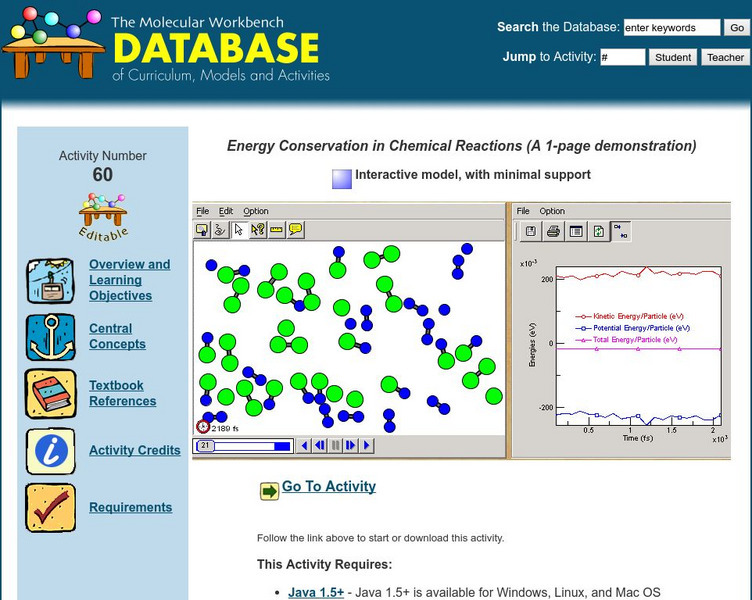
The Molecular Workbench Database: Energy Conservation in Chemical Reactions
Follow the energy conversion from potential to kinetic in this interactive activity that explores total energy in chemical reactions.
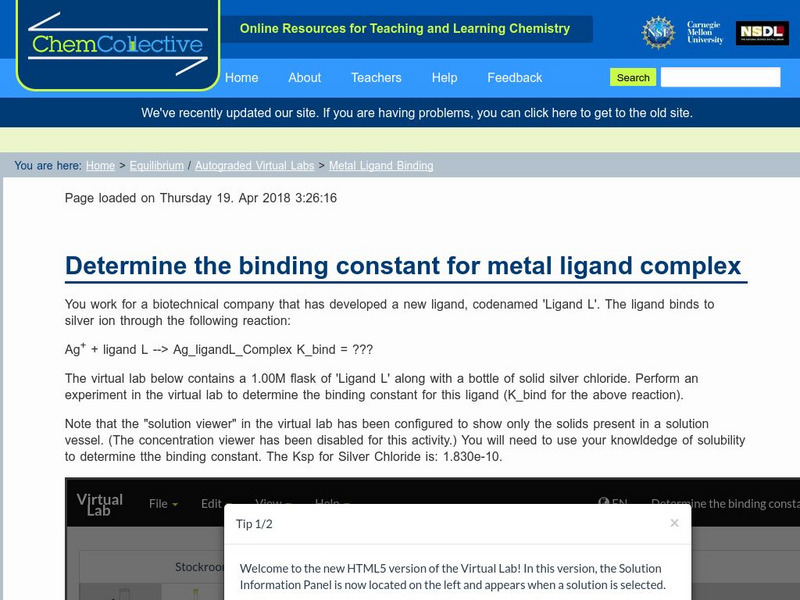
Chemistry Collective
Chem Collective: Metal Ligand Binding
Use silver chloride to determine the binding constant for a metal ligand complex.