Hi, what do you want to do?






Curated OER
How Big is a Molecule?
High schoolers estimate the size of a molecule of oleic acid. They conduct an experiment using chalk dust, water, and oleic acid, solve various calculations, and answer discussion questions.

Curated OER
Angular Solution of Hydrogen Atom
Students participate in an angular solution of hydrogen activity. Using this activity, students also illustrate eigenvalue problems applied in mathematics. They explore Schrodinger's equation and particle wave duality.

Curated OER
How Much Do I Know About Water?
Sixth graders explore how water behaves on a penny. In this states of matter lesson, 6th graders observe water as they add drops to a penny. This lesson helps students apply the adhesive properties of water to the water cycle.

Curated OER
Fallout!
Pupils plot the locations of fallout from two disasters that polluted much of the world's air. They plot the ash fallout from the 1980 Mt. St. Helen's eruption to see what the wind patterns in the United States look like overall. Next...
CK-12 Foundation
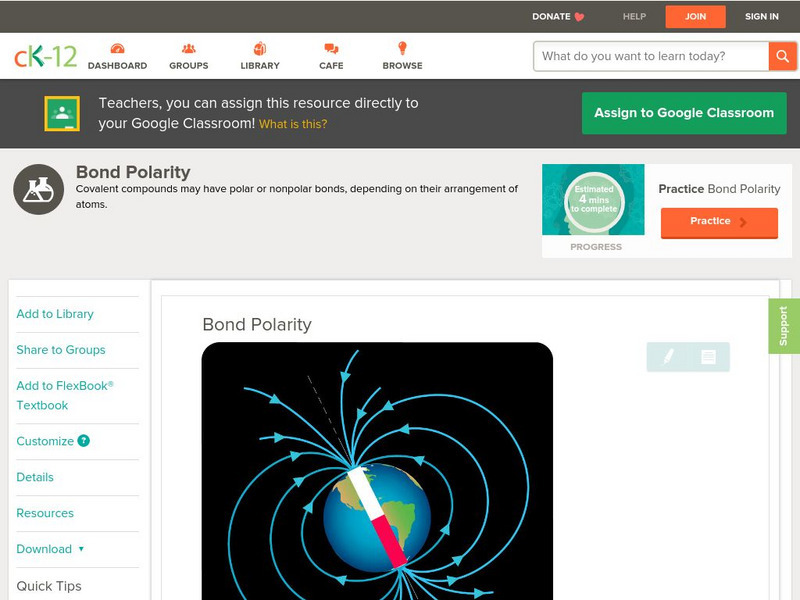
Ck 12: Chemistry: Bond Polarity
[Free Registration/Login may be required to access all resource tools.] Covers polarity and covalent bonds.

Chiral Publishing
Chiral Publishing: An Introduction to Chemistry: London Forces and Polar Molecules
Learn about London forces, which increase the attraction between polar molecules and the attraction between nonpolar molecules. Pictures and chemical structures allow for further understanding. Also find links for animations and...
CK-12 Foundation
Ck 12: Polarity and Intermolecular Forces
[Free Registration/Login may be required to access all resource tools.] The following online tutorial describes how the electronegativity difference between two atoms in a covalent bond results in the formation of a nonpolar covalent,...
Georgia Department of Education
Ga Virtual Learning: Ap Chemistry: Bonding
In this module students explore the properties of chemicals with covalent and ionic bonds. Students learn that there are different types of covalent bonds, polar and nonpolar, and that the type of covalent bond along with the shape of a...
CK-12 Foundation
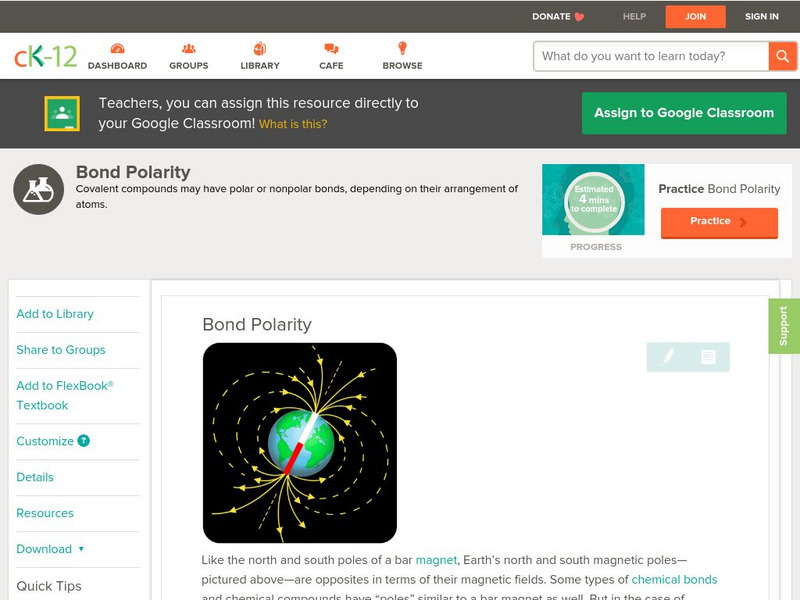
Ck 12: Physical Science: Bond Polarity
[Free Registration/Login may be required to access all resource tools.] Polarity and covalent bonds.
CK-12 Foundation
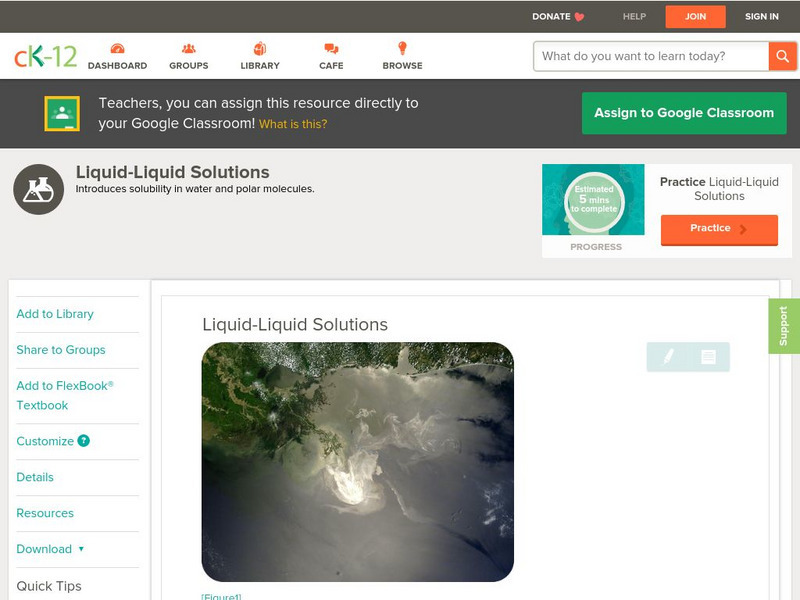
Ck 12: Chemistry: Liquid Liquid Solutions
[Free Registration/Login may be required to access all resource tools.] Covers solubility in water and polar molecules.
Vision Learning
Visionlearning: Chemistry: The Nature of the Chemical Bond
This site talks about ionic, polar covalent, and non-polar covalent bonding.

Concord Consortium
Concord Consortium: Molecular Workbench Showcase: Chemistry, Chemical Bonds
Simulations to show students the nature of chemical bonds. Simulations include an explanation of stereochemistry, atomic orbitals, chemical polarity, formation of an atom, and a summary quiz.
CK-12 Foundation
Ck 12: Polarity in Chemical Bonds
[Free Registration/Login may be required to access all resource tools.] Students will determine the polarity of a chemical bond using the electronegativity chart, and then distinguish between nonpolar covalent, polar covalent, and ionic...
University of Arizona
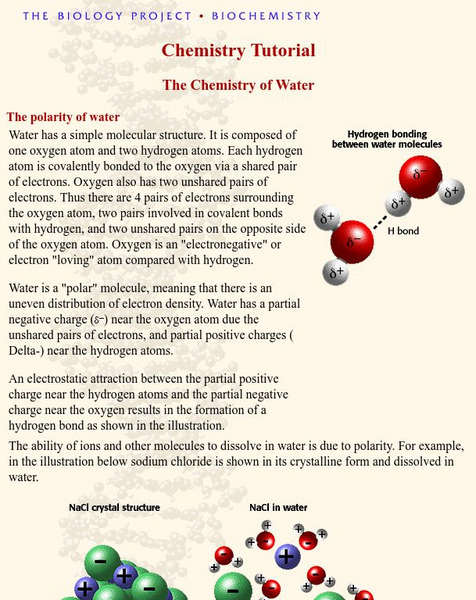
Ua: Chemistry Tutorial
This general tutorial begins with an explanation of the polarity of the water molecule and the effects this polarity has on the properties of water. Goes on to introduce organic molecules and has a thourough tutorial on the third page.
Ohio State University
Ohio State University: Electronegativity & Bond Polarity
Excellent graphics help this page explain the relationship between electronegativity and bond polarity.

Alabama Learning Exchange
Alex: Mentos, Soda, and Nucleation
In this lesson, Mentos candy and different types of soda are used to show examples of nucleation, surface tension, surface area, polar attractions, and supersaturated materials. A video will be used to show the examples and the students...
CK-12 Foundation
Ck 12: General Chemistry
[Free Registration/Login may be required to access all resource tools.] Students will be introduced to some of the basic concepts of chemistry.
Simon Fraser University
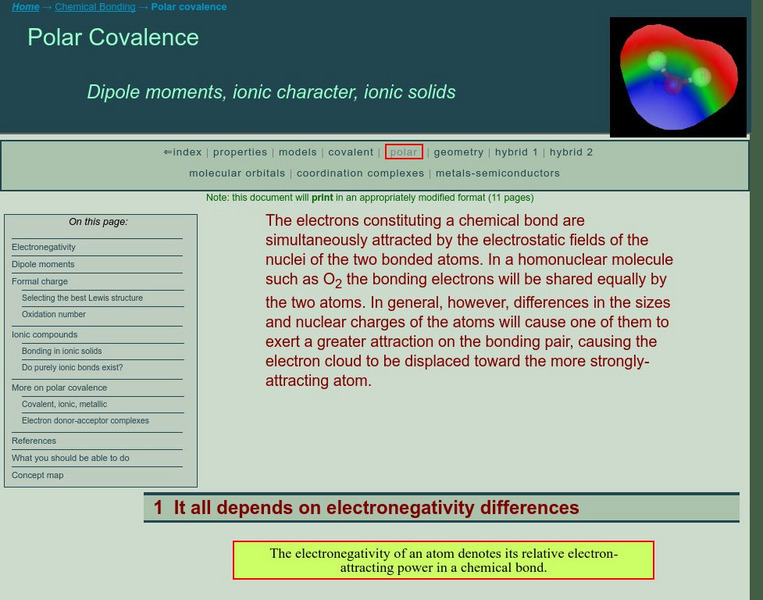
Chem1 Virtual Textbook: Polar and Nonpolar Bonds
The General Chemistry Virtual Textbook, or Chem 1, is broken into several sections covering various aspects of topics related to chemistry. This section deals with chemical bonding and specifically the study of both polar and nonpolar...
American Chemical Society
Middle School Chemistry: Lesson Plans: Water Is a Polar Molecule
Students develop their own water molecule model to help them understand the idea that water has a slight positive charge at one end of the molecule and a slight negative charge at the other.
American Chemical Society
Middle School Chemistry: Chapter 5: The Water Molecule and Dissolving
Nine exemplary chemistry lessons about the water molecule and dissolving complete with handouts and animations.
American Chemical Society
Middle School Chemistry: Lesson Plans: Surface Tension
Students observe and investigate why water has a strong surface tension.
American Chemical Society
Middle School Chemistry: Lesson Plans: Can Liquids Dissolve in Water?
Lesson plan with mulitmedia links in which students identify and control variables to help design a solubility test for different liquids in water.
American Chemical Society
Middle School Chemistry: Lesson Plans: Temperature Changes in Dissolving
Media-rich lesson in which learners discover that it takes energy to break bonds, and that energy is released when bonds are formed during the process of dissolving. They also determine whether dissolving is either exothermic or...
American Chemical Society
Middle School Chemistry: Lesson Plans: Why Does Water Dissolve Salt?
Students use their own model of a salt crystal and water molecule to show how water dissolves salt. Then, they relate their observations to the structure of salt, water, and alcohol on the molecular level.