Hi, what do you want to do?






Curated OER
How Much Do I Know About Water?
Sixth graders explore how water behaves on a penny. In this states of matter lesson, 6th graders observe water as they add drops to a penny. This lesson helps students apply the adhesive properties of water to the water cycle.

Curated OER
The Connection Between Pigment and Light Colors
Students learn the procedure for mixing secondary colors from primary pigments and observe the results of mixing two primary colors.

Curated OER
Fallout!
Pupils plot the locations of fallout from two disasters that polluted much of the world's air. They plot the ash fallout from the 1980 Mt. St. Helen's eruption to see what the wind patterns in the United States look like overall. Next...

Curated OER
Wave Types and Characteristics
Ninth graders identify the different parts of a wave. In this physics lesson, 9th graders observe wave behavior as it travels through a boundary. They determine the relationship between wavelength, frequency and velocity.
CK-12 Foundation
Ck 12: Polarity and Intermolecular Forces
[Free Registration/Login may be required to access all resource tools.] The following online tutorial describes how the electronegativity difference between two atoms in a covalent bond results in the formation of a nonpolar covalent,...
Georgia Department of Education
Ga Virtual Learning: Ap Chemistry: Bonding
In this module students explore the properties of chemicals with covalent and ionic bonds. Students learn that there are different types of covalent bonds, polar and nonpolar, and that the type of covalent bond along with the shape of a...
Vision Learning
Visionlearning: Chemistry: The Nature of the Chemical Bond
This site talks about ionic, polar covalent, and non-polar covalent bonding.
CK-12 Foundation
Ck 12: Polarity in Chemical Bonds
[Free Registration/Login may be required to access all resource tools.] Students will determine the polarity of a chemical bond using the electronegativity chart, and then distinguish between nonpolar covalent, polar covalent, and ionic...

Concord Consortium
Concord Consortium: Molecular Workbench Showcase: Chemistry, Chemical Bonds
Simulations to show students the nature of chemical bonds. Simulations include an explanation of stereochemistry, atomic orbitals, chemical polarity, formation of an atom, and a summary quiz.
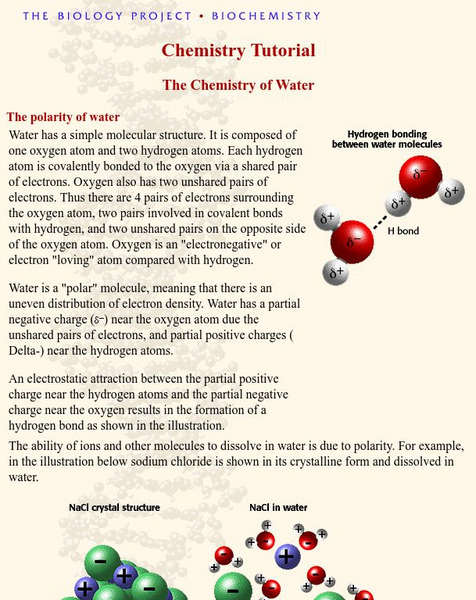
University of Arizona
Ua: Chemistry Tutorial
This general tutorial begins with an explanation of the polarity of the water molecule and the effects this polarity has on the properties of water. Goes on to introduce organic molecules and has a thourough tutorial on the third page.
CK-12 Foundation
Ck 12: Chemistry: Bond Polarity
[Free Registration/Login may be required to access all resource tools.] Covers polarity and covalent bonds.

Ohio State University
Ohio State University: Electronegativity & Bond Polarity
Excellent graphics help this page explain the relationship between electronegativity and bond polarity.
CK-12 Foundation
Ck 12: Physical Science: Bond Polarity
[Free Registration/Login may be required to access all resource tools.] Polarity and covalent bonds.
CK-12 Foundation
Ck 12: Chemistry Simulation: Soap
[Free Registration/Login Required] Learn the chemistry behind the ability of soap molecules to remove stains from clothing. The amphipathic nature of soap molecules is highlighted.
Chiral Publishing
Chiral Publishing: An Introduction to Chemistry: Predicting Molecular Polarity
This section in the online textbook describes how to tell if a molecule is polar or non polar. Detailed steps and examples are good references. Also find links to presentations and chapter maps for other chemistry topics.
Chiral Publishing
Chiral Publishing: An Introduction to Chemistry: London Forces and Polar Molecules
Learn about London forces, which increase the attraction between polar molecules and the attraction between nonpolar molecules. Pictures and chemical structures allow for further understanding. Also find links for animations and...
CK-12 Foundation
Ck 12: General Chemistry
[Free Registration/Login may be required to access all resource tools.] Students will be introduced to some of the basic concepts of chemistry.
Simon Fraser University
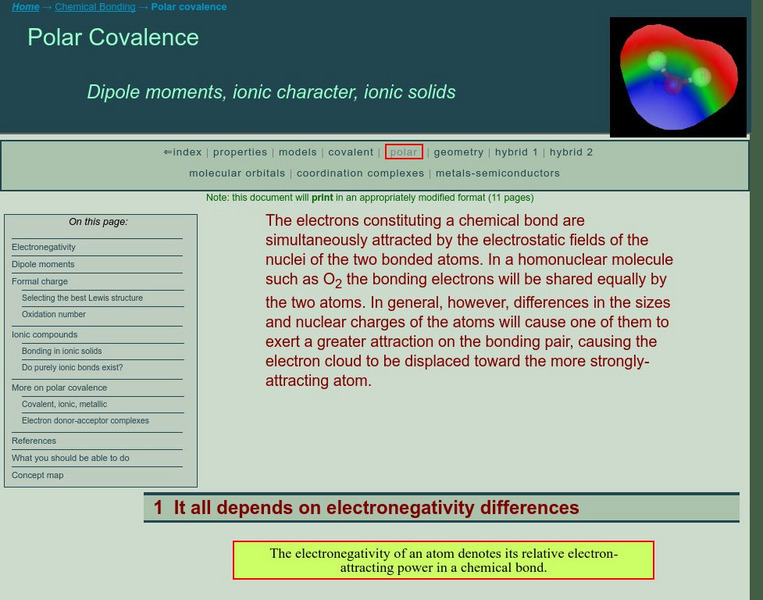
Chem1 Virtual Textbook: Polar and Nonpolar Bonds
The General Chemistry Virtual Textbook, or Chem 1, is broken into several sections covering various aspects of topics related to chemistry. This section deals with chemical bonding and specifically the study of both polar and nonpolar...
American Chemical Society
Middle School Chemistry: Chapter 5: The Water Molecule and Dissolving
Nine exemplary chemistry lessons about the water molecule and dissolving complete with handouts and animations.
CK-12 Foundation
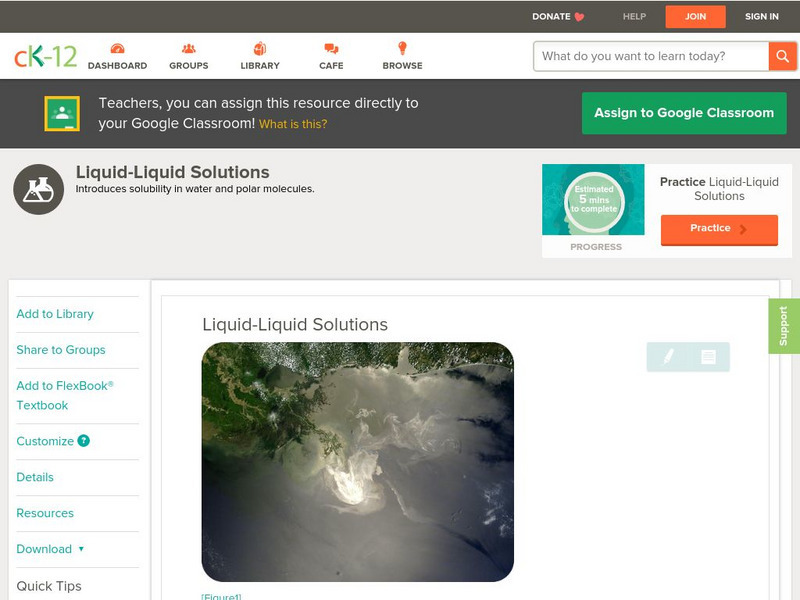
Ck 12: Chemistry: Liquid Liquid Solutions
[Free Registration/Login may be required to access all resource tools.] Covers solubility in water and polar molecules.
Frostburg State University
General Chemistry: Why Oh, Nh, and Fh Bonds Are Polar
Frostburg State University provides a brief explanation to the question of why small hydrogen molecules, such as OH, NH, and FH, are very polar.
American Chemical Society
Middle School Chemistry: Water Is a Polar Molecule
Explore the water molecule, and understand how it is a polar molecule.

National High Magnetic Field Laboratory
Magnet Academy: Simple Electrical Cell
This is a Java tutorial showing the simple voltaic (or galvanic) electrical cell, which is the most basic type of "wet" cell and demonstrates the fundamental chemistry behind batteries.
American Chemical Society
Middle School Chemistry: Lesson Plans: Why Does Water Dissolve Sugar?
Lesson plan in which students design an experiment to determine if different types of liquids affect the amount of dissolution of an M&M candy shell.