Hi, what do you want to do?






Curated OER
Backwards Goes It Does
Students create a three-dimensional model of the Chicago river watershed to determine the flow of the river at its mouth. They use prepared clear gelatin and topographic maps to discover that the building of canals actually reversed the...

Curated OER
Water Quality Tests Explained
Students define all eight water quality parameters and list at list one source for each of the eight water quality parameters. They determine how each of the eight parameters affect river ecosystems.

Curated OER
What is a River?
Students study the various types of bodies of water: rivers, oceans, lakes and ponds. They observe models of each and then use clues to discuss how they are alike and different. They imagine they have found a new planet and draw a map...

Curated OER
The Cost of Telling the Truth
High schoolers examine Leopold's Land Ethic involving illegal river dumping. They consider the dilemmas of the case study and share their ideas for a solution using group discussion and individual answers.

Curated OER
Choices Make A Difference
Students are explained that wastewater treatment plants are regulated as to the quality of water they may discharge into our rivers and canals. They are explained that wastewater treatment plants clean many pollutants out of the...

Curated OER
Erosion: Natural or Unnatural
Students explore how water has the power to erode, how developing the land (building roads, buildings and parking lots) increases the amount of water reaching our rivers, and how this greater quantity of water increases erosion. They...

Curated OER
Water Quality Tests Explained
Students identify the eight tests done to check for water quality. In this ecology lesson, students explain why it's important to test water in rivers. They explore sources of river water pollution.

Curated OER
Watercycle
Third graders examine the natural circulation of water from oceans, lakes, and rivers to evaporation into the air, and then to condensation to produce rain falling back to the soil as components of the water cycle.

Curated OER
A Bridge Going Up and Down
Young scholars recognize the purpose of the Michigan Avenue Bascule Trunnion Bridge. They examine photos of bridges and sing a song about Chicago's famous bascule trunnion bridge to investigate how
moveable bridges work.

Curated OER
Interpreting Aerial Photographs
Students interpret aerial photographs. They view aerial photographs or satellite-produced images to locate and identify physical and human features. They study satellite images and label their images for bodies of water, clouds,...

Curated OER
Biodiversity - Who Cares?
Learners articulate some of the impacts of loss of biodiversity. They play a game that demonstrates why having a rich variety of life is important to the survival of ecosystems and how invasive species are threatening local biodiversity.

Curated OER
Building an Ecosystem
Students research a variety of local and world ecosystems. Students will create a collage to represent the biotic and abiotic factors and interactions important to their given ecosystem.Students will understand that an ecosystem is...

Curated OER
Dinosaur Tracks and Critical Thinking
Get your young scientists excited about geology through the study of dinosaur tracks! They will use their power of observation to learn how tracks are made and use critical thinking strategies to suggest a scenario in which they were...

Curated OER
How Old Is Illinois?
Students use fossils found in rocks to determine the age of rock in Illinois. They use a chart to identify the fossils and then identify the periods of rock.

Curated OER
Living Organisms as Indicators of Pollutants in Fresh Water Ecosystems
Students observe the effects of pollution on living organisms. In this pollution lesson plan, students observe fresh water Hydra and look at their structures and movement. They place samples of pond and lake water on the Hydra and...

Curated OER
Water Exploration Station
Students explore the characteristics of water. In this water exploration lesson, students participate in various learning centers to inquire how water drains and how to increase the flow of water. Students use estimation and measurement...

Curated OER
The Wrights' Flight: History Through Primary Sources
Students read primary source material about the Wrights' first flight such as a journal and a telegram. In this The Wrights' Flight instructional activity, students select the most reliable primary source and compare the pros and cons of...

Curated OER
Oceans
First graders recognize that nearly three quarters of the Earth is covered by ocean. They locate the Pacific, Atlantic, Indian, Arctic and Antarctic oceans on a map. They describe the difference between ocean water and fresh water.

Curated OER
Four Forces of Flight
Students explore the four forces of flight. They investigate the four forces of flight: lift, drag, thrust and weight (gravity). They experiment with flight-testing various objects commonly found around the house and constructing paper...
Chicago Zoological Society
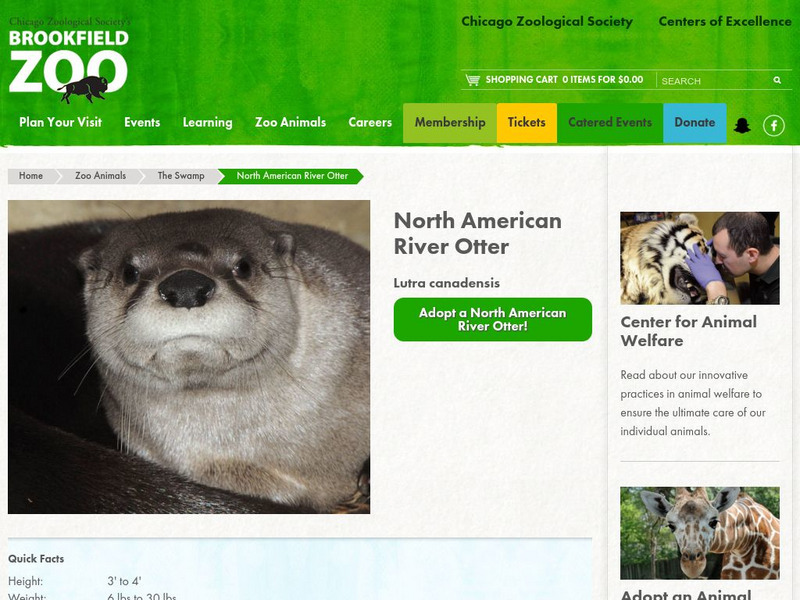
Chicago Zoological Society: Zoo Explorer: North American River Otter
Familiarize yourself with the North American river otter by browsing this brief overview from the Brookfield Zoo. This animal guide includes quick facts and information on the appearance, habitat, social and eating habits, and other...