Hi, what do you want to do?





Center For Civic Education
Center for Civic Education: Resource Bank
This page contains an extensive collection of links to pdf versions of lessons and handouts needed to teach the Citizens, Not Spectators curriculum. Has lessons for upper elementary, middle school, and secondary.
iCivics
I Civics: Games: Cast Your Vote
This resource is an interactive educational game that places the players in control of all three branches of government to test their abilities to turn issues of concern into full-fledged laws. In the debate, choose the questions to help...

iCivics
I Civics: Mini Lesson: Congressional Committees
Students discover the different types of congressional committees and their responsibilities in this lesson.
iCivics
I Civics: A Very Big Branch
Students learn how the executive departments and agencies regulate and enforce governmental policies, and they explore the roles and responsibilities of the presidential cabinet.
US Government Publishing Office
Ben's Guide to u.s. Government: Duties and Responsibilities of Citizens
This site provides a brief summary of the duties and responsibilities of citizens. The subject of the page focuses on voting. Includes links to citizenship, the Bill of Rights, and more.
Other
The Civics Institute: Get Involved!
This extremely detailed site has students becoming involved in their community government.
Daily Teaching Tools
Daily Teaching Tools: I Civics Attributes
This Daily Teaching Tools resource explains the attributes associated with the free educational game designed by Sandra Day O'Connor, iCivics. Teachers can use this resource to assess understanding of the American government and...
HotChalk
Hot Chalk: Lesson Plans Page: A Rights vs. Responsibilities Game
Directions for a dominos game. The teacher, before class or with students' help, creates dominos depicting various occasions. Students identify the responsibilities they would have for each occasion. Then students can use the pieces to...
NPR: National Public Radio
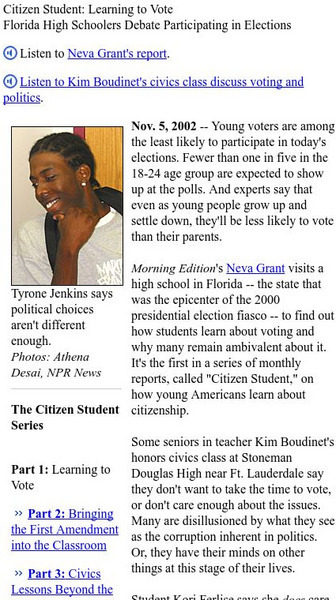
Npr: Citizen Student
A multi-part NPR program on the views of students about civic participation. Part 1 discusses Voting, Part 2 discusses "Bringing the First Amendment into the Classroom," and Part 3 talks about the strong messages teenagers have grown up...

Khan Academy
Khan Academy: The Bureaucracy
This resource from Khan Academy provides practice questions about the government's bureaucracy. These questions are intended for students taking high school or college level American Government and Civics courses, including the AP...

Khan Academy
Khan Academy: Discretionary and Rule Making Authority
This resource from Khan Academy provides practice questions over discretionary and rule-making authority. These questions are intended for students taking high school or college level American Government and Civics courses, including the...
iCivics
I Civics: Executive Command
Ever wanted to be President for a day? In Executive Command, you can be President for four years! Try to accomplish what you set as your agenda while facing the challenges and responsibilities that crop up along the way. Being...
iCivics
I Civics: Our Courts: Constitution Day Lesson: Checks and Balances [Pdf]
Students learn the roles and responsibilities of each branch of government and where the checks and balances are located in this role-playing lesson. Requires Adobe Reader.
iCivics
I Civics: Voting: Will You Do It?
Voting isn't a requirement, but it is our responsibility and our right. Find out who can vote and the differences in voting by state.
iCivics
I Civics: Crisis Collaboration: Covid 19 Mini Lesson
Explore the actions and relationships between different levels of government as they figure out what to do in response to COVID-19. This activity has been adapted for digital and remote learning use and a traditional lesson plan is...
iCivics
I Civics: Tribal Government
As sovereign nations, American Indian and Alaska Native tribes develop and manage their own governments. This lesson examines the varied structures and functions of tribal government as well as the relationship these nations have with...
Constitutional Rights Foundation
Constitutional Rights Foundation: Building Democracy: Every New Generation
Activity in which students read and write about whether or not today's generation of youth are prepared for the leaderhip and citizenship roles of tomorrow. Students will evaluate the role of schools and recommend approach to civic...
Constitutional Rights Foundation
Constitutional Rights Foundation: Global Warming: What Should We Do About It?
Activity based resource for teachers in which students are involved in reading summaries, literature and scientific reports about Global Warming, formulating a response on how to approach Global Warming, then taking part in a mock Global...
Other
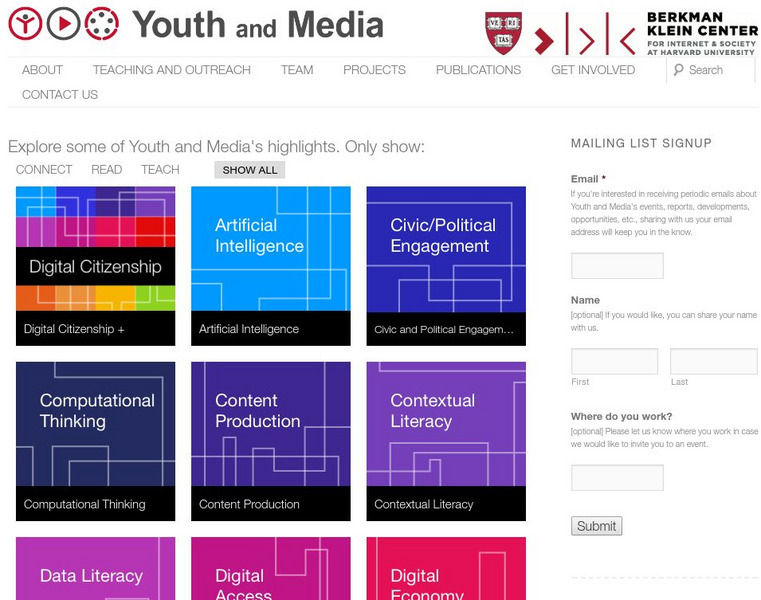
Berkman Center for Internet & Society: Confronting Online Challenges
Youth and Media focuses on the challenges young people face when accessing the Internet. Website addresses online safety, privacy, information quality and civic participation. Includes links to ongoing projects, publications and ways for...
PBS
Pbs Learning Media: Writing in u.s. History: The Bill of Rights
Explore why the Bill of Rights was added to the Constitution and its enduring impact on defining our rights. In this interactive lesson from WGBH, students develop a written argument in response to the question "How does the Bill of...
CPALMS
Florida State University Cpalms: Florida Students: Trial by Jury: You Decide!
Learn about trial by jury in this tutorial where you exercise your responsibility as a citizen by serving on a jury and deciding on a case. A PDF file of the tutorial is available.
Other
Dirksen Center: Why Is It Important to Vote?
A basic right in a democracy. We know we should vote, but does our vote mean anything? Good answers to some good questions. This site provides many classroom resources.
PBS
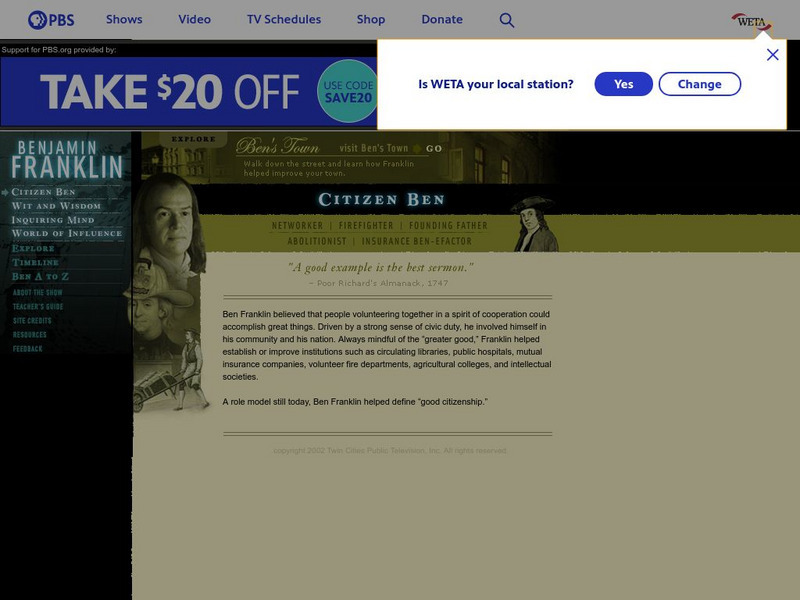
Pbs: Benjamin Franklin: An Extraordinary Life: Citizen Ben
Read a five-part essay on Franklin's sense of civic duty and learn why he is still, to this day, considered a role model of good citizenship.
PBS
Pbs Learning Media: Your America: Democracy's Local Heroes: Student Guide
Investigate the rights and responsibilities of American citizenship focusing on examples of citizens who took action to effect positive changes. Explore ways in which students can become involved in their communities.