Hi, what do you want to do?






Digital Public Library of America
Dpla: Torn in Two: Mapping the American Civil War
This exhibition tells the story of the American Civil War both nationally and locally in Boston, Massachusetts, through maps, documents, letters, and other primary sources.

Other
Vox: 37 Maps That Explain the American Civil War
April 1865 was a momentous month in American history. On April 9, the Confederate army under Robert E. Lee surrendered to the Union forces of Ulysses S. Grant, effectively ending the Civil War. Then on April 14, the victorious President...
Other
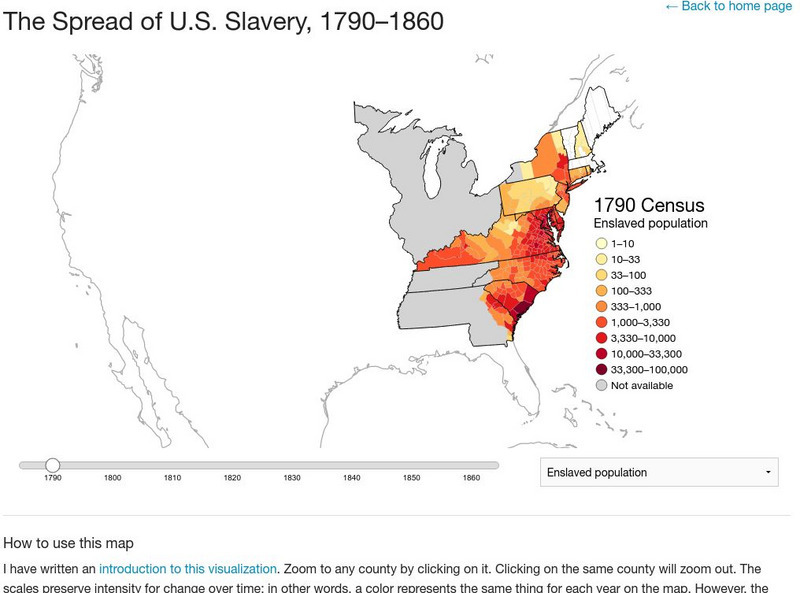
The Spread of u.s. Slavery, 1790 1860
Presents population maps of enslaved and free African Americans before the Civil War based on census population.
University of Oregon
Mapping History: American History
Interactive and animated maps and timelines of historical events and time periods in American history from pre-European times until post-World War II.
National Women’s History Museum
National Women's History Museum: Harriet Tubman
View this engaging online exhibit to learn about Harriet Tubman, an outspoken advocate for African American and women's rights.
Tom Richey
Tom richey.net: The Crisis of the Union (1850 1860) [Ppt]
Presents key ideas for examining the events and issues that led to the American Civil War.
Art Institute of Chicago
Art Institute of Chicago: Art Access: American Art to 1900
Study works of American art from the eighteen and nineteenth centuries. Works in a variety of media, including the decorative arts, are represented as are pieces by some of America's best-known artists: Copley, Church, Homer, and...
Curated OER
Uncle Tom and Slave Owner Simon Legree
An overview of slave revolts and abolitionist efforts during the first half of the nineteenth century, leading up until the Civil War. Read about the Underground Railroad, the colonization movement, and various anti-slavery books.
Curated OER
Educational Technology Clearinghouse: Clip Art Etc: Abraham Lincoln
Abraham Lincoln, former United States President, involved in slavery issues and the Civil War.-E. Benjamin Andrews 1895