McGraw Hill
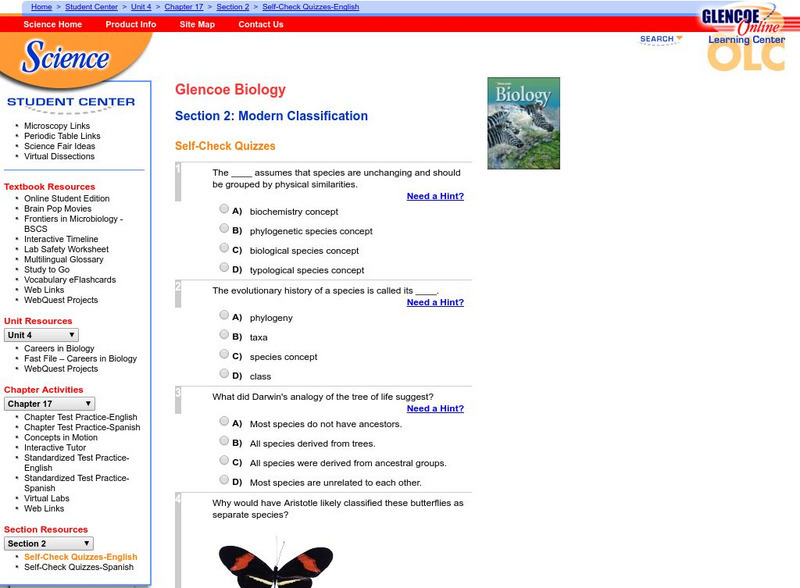
Glencoe Biology: Modern Classification: Self Check Quiz
Try these five self-checking quiz questions over modern classification of living things. Click on the hints to see information about each question.

Other
Geology.com: Rocks: Pictures of Sedimentary Rocks
Presents photographs of examples of clastic, chemical, and organic sedimentary rocks, with short descriptions underneath each rock image. Each rock name is also linked to its own dedicated page with a great deal of additional information...

BiologyWise
Biology Wise: Classification of Amoeba (Ameba)
Describes the characteristics of amoeba and their classification.

Alabama Learning Exchange
Alex: What's Your Classification?
After completing this activity, the students will understand that scientists group animals into categories. Students will understand that scientists use specific characteristics to group animals. They will also extend their knowledge of...
Estrella Mountain Community College
Online Biology Book: The Nature of Science and Biology
Use the scientific reasoning and critical thinking to take an in-depth look at the basics of biology.
Estrella Mountain Community College
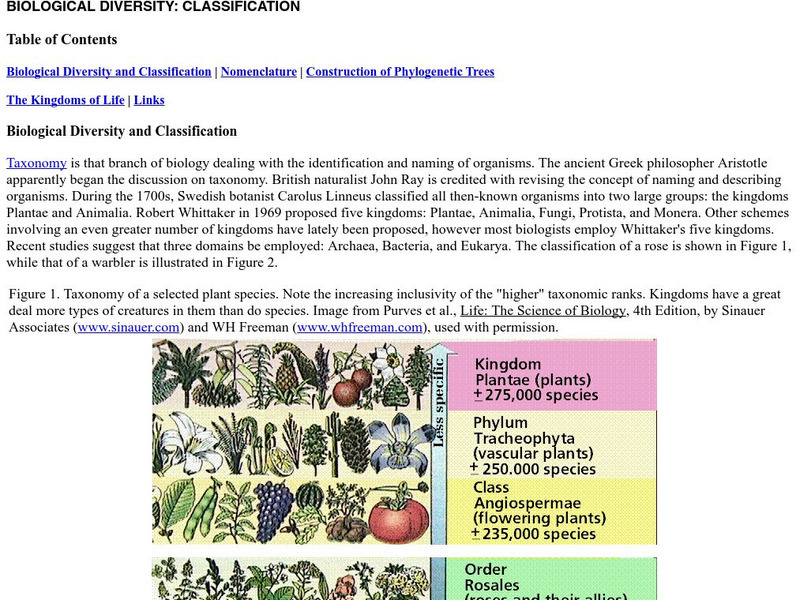
Estrella Mountain College: Classification
Discusses many aspects of information pertainingto organism classification. Provides links to other areas in biology as well.
Other
Frostburg State University: Organic Chemistry Tutorials
This site features tutorials on alkenes, alkanes, alkynes, alcohols, carboxylic acids, amines, ketones, aldehydes, and benzene. The tutorials lists the properties of each, structure and classification, the nomenclature, and gives...
US Department of Agriculture
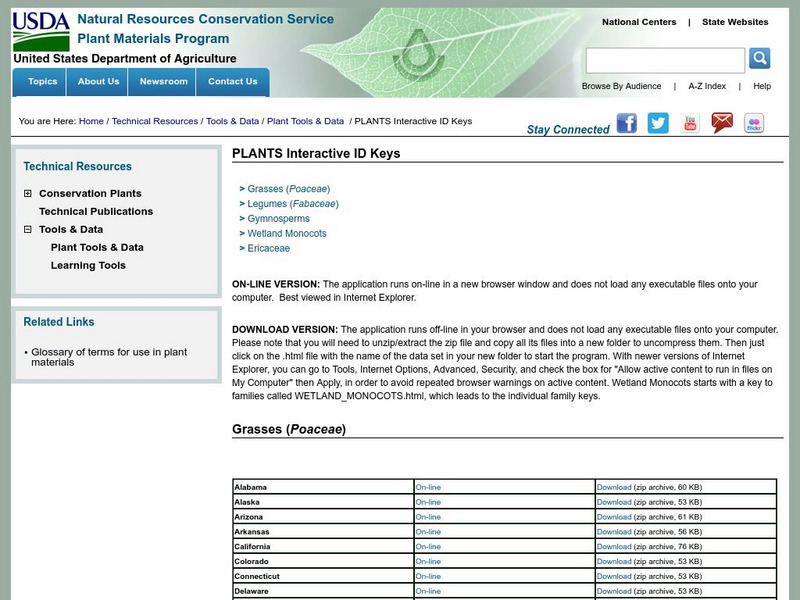
Us Department of Agriculture: Plants Interactive Id Keys
A database of information about plants across the United States and how to identify them. Covers grasses, legumes, gymnosperms, wetland monocots, and the Ericaceae flowering plants. The information is contained in downloadable zip files,...
BiologyWise
Biology Wise: A Brief Understanding of Euglena Movement
Describes the characteristics and classification of Euglena, how it reproduces, and how it is able to move through water using its single flagella.
Discovery Education
Discovery Education: Animal Classification
Use this activity to help young scholars understand the reasons for classifications and ways that different species are separated.
Other
Math and Science Activity Center: Classification of Living Things
Kingdom is the highest rank used in the biological taxonomy of all organisms. There are 6 kingdoms in taxonomy. Every living thing comes under one of these 6 kingdoms. The six kingdoms are Eubacteria, Archae, Protista, Fungi, Plantae,...
BiologyWise
Biology Wise: Different Types of Bacteria
Discusses the different criteria used to classify bacteria and the groups of bacteria within each category. Groups are organized by characteristics such as morphology, shape, cell wall structure, and presence of flagella.
CK-12 Foundation
Ck 12: Biology: Classifying Organisms Study Guide
This comprehensive study guide covers the main terms and concepts needed for a unit on classifying organisms.
CK-12 Foundation
Ck 12: Life Science: 11.9 Organization of Living Things
Learn the system that scientists use to classify living things.
Other
Organic Chemistry on Line: Acids and Bases
The bottom of this page gives an excellent idea of what Lewis acids and bases are. Inculdes graphics to aid in understanding.
PBS
Pbs Learning Media: Living and Nonliving
What is it that distinguishes a living organism from a nonliving object? This collection of images presents examples that aren't as clear-cut as one might think, enticing students to question the meaning of life.
Texas Education Agency
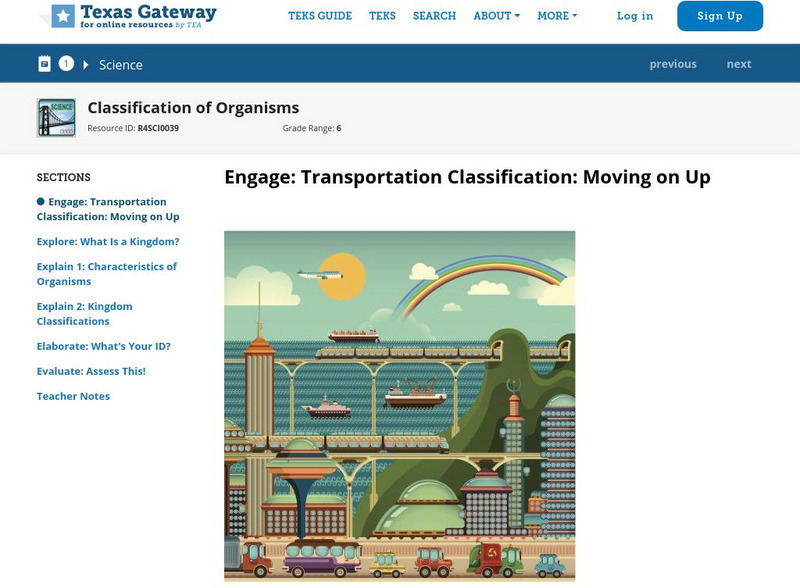
Texas Gateway: Transportation Classification: Moving on Up
In this learning module, students will begin to undestand the how kingdoms are classified.
Utah Education Network
Uen: Trb 4:5 Investigation 7 Classification Schemes
Activity involves placing organisms into the correct classification.
University of British Columbia
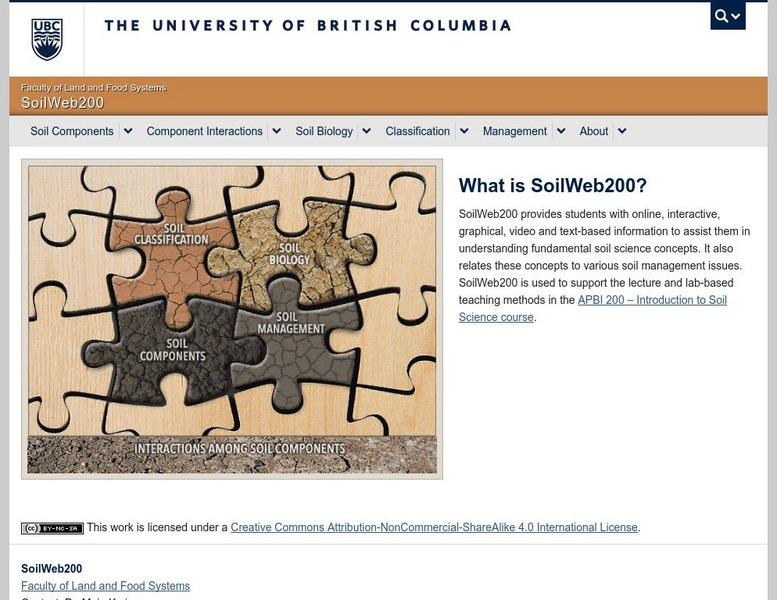
University of British Columbia: Soil Components
Use this interactive website to learn everything you wanted to know about the four components of soil: minerals, organic, water, and air. Many links along the way assist with comprehension by allowing you to view photographs, charts, and...
Cornell Lab of Ornithology
Cornell Lab of Ornithology: All About Birds
One of the great attractions of this site is the ability to listen to the birds. Each bird is categorized with a picture, description, its cry, conservation status and "Cool Facts." There are tips for attracting birds as well as...

Other
Alternative Classifications of Life
The Linnaean system (1758) classified all macroscopic living organisms as either Animals or Plants, based on whether they moved [anima, with a soul] or not. Thus, Fungi were included as plants. With the invention of the microscope and...

TED Talks
Ted: Ted Ed: The Evolution of Animal Genitalia
Genitals are the fastest-evolving organs in the animal kingdom. Menno Schilthuizen explains how the evolutionary biology of nature's nether regions uncovers a hidden world of seduction, conflict, and rivalry.

Alabama Learning Exchange
Alex: I Know What I Am, but What Are You?
During this instructional activity students will develop an understanding of how to classify living things and what creates the distinction among them. They will learn to classify living things by effects, environment, and activity.
BiologyWise
Biology Wise: An Overview of the Euglena Classification
Describes the classification, structure, habitat, lifespan, method of reproduction, and diet of Euglena, a unicellular organism.