Hi, what do you want to do?






Curated OER
Classy
Students explore the classification system in this seven lessons unit. The diversity of life forms and their characteristics are examined using a microscope. Kingdoms, classes, and families are investigated.

Curated OER
What Lives In A Shell?
Second graders study the readily observable characteristics of marine invertebrates, 2nd graders research the invertebrates and complete worksheets in this series of lessons.

Curated OER
The Crusty Fossils
Students identify some of the different species of crabs and tell how they adapt themselves to their environment. They discuss the evolution and stages of development of the crabs. They identify the Phylum Arthropoda and the Class...

Curated OER
Animal Diversity
Students use the Animal Diversity E-Sheet to access the Where Can Animals Live? online book.

Curated OER
Everything in Its Place: Science Classification
Students investigate the system of classification for living things through the sixteen lessons of this unit. The five kingdoms of monerans, protists, fungi, plants, and animals form the basis of several experiments as the similarities...

Curated OER
Animal Diversity
Students examine plants and animals for their similarties and differences. They are read stories and note how the animals in the stories do not have the qualities that real animals have. They complete a worksheet to end the lesson plan.

Biology Junction
Introduction to Animals Crossword Puzzle
In this introduction to animals instructional activity, students complete a crossword puzzle with 47 questions on the types and characteristics of animals.

Curated OER
Animal Diversity
Students explore biology by completing science worksheets in class. In this animal anatomy lesson, students read the book The Adventures of Marco and Polo and identify the animals mentioned in it. Students examine a real life animal and...

Curated OER
Pheed the World: Edible Phyla
Students discuss the contributions of different organisms to our world. In this biology activity, students research countries with limited food supply. They create an improvement plan for a fictitious country assigned to them.

Curated OER
What is a Fossil?
Students determine what a fossil is and distinguish between body fossils and trace fossils. They examine pictures of fossils and determine which represents a trace or body fossil.

Curated OER
Amphibian Features - Frog Dissection
Seventh graders examine the physical features of an amphibian. In this investigative lesson students compare and contrast the anatomy of a frog to a human.
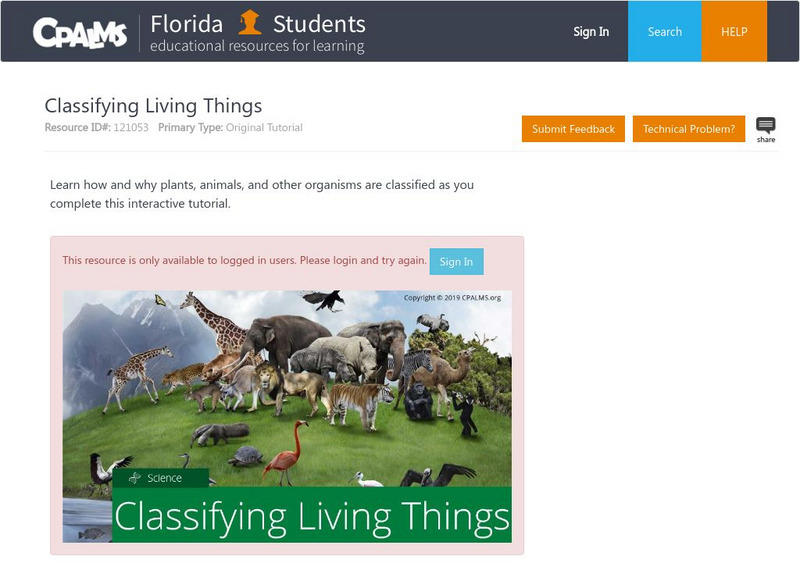
CPALMS
Florida State University Cpalms: Florida Students: Classifying Living Things
Learn how all living things are classified.

E-learning for Kids
E Learning for Kids: Science: Caribbean Sea: How Can We Classify Animals?
Welcome to Hideaway Island where five pirates need to find crews for their ships. Join in and learn about animals with backbones.
Sophia Learning
Sophia: Animals: Vertebrates: Lesson 3
This lesson will explain the characteristics of animals that are classified as vertebrates. It is 3 of 4 in the series titled "Animals: Vertebrates."
Sophia Learning
Sophia: Animals: Vertebrates: Lesson 2
This lesson will explain the characteristics of animals that are classified as vertebrates. It is 2 of 4 in the series titled "Animals: Vertebrates."
Sophia Learning
Sophia: Animals: Vertebrates: Lesson 4
This lesson will explain the characteristics of animals that are classified as vertebrates. It is 4 of 4 in the series titled "Animals: Vertebrates."

ClassFlow
Class Flow: Classifying Invertebrates
[Free Registration/Login Required] This is a lesson on classifying invertebrates based on their observable features. It focuses on the three types of worms: flatworm, roundworm, and segmented worm. The lesson contains 3 videos as well as...

ClassFlow
Class Flow: What Are Vertebrates?
[Free Registration/Login Required] This flipchart discussed the characteristics of vertebrates. Using Activotes, students are asked to classify characteristics and deduce the common features and determine the defining characteristic. Web...

Other
Science4 Us: Animals
In online and offline activities, students broaden their understanding of animals by learning to identify and classify animals into six categories: mammals, birds, fish, amphibians, reptiles, and invertebrates.

Alabama Learning Exchange
Alex: Classification
This lesson plan will explain the reasons that society groups and classifies. The lesson plan has a hands-on component that helps students connect everyday grouping with the way that scientists group and classify all living organisms.
ArtsNow
Arts Now Learning: What Class Are You In? [Pdf]
Drawing evidence from informational text and using it to compose text for ABA form in music, 5th graders will add onto a poem about vertebrates and how they are classified.
My Science Site
Middle School Science: Shoe Classification Lab [Pdf]
This concise worksheet site will enable students to learn how to create a classification system and to understand the reasons for classification in science. Requires Adobe Reader.
The Franklin Institute
The Franklin Institute: Living Things Families
What do centipedes and crabs have in common? What's so special about a backbone? Check this site out from The Franklin Institute if you are interested in biology and classification.

ClassFlow
Class Flow: Animal Classification
[Free Registration/Login Required] Students will classify organisms into groups and relate how they determined the groups with how and why scientists use classification. They will also demonstrate how animals are sorted into groups...