Hi, what do you want to do?






Vision Learning
Visionlearning: Data: Using Graphs and Visual Data in Science
An explanation of how data can be turned into visual forms which can help people comprehend information easier than observing numbers.
BSCS Science Learning
Bscs: Invitations to Inquiry With Data Using Field Scope
Invitations to Inquiry are short instructional activities designed to help middle and high school students work with large data sets. Teachers and students use the interactive FieldScope platform to collect, visualize, and analyze...
NASA
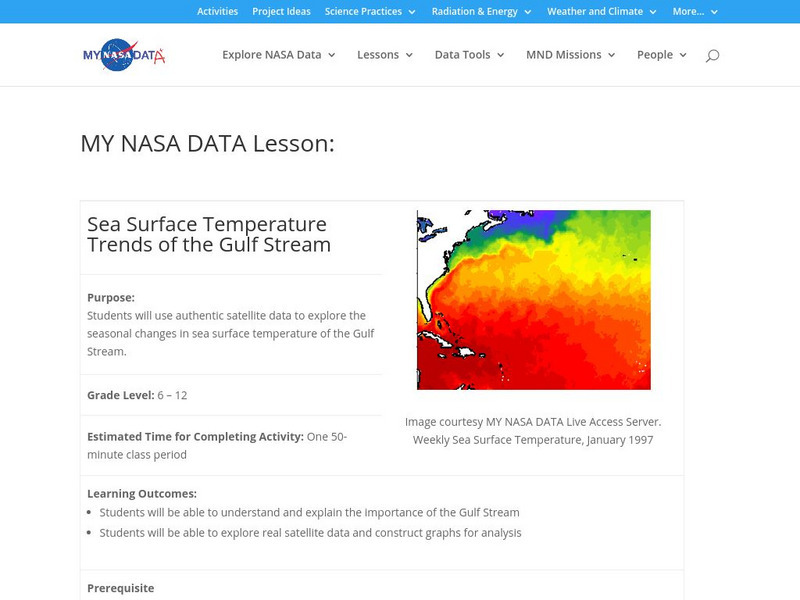
Nasa: Sea Surface Temperature Trends of the Gulf Stream
Students investigate changes in the surface temperatures of the Gulf Stream over the course of the seasons using data collected by NASA's satellites. The data is inputted into a spreadsheet and graphed.
Center for Innovation in Engineering and Science Education, Stevens Institute of Technology
Ciese: Catch a Wave
In this project for Grades 6 to 12, young scholars will use real data collected online to learn how waves and tides work. They will learn what causes water to move, and how waves and tides impact on humans, organisms and waterfront...

Other
Univ. Of Copenhagen: Centre for Ice and Climate: Preserved Fossil Dna in the Ice
Discusses how fossil DNA data that is collected from ice cores is used by scientists to reconstruct the composition of past ecosystems and their biodiversity, as well as climates. There is a great deal of other information on the website...
Climate Literacy
Clean: Climate and Civilization: The Maya Example
Students use geophysical and geochemical data collected by the Ocean Drilling Program to examine climate in Central America during the recent past. They also have the opportunity to investigate the link between climate change and...
US Geological Survey
Usgs: North Carolina District Science Plan
The North Carolina District of the Water Resources Discipline, U.S. Geological Survey (USGS), is committed to collecting hydrologic data and conducting hydrologic investigations of the highest quality. North Carolina District staff...
BSCS Science Learning
Bscs: Frog Eat Frog World
Using maps and graphs of large data sets collected in FrogWatch, students will determine the range, preferred land cover, and proximity to water of the American bullfrog to figure out the bullfrog's requirements for food, water, and...
NASA
Nasa Earth Observatory: Should We Talk About the Weather?
Discover how scientists use the BOREAS to gather data such as heat, carbon dioxide, water vapor, and more to see what role these levels have on climate changes.
McGraw Hill
Mc Graw H Ill: Edward S. Kubany, ph.d.
Read a short biography of psychologist Edward S. Kubany, developer of the Trauma-Related Guilt Inventory (TRGI).
Science and Mathematics Initiative for Learning Enhancement (SMILE)
Smile: Lab Work Forces & Acceleration
The Illinois Institute of Technology provides this site. The site contains a graphing activity which illustrates that a constant force exerted upon an object results in constant acceleration. Rolling carts and stopwatches are used to...