Hi, what do you want to do?






Physics Classroom
The Physics Classroom: The Electromagnetic and Visible Spectra
A tutorial on the electromagnetic and visible spectra. Discusses dispersion and how perceptions of white and black are related to the visible light spectrum.

Science Made Simple
Science Made Simple: Why Is the Sky Blue?
This website has three different projects from which to choose on the topic of why the sky is blue. Also, you can scroll up to learn more about why the sky is blue.

NASA
Nasa: The Space Place: Why Is the Sky Blue?
Learn about colors of light by exploring how prisms work. Discover the different colors of the spectrum and how the visible light is what we see.
Curated OER
Georgia State University: Color
This site from Georgia State University discusses the location of visible light on the electromagnetic spectrum. Includes the wavelength values for various colors of light within the visible light spectrum.
Center of Science and Industry
Cosi Columbus: Coffee Filter Rainbows
Science experiment that demonstrates chromotography. Includes full list of materials, procedures, and scientific explanation of what happens with different colors when they are soaked with water.
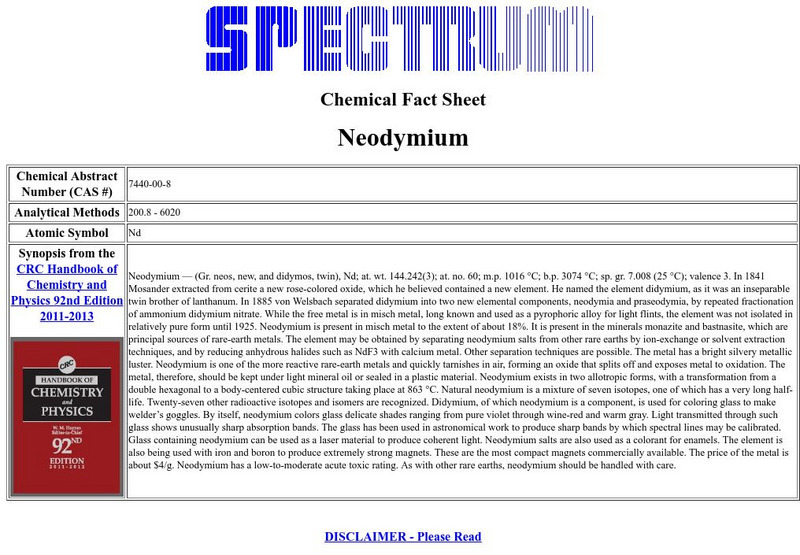
Florida-Spectrum Environmental Services
Florida Spectrum: Chemical Fact Sheet: Chemical Fact Sheet: Neodymium
Thorough summary of information on neodymium, its properties and uses. Good resource for this individual element.

Exploratorium
Exploratorium: How to Build a Spectroscope
Instructions for how to construct a spectroscope from basic materials, which can be used to study colors produced by light from different sources. Adult supervision may be required for the use of the utility knife. Includes an...
Curated OER
The Colour Wheel
A review of terms associated with the study of color as an element of art: spectrum, hue, color wheel, primary colors, secondary colors, tertiary colors, complementary colors, and analogous colors.
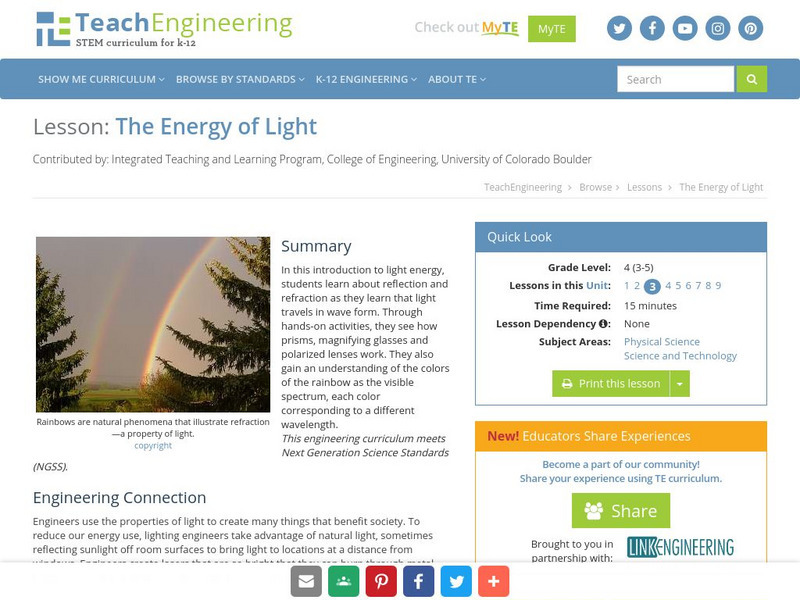
TeachEngineering
Teach Engineering: The Energy of Light
In this introduction to light energy, students learn about reflection and refraction as they learn that light travels in wave form. Through hands-on activities, they see how prisms, magnifying glasses and polarized lenses work. They also...

Khan Academy
Khan Academy: Understanding Spectra
This is an 8-problem quiz/practice to increase students' understanding of spectra. Color is a property of light. Test your understanding of this concept and how light can be represented in with a spectral power distribution.
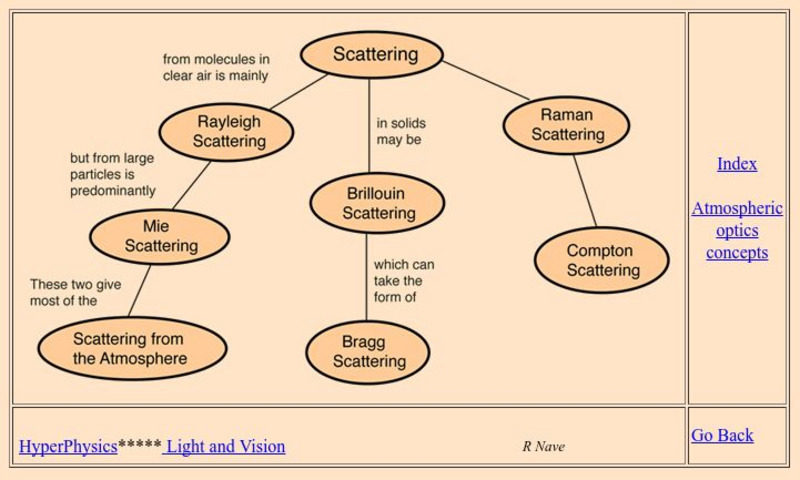
Georgia State University
Georgia State University: Hyper Physics: Scattering Concepts
A collection of several pages explaining the principles which underlie Rayleigh scattering of light.
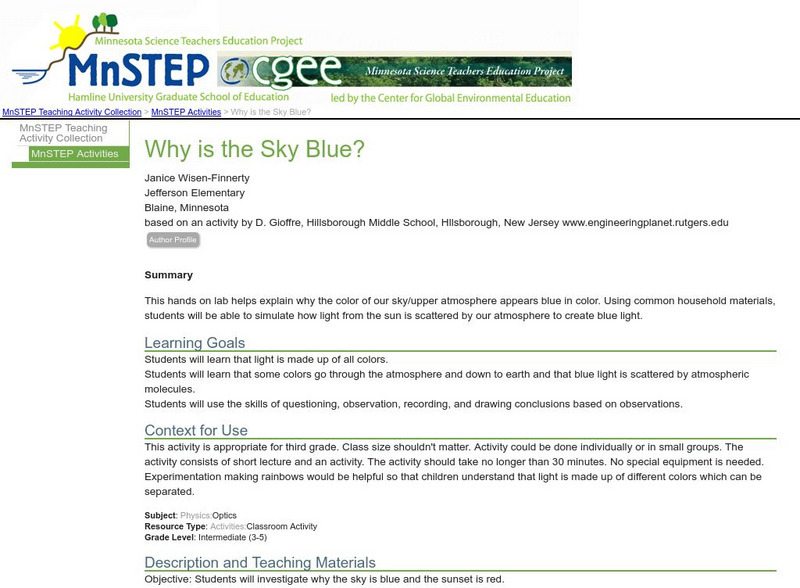
Science Education Resource Center at Carleton College
Serc: Mn Step: Why Is the Sky Blue?
Students will learn about refraction and the scattering of sunlight as it enters the atmosphere, which causes the colors in light to separate, giving us blue skies and colorful sunrises and sunsets.
Space Telescope Science Institute
Amazing Space: Star Light, Star Bright
An online exploration where students learn the basics about light and the properties of waves and the electromagnetic spectrum. Students will also learn how to measure wavelength and frequency so they can understand the electromagnetic...
CK-12 Foundation
Ck 12: Chemistry Simulation: Neon Lights
[Free Registration/Login Required] Neon lights are a type of discharge tube. Observe how electrons create colored light in a hydrogen gas discharge tube. Can you figure out why hydrogen's emission spectrum contains more than one color of...
South Carolina Educational Television
Etv: Nasa Online: Light: Scattering Light
An introduction to the concept of the visible light spectrum provided in an animated format.
Discovery Education
Discovery Education: Physical Science
The Discovery Channel provides numerous lesson plans dealing with the physical sciences. Content is organized by grade level, but all lesson plans include suggestions for adaptations for older or younger audiences.
Optical Society
Optical Society of America: Optics for Kids: What Causes Rainbows?
An experiment to demonstrate how to make a rainbow and why they form.
Exploratorium
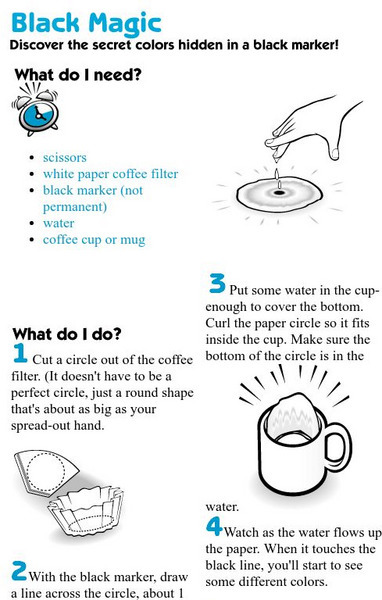
Exploratorium: Black Magic
A great and easy-to-do activity where students separate the colors in a black marker and develop an understanding that black is a composite of other colors.
University Corporation for Atmospheric Research
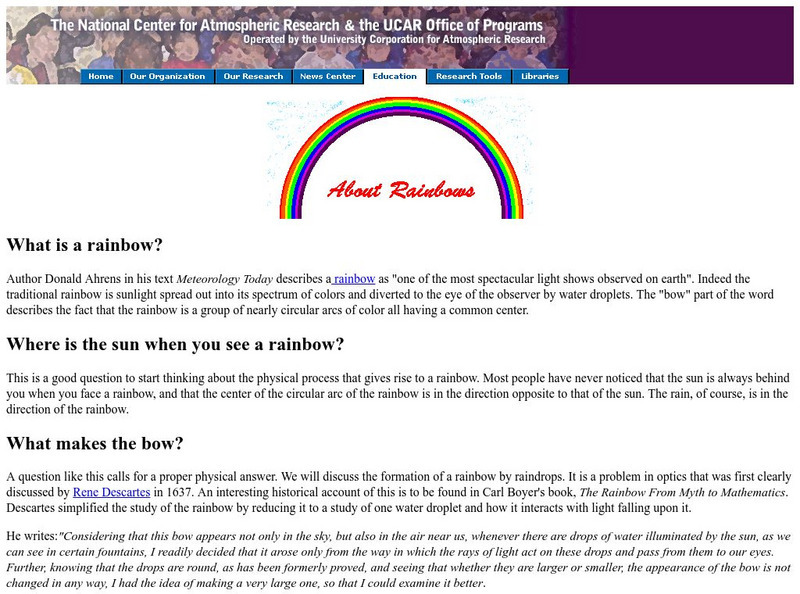
Ucar: About Rainbows
This site from the University Corporation of Atmospheric Research provides an illustrated article about the phenomenon of rainbows.
Optical Society
Optical Society of America: Optics for Kids: Release the Rainbow
A simple activity to demonstrate how light separates into colors when it passes through water acting as a prism.
TeachEngineering
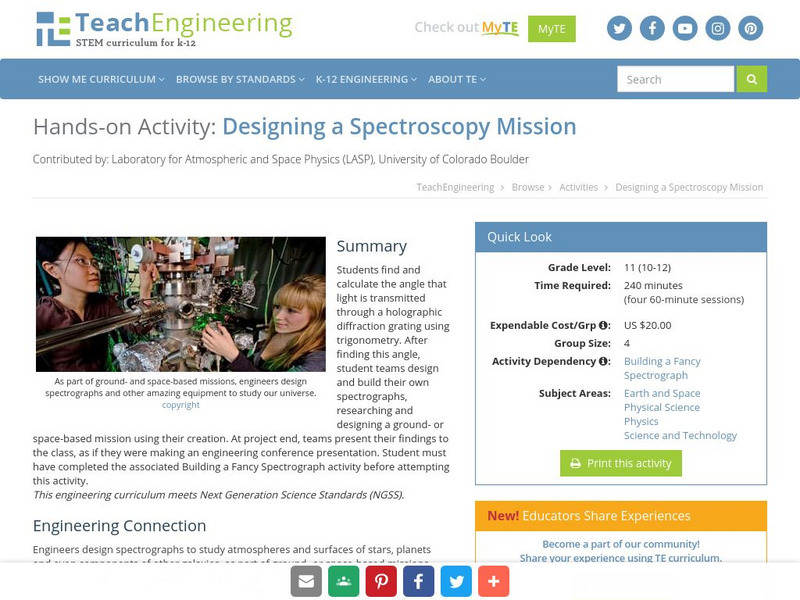
Teach Engineering: Designing a Spectroscopy Mission
Students find and calculate the angle that light is transmitted through a holographic diffraction grating using trigonometry. After finding this angle, student teams design and build their own spectrographs, researching and designing a...
Frostburg State University
General Chemistry Online: Ten Signs of Chemical Change
Resource provides the ten signs that tell when a chemical change has occured. Each sign has a detailed explanation.
TED Talks
Ted: Ted Ed: Light Waves, Visible and Invisible
Lucianne Walkowicz shows us the waves just beyond our perception: microwaves, radio waves, x-rays and more. [5:58]