Hi, what do you want to do?






American Chemical Society
Preparation and Combustion of Biodiesel
The United States is the world's largest producer of biofuel. During an in-class investigation, young scientists produce their own biodiesel. They burn a sample of it to determine the heat of combustion. Then they discuss the...

Teach Engineering
Combustion and Air Quality: Emissions Monitoring
Help your class determine the types of pollutants coming from vehicle exhaust. Groups use an air quality monitor to determine the emissions from different vehicles, to gain knowledge about combustion energy, and to predict how the...

Teach Engineering
Wizardry and Chemistry
No need to go to Ollivanders to buy a magic wand. In the chemistry lab activity, young magicians mix chemicals to create combustible compounds. By applying these compounds to an iron wire, they create magic wands.

Texas State Energy Conservation Office
Investigation: Chemical Models
Science teams make models of four different hydrocarbon compounds that we commonly use for fuel. Then they demonstrate chemical reactions that result when energy is produced. This can be used as an enrichment when your class is studying...
Other
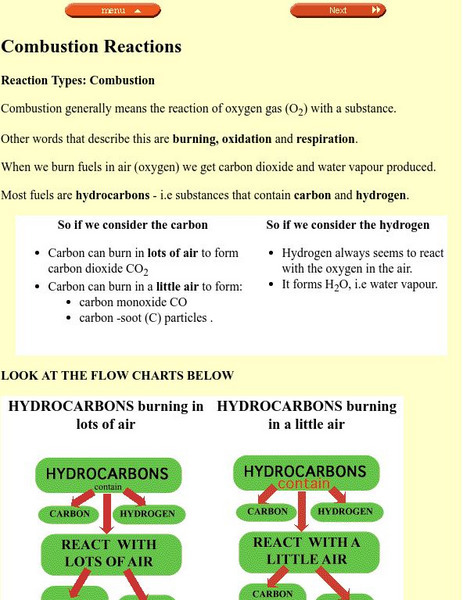
Staffordshire Net Learning/ Combustion Reactions
A very useful site with information and examples of combustion reactions.
Science Education Resource Center at Carleton College
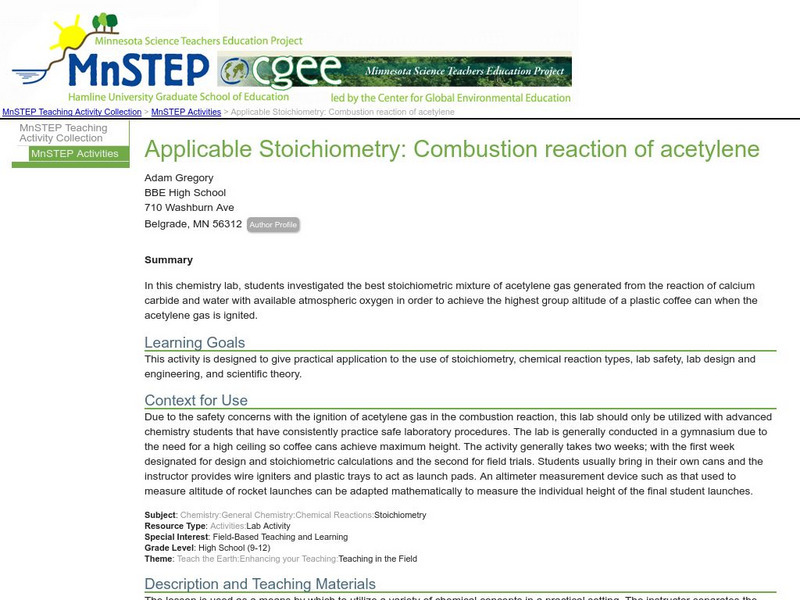
Serc: Applicable Stoichiometry: Combustion Reaction of Acetylene
In this chemistry lab, students investigated the best stoichiometric mixture of acetylene gas generated from the reaction of calcium carbide and water with available atmospheric oxygen in order to achieve the highest group altitude of a...
TeachEngineering
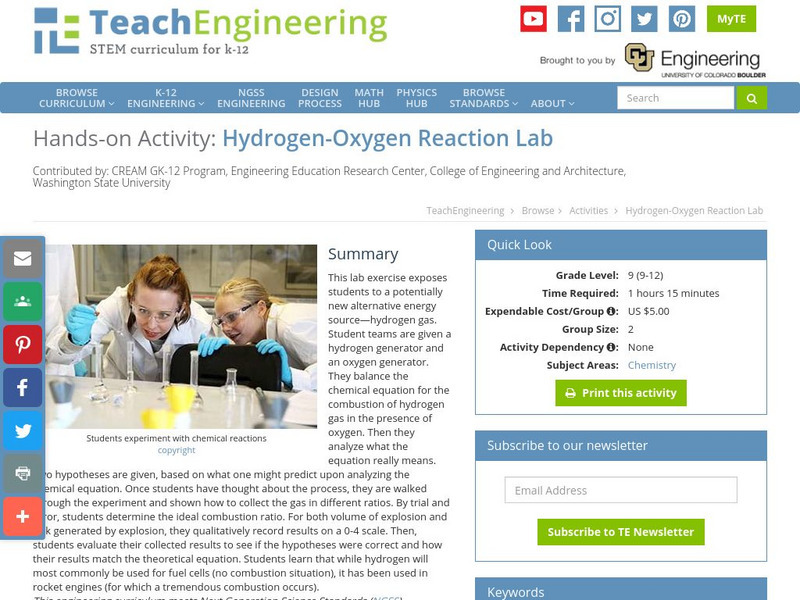
Teach Engineering: Hydrogen Oxygen Reaction Lab
This lab exercise exposes students to a potentially new alternative energy source-hydrogen gas. Student teams are given a hydrogen generator and an oxygen generator. They balance the chemical equation for the combustion of hydrogen gas...

Other
The Science House: Floating Candles
In this experiment students observe a combustion reaction and deduce the components necessary for the reaction to occur. They also see the relationship between pressure, volume, and number of molecules for gases.
Physics Central
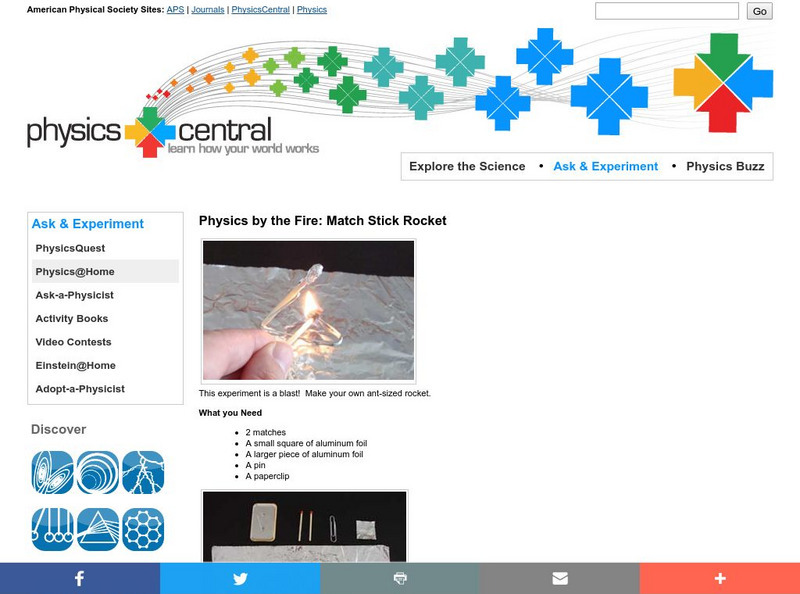
Physics Central: Physics by the Fire: Match Stick Rocket
Match stick rockets makes a great demonstrations to show students Newton's third law. By covering a match with tin foil, students can see the reaction thrust as the molecules escaping the matchstick are propelled into the air. Lesson...
Science Buddies
Science Buddies: Project Ideas: Rocketology: Baking Soda and Vinegar
The objective of this science fair project is to determine the correct ratio of baking soda to vinegar that will result in the highest launch of a plastic film canister. The Science Buddies project ideas are set up consistently beginning...
TeachEngineering
Teach Engineering: Rocket Power
By making and testing simple balloon rockets, students acquire a basic understanding of Newton's third law of motion as it applies to rockets. Using balloons, string, straws and tape, they see how rockets are propelled by expelling...
American Geosciences Institute
American Geosciences Institute: Earth Science Week: Chemistry of Burning
In this activity, students use pipe cleaners and foam balls to build a model of a hydrocarbon molecule. They then modify it to demonstrate the chemical reaction that happens when the hydrocarbon is burned.
Michigan Reach Out
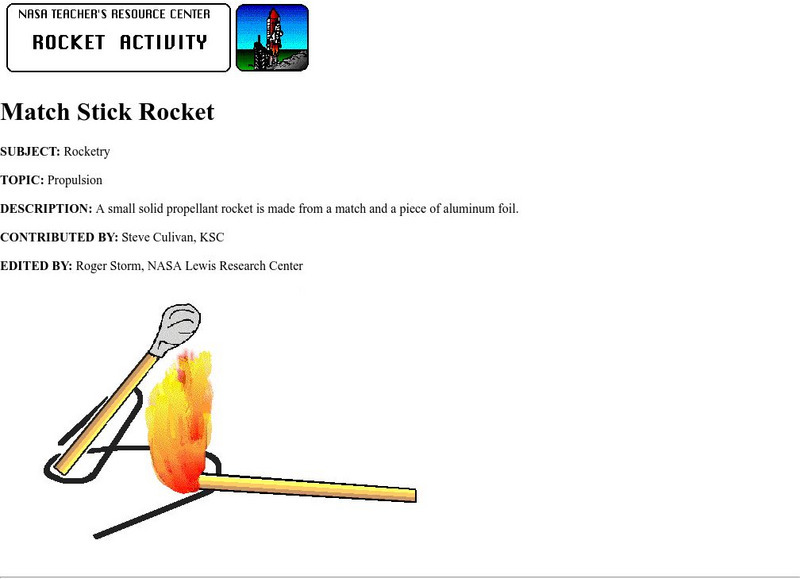
Nasa Trc: Match Stick Rocket
In this online lesson plan students can experience Newton's Laws of Motion in relation to rockets with this experiment.